Blog
Back to blog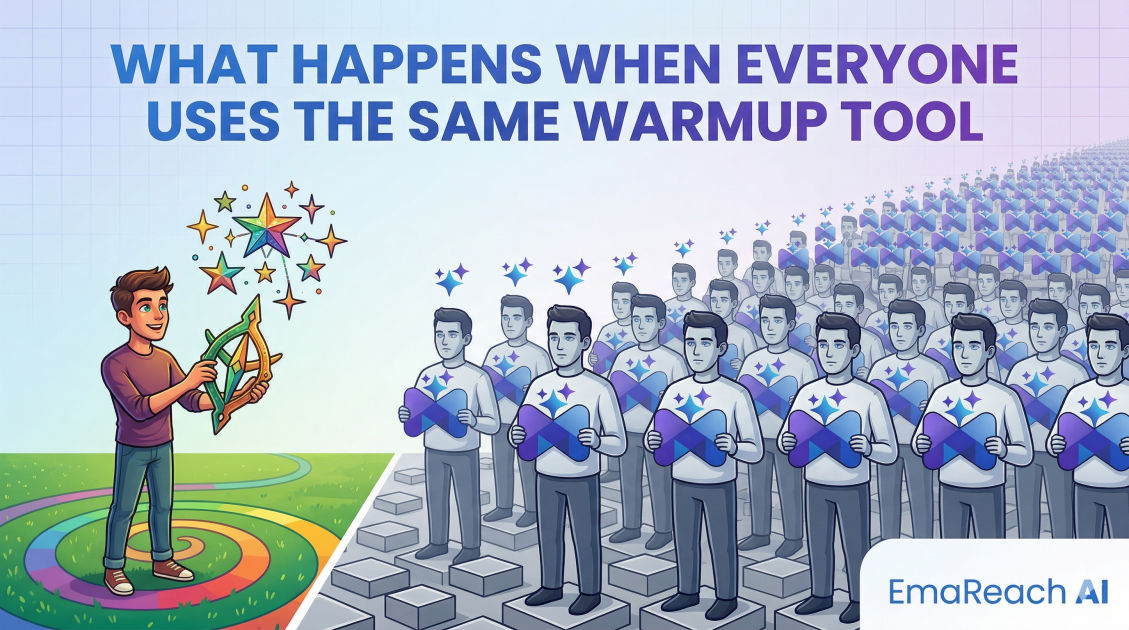
What Happens When Everyone Uses the Same Warmup Tool
cold emailemail deliverabilityoutreach strategywarmup toolsemail marketingspam filtersinbox placement
The Hidden Risk of Consensus in Email Deliverability
Email outreach has undergone a massive transformation. Gone are the days when a simple spreadsheet and a personal Gmail account were enough to scale a business. Today, high-volume cold email is a sophisticated game of cat and mouse between senders and Internet Service Providers (ISPs). At the heart of this battle lies the "warmup tool"—a software solution designed to simulate human behavior and build sender reputation. However, a fascinating and dangerous phenomenon is occurring: the consolidation of the market.
When thousands of businesses flock to the exact same warmup tool, the very mechanism designed to protect their deliverability may become their greatest vulnerability. This article explores the systemic risks, technical implications, and strategic pitfalls that occur when the industry relies on a single point of failure for email reputation.
The Mechanics of Warmup: A Quick Refresher
To understand the danger of uniformity, we must first understand how warmup tools work. When you create a new email domain or mailbox, it has no history. If you immediately send 500 emails, ISPs like Google and Microsoft flag this as suspicious "spammy" behavior. Warmup tools solve this by creating a network of accounts that interact with one another.
These tools automatically send emails from your account to other accounts in their pool, open them, mark them as important, and move them out of the spam folder. This signal tells the ISP that your content is valuable and that real humans are engaging with it. But what happens when the "humans" interacting with your emails are all controlled by the same algorithm, hosted on the same infrastructure, and following the same patterns?
The Pattern Recognition Trap
ISPs are not static entities; they are powered by some of the most advanced machine learning models in existence. Their primary goal is to protect their users' inboxes from automated noise. When everyone uses the same warmup tool, they inadvertently create a massive, identifiable footprint.
1. The "Pool" Becomes a Target
Warmup tools operate on a peer-to-peer basis. You help others, and they help you. However, if a specific tool becomes the industry standard, its "pool" of accounts grows so large that it becomes easy for an ISP to map out. If an ISP identifies a cluster of 50,000 accounts that all exhibit identical behavioral patterns—sending emails at the same intervals, using the same sentence structures, and clicking the 'Mark as Important' button within the same millisecond range—it can shadow-ban the entire network.
2. Algorithmic Signature
Every software developer has a "style," and every algorithm has a signature. If a warmup tool uses a specific set of templates or a predictable randomization logic for its subject lines, ISPs can create a fingerprint for that tool. Once that fingerprint is identified, any account associated with that tool loses its "mask" of being a human user. Instead of appearing as a legitimate business, you appear as a participant in a coordinated reputation-manipulation scheme.
3. IP and Infrastructure Overlap
Many lower-tier warmup tools host their internal systems on the same cloud providers or use similar proxy configurations. When a critical mass of users congregates on a single platform, the volume of traffic coming from those specific server ranges to Google’s or Outlook’s SMTP servers becomes an anomaly. ISPs are remarkably good at connecting the dots between seemingly unrelated accounts when they share underlying infrastructure markers.
The Erosion of "Real" Engagement
The goal of a warmup tool is to mimic reality. But as the saying goes, "When a measure becomes a target, it ceases to be a good measure." If 90% of your "engagement" comes from other bots in the same tool, you aren't actually warming up your email; you are inflating a bubble.
When you eventually pivot to sending real cold outreach to actual prospects, the discrepancy between your "warmup" behavior and your "real" behavior is jarring. The ISP sees that while you were talking to other bots in the warmup pool, you had a 100% open rate. But the moment you email a CEO, your engagement drops to 15%. This sudden shift is a massive red flag.
To avoid this, savvy marketers are moving toward integrated platforms that don't just "fake" engagement but facilitate high-quality outreach. EmaReach is a prime example of this evolution. Stop Landing in Spam. Cold Emails That Reach the Inbox. EmaReach AI combines AI-written cold outreach with inbox warm-up and multi-account sending—so your emails land in the primary tab and get replies. By blending the warmup process with actual AI-driven personalization, the transition from warmup to live outreach becomes seamless and much harder for ISPs to detect.
The Problem of Content Homogeneity
Most warmup tools use a library of pre-written text to fill the bodies of their emails. These are often nonsensical paragraphs about weather, coffee, or generic business advice. When everyone uses the same tool, the same 1,000 snippets of text are cycled through millions of inboxes.
ISPs use Content-Based Filtering. They look for strings of text that have been previously associated with spam or automated systems. If a warmup tool’s content library is leaked or identified, every account using that tool is instantly compromised. This is why using a tool that generates unique, AI-driven content for each warmup interaction is no longer a luxury—it is a necessity for survival.
The Strategic Risk: Single Point of Failure
Beyond the technical limitations, there is a significant business risk to using the same tool as all your competitors.
Dependency and De-platforming
If the ISP decides to take a hard stance against a specific warmup tool, every business relying on that tool could see their outreach capabilities vanish overnight. We have seen this happen in the social media automation space, where thousands of accounts were nuked simultaneously because they were all linked to a single popular automation platform. Email is no different.
The Feedback Loop of Poor Quality
In a shared warmup pool, you are only as strong as the weakest link. If a tool is easy to access, it will attract low-quality spammers who want to quickly burn through domains. These spammers join the same pool you are in. If their accounts get flagged for sending malicious links or phishing content while they are "warming up" with your account, your domain can be associated with theirs through "guilt by association."
Moving Beyond the Commodity Warmup
If the industry standard is becoming a trap, how should a sophisticated growth team approach deliverability? The answer lies in diversification and intelligent automation.
1. Diversify Your Toolset
Don't put all your eggs in one basket. Using multiple warmup providers or rotating your domains across different systems can help break the pattern recognition that ISPs use to identify automated clusters. This prevents a single tool's failure from taking down your entire sales operation.
2. Prioritize AI-Driven Personalization
Static warmup content is dead. The future belongs to tools that use Large Language Models (LLMs) to generate dynamic, contextually relevant conversations. When your warmup emails look like actual business correspondence—discussing industry trends, asking relevant questions, and responding with nuance—ISPs are much more likely to categorize them as legitimate traffic.
3. Multi-Account Architecture
Rather than sending 1,000 emails from one domain, modern outreach involves sending 25 emails from 40 different domains. This distribution of volume makes it much harder for ISPs to track patterns. When this strategy is combined with a robust warmup process, the risk is mitigated significantly.
The Role of EmaReach in the Modern Ecosystem
In a landscape where standard tools are being identified and throttled, the need for a more integrated solution is clear. The traditional model of "Warmup Tool A" + "Sending Tool B" + "Writing Tool C" creates too many fingerprints.
EmaReach solves this by unifying the stack. Because it manages the AI-writing, the warmup, and the sending across multiple accounts in one ecosystem, it creates a cohesive and human-like sender profile. It moves away from the "bot-heavy" look of traditional warmup pools and focuses on the ultimate goal: reaching the inbox. By ensuring that your emails land in the primary tab rather than the promotions or spam folder, it bypasses the common pitfalls of shared-tool over-saturation.
Technical Deep Dive: Why ISPs Love Uniformity
To appreciate the gravity of using a common tool, we should look at how SPAM filters actually classify data. Most modern filters use a Bayesian inference model. This is a statistical method where the filter calculates the probability that an email is spam based on past evidence.
If the filter sees the word "Atmospheric" in 50,000 emails that are all sent at precisely 3:00 AM across 10,000 different domains, the "spam score" for the word "Atmospheric" and that specific sending time skyrockets. When everyone uses the same warmup tool, they provide the ISPs with a massive data set to train their filters against. You are effectively paying a monthly subscription to help ISPs get better at blocking you.
The Evolution of Email Security
We are moving toward a "Zero Trust" model in email. In the past, having SPF, DKIM, and DMARC records set up was enough to get you through the door. Today, those are just the table stakes. ISPs are now looking at:
- Read Time: How long does a user stay on the email?
- Reply Depth: Does the conversation go back and forth multiple times?
- Forwarding Rates: Is the content valuable enough to be shared?
- Link Click-Through Consistency: Are the links being clicked by different IP addresses or the same ones?
Basic warmup tools struggle to simulate these deeper metrics. They can click a link, but they can't simulate a user reading a 300-word email for 45 seconds before replying. The more people who use a tool that doesn't do these things, the easier it is for ISPs to distinguish between "Warmup Traffic" and "Revenue Traffic."
Best Practices for the New Era of Outreach
To stay ahead of the curve and avoid the "same tool" trap, consider the following strategy:
- Start Slow and Randomize: Even with a tool, don't follow a linear path. Vary your ramp-up schedule.
- Use Custom Tracking Domains: One of the easiest ways for an ISP to link users of the same tool is through the default tracking domains provided by the software. Always set up your own CNAME for tracking.
- Monitor Your Sender Score Constantly: Don't assume your warmup is working just because the software says it is. Use third-party tools to check your IP and domain reputation independently.
- Balance Automation with Manual Intervention: Occasionally log in to your warmup mailboxes and send a manual email to a friend or colleague. This breaks the 100% automated pattern.
- Choose Integrated Solutions: Use platforms like EmaReach that understand the interplay between content quality and deliverability. The more "human" your content is, the less the ISP cares about the underlying tool.
Conclusion
The convenience of a popular warmup tool is a double-edged sword. While it provides an easy entry point for cold outreach, the mass adoption of identical tools creates a collective footprint that is easy for ISPs to track and neutralize. When everyone uses the same script, the audience—in this case, the spam filter—quickly learns the ending.
To thrive in the current email climate, businesses must move away from commodity tactics. Success now requires a blend of sophisticated AI, decentralized sending structures, and a commitment to quality over sheer volume. By understanding the risks of the "same tool" phenomenon, you can position your outreach strategy to be more resilient, more human, and ultimately, more profitable. The goal isn't just to warm up an account; it's to build a lasting reputation that survives the ever-evolving algorithms of the digital gatekeepers.
EmaReach AI
Ready to scale your cold email outreach?
Join thousands of teams using EmaReach AI for AI-powered campaigns, domain warmup, and 95%+ deliverability. Start free — no credit card required.
Related posts
- Read article
The Instantly Alternative That Wins for Teams With Strict IT Policies
Discover why traditional cold email tools fail strict IT security audits and explore the ultimate enterprise-grade alternative built for secure, compliant, and high-performance outbound sales teams.
- Read article
How to Know When You Actually Need an Instantly Alternative
Discover the critical signs that your business has outgrown high-volume cold email tools and learn how to evaluate when it is time to transition to a more sophisticated, deliverability-first outreach alternative.