Blog
Back to blog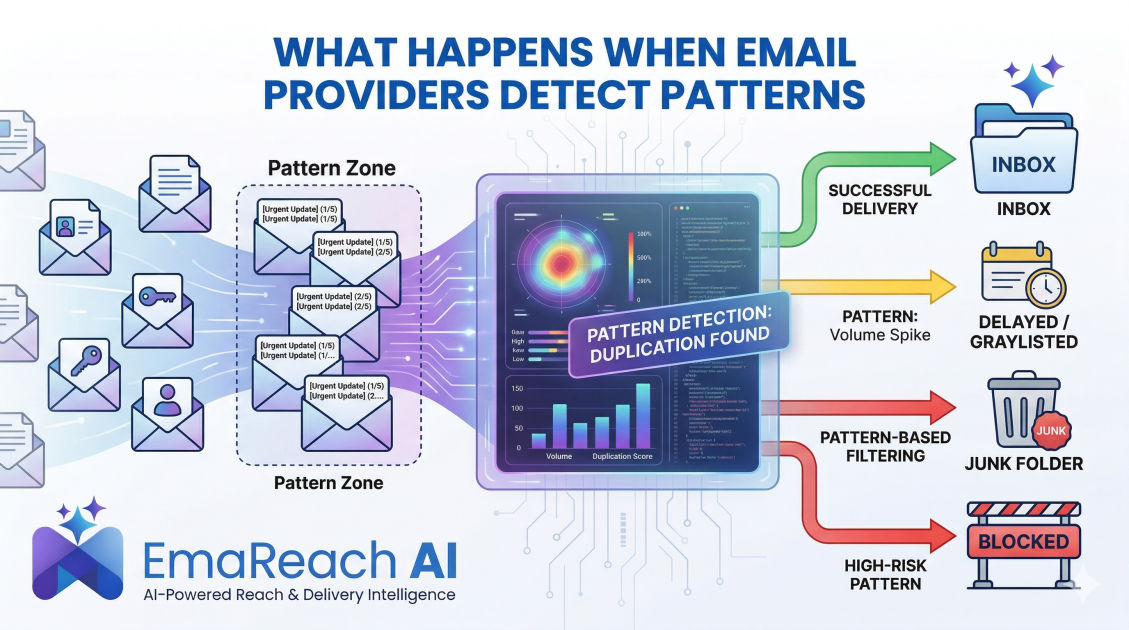
What Happens When Email Providers Detect Patterns
email deliverabilityspam filterscold outreachemail marketingsender reputationESPsinbox placement
Introduction
In the modern digital landscape, email remains the backbone of professional communication, marketing, and sales outreach. However, the gatekeepers of this ecosystem—Email Service Providers (ESPs) like Gmail, Outlook, and Yahoo—have become incredibly sophisticated. They no longer rely solely on simple keyword filters or blacklists to identify unwanted mail. Instead, they utilize complex algorithmic systems designed to detect patterns.
When you send an email, you aren't just sending a message; you are transmitting a data packet that fits into a broader behavioral footprint. If that footprint mirrors the behavior of a spammer or a low-quality sender, the provider's defensive systems trigger a series of consequences. Understanding these patterns is the difference between a successful campaign and a wasted investment.
The Architecture of Pattern Detection
Email providers use machine learning and artificial intelligence to analyze trillions of data points. They look for anomalies and repetitions that deviate from "normal" human interaction. Pattern detection operates on several layers simultaneously: the technical infrastructure, the sending behavior, and the recipient's engagement.
Technical Infrastructure Patterns
Before a single word of your email is read, the ESP examines the technical signature of your sending server. If you are sending thousands of emails from a fresh IP address that has no previous history, this is a massive red flag. Spammers often buy new domains, blast out millions of emails, and abandon them once they are blocked—a tactic known as "snowshoeing."
Providers look for consistency in your DNS records, including SPF (Sender Policy Framework), DKIM (DomainKeys Identified Mail), and DMARC (Domain-based Message Authentication, Reporting, and Conformance). If these are missing or fluctuate frequently, it suggests a lack of professional setup, triggering pattern-based filters.
Sending Volume and Velocity
One of the most obvious patterns is the "spike." A typical business user sends a modest number of emails throughout the day with natural gaps for lunch, meetings, and sleep. In contrast, automated scripts often send emails in perfectly timed intervals or massive bursts.
If an account suddenly jumps from sending five emails a day to five hundred, the provider’s monitoring system will flag this as suspicious activity. This is why "warming up" an email account is so critical. Without a gradual increase in volume, you are essentially telling the provider's algorithm that your account has been compromised or is being used for unauthorized bulk mailing.
The Role of Content Fingerprinting
Modern ESPs use "fingerprinting" to identify the content of an email even if the words are slightly changed. If you send the exact same template to 1,000 people, the provider identifies that specific structure.
Hash-Based Filtering
When an email is sent, the provider creates a "hash" or a digital thumbprint of the message body. If they see the same hash appearing across thousands of different inboxes within a short window, and especially if some of those recipients mark it as spam, the hash is blacklisted. This means every subsequent email with that identical structure will be diverted to the spam folder automatically, regardless of the sender's reputation.
Semantic Analysis
Patterns aren't just about identical text; they are also about intent. Natural Language Processing (NLP) allows providers to detect the "vibe" of an email. Patterns of aggressive sales language, excessive use of superlatives, or suspicious links are categorized. If your outreach consistently follows a pattern of "Urgent," "Buy Now," or "Limited Offer," you are training the filter to view you as a promotional entity rather than a personal communicator.
User Engagement as a Feedback Loop
The most powerful pattern an email provider tracks is how recipients interact with your mail. This is often referred to as "reputation." Every action a user takes sends a signal:
- Open Rates: If your emails are consistently ignored, it signals that your content is irrelevant.
- Deletions Without Opening: This is a strong negative signal suggesting the subject line is deceptive or the sender is unknown.
- Marking as Spam: The ultimate negative signal. A pattern of even 0.1% spam complaints can destroy a domain's deliverability.
- Moving to Primary: If a user drags your email from the "Promotions" tab to the "Primary" tab, it signals a high-value relationship.
When a provider detects a pattern of low engagement across a specific IP or domain, they begin to throttle your emails. Throttling is the practice of intentionally slowing down the delivery of your messages to see how the few that do get through are received. If the engagement remains low, the "Death Spiral" begins.
Navigating the Challenges of Cold Outreach
For businesses relying on cold outreach, these pattern-detection systems present a significant hurdle. You need to reach new prospects, but doing so at scale often triggers the very filters meant to stop spammers.
This is where specialized technology becomes essential. To maintain a human-like pattern, you must diversify your sending sources and ensure your content feels unique to every recipient.
Stop Landing in Spam. Cold Emails That Reach the Inbox. EmaReach (https://www.emareach.com/) is designed specifically to solve these pattern-related issues. EmaReach AI combines AI-written cold outreach with inbox warm-up and multi-account sending—so your emails land in the primary tab and get replies. By distributing your volume across multiple accounts and using AI to vary the content, you break the patterns that lead to the spam folder.
The Consequences of Being Flagged
What actually happens when a provider decides you’ve matched a negative pattern? It usually happens in stages:
1. The Promotions Tab Ghetto
For Gmail users, the first sign of pattern detection is often being relegated to the Promotions tab. While better than the spam folder, it significantly reduces visibility and open rates. This happens when the provider detects "bulk-like" characteristics but doesn't see enough negative signals to block you entirely.
2. Temporal Throttling
Your emails may start taking hours to arrive. The ESP is essentially putting your mail in a "waiting room" to check if other recipients are complaining about similar messages sent earlier in the batch.
3. The Spam Folder
Once a pattern is confirmed as "unsolicited," your emails will bypass the inbox entirely. At this stage, your domain reputation is actively being damaged. Recovering from this requires a total halt in sending and a rigorous re-warming process.
4. Domain and IP Blacklisting
In extreme cases, the provider will block your domain or IP address at the gateway. No mail will get through, and you may even receive "Bounce" messages stating that the connection was refused due to reputation issues. This can affect not just your marketing efforts, but your internal corporate communications as well.
Strategic Ways to Break the Pattern
To succeed in email communication today, you must "un-pattern" your behavior. This involves mimicking the randomness and specificity of a real human being.
Randomization of Sending Times
Instead of sending at 9:00 AM every Tuesday, use tools that randomize the sending time within a specific window. This prevents the "heartbeat" pattern that automated bots often exhibit.
Dynamic Content Insertion
Go beyond simply inserting a first name. Use AI to generate unique opening sentences or to reference specific details about the recipient’s business. If every email has a different word count and a different sentence structure, providers cannot easily create a content hash to block you.
Multi-Inbox Management
Instead of sending 500 emails from one account, send 25 emails from 20 different accounts. This keeps the volume per account well within the limits of "normal" human behavior, making it much harder for algorithmic filters to detect a large-scale campaign.
The Future of Pattern Detection
As AI continues to evolve, email providers will move toward "identity-based" filtering. They will look at the long-term history of a sender across the entire web, not just their email behavior. Factors like LinkedIn presence, website traffic, and social proof may eventually play a role in how an ESP perceives your legitimacy.
Furthermore, the "Greymail" category—mail that isn't technically spam but isn't wanted either—is being targeted more aggressively. Providers are giving users more prominent tools to "Unsubscribe" or "Report," and they are using those clicks to train their global filters in real-time.
Conclusion
Email providers are in a constant arms race with senders. Their goal is to protect the user experience by filtering out noise, while your goal is to deliver value. When you understand that providers are looking for patterns of automation, low engagement, and technical inconsistency, you can adjust your strategy to appear more human and more relevant.
Success in modern email requires a blend of high-quality content and sophisticated delivery technology. By avoiding the common pitfalls of volume spikes, repetitive templates, and poor technical setups, you can ensure your message actually reaches the person it was intended for. In an era of algorithmic gatekeeping, being "pattern-aware" is the only way to stay in the inbox.
EmaReach AI
Ready to scale your cold email outreach?
Join thousands of teams using EmaReach AI for AI-powered campaigns, domain warmup, and 95%+ deliverability. Start free — no credit card required.
Related posts
- Read article
The Instantly Alternative That Finally Gets Outbound Analytics Right
Discover why high-volume cold email requires a shift from surface-level vanity metrics to deep, data-driven revenue attribution, and explore the ultimate alternatives for mastering outbound engineering.
- Read article
What You Gain and What You Give Up When Switching From Instantly
Thinking about migrating your cold email stack? This detailed guide breaks down the exact operational advantages you gain and the core features you sacrifice when switching away from Instantly's popular outreach platform.