Blog
Back to blog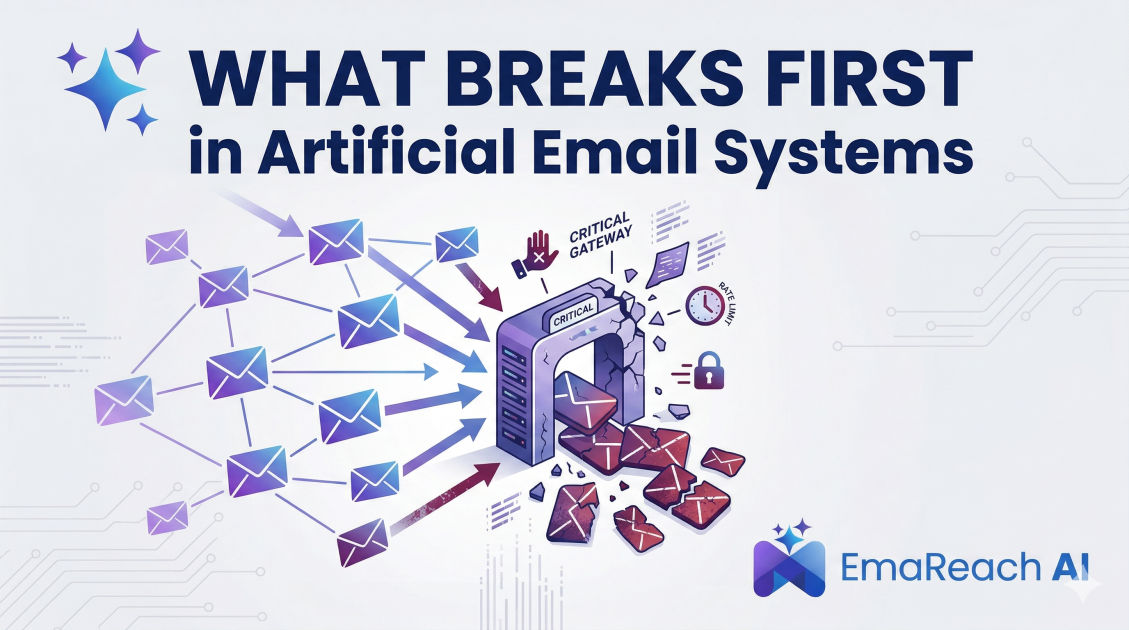
What Breaks First in Artificial Email Systems
email deliverabilityartificial intelligencecold outreachautomationemail marketinginbox warm-up
Introduction: The Fragile Architecture of Automated Outreach
Artificial email systems have revolutionized the way businesses communicate, allowing for unprecedented scale in outreach, marketing, and customer engagement. By leveraging large language models (LLMs) and automated sequencing, companies can now send thousands of personalized messages in the time it once took to draft a single letter. However, this efficiency comes with a hidden cost: complexity. As these systems become more sophisticated, the number of potential failure points increases exponentially.
When we talk about what "breaks" in an artificial email system, we aren't just referring to code errors or server downtime. In the context of modern email, failure is often silent. It manifests as a plummeting open rate, a sudden surge in spam complaints, or a slow degradation in the quality of AI-generated prose that eventually alienates the recipient. To master the art of automated communication, one must understand the structural weaknesses of these systems and where the first cracks typically appear.
The Technical Foundation: Why Infrastructure Crumbles
The most immediate and visible failures occur at the infrastructure level. Even the most brilliant AI-written content is worthless if the technical delivery mechanism fails. In artificial email systems, the technical debt often accumulates in the DNS settings and IP reputation management.
Authentication and Protocol Failures
Modern email security protocols like SPF (Sender Policy Framework), DKIM (DomainKeys Identified Mail), and DMARC (Domain-based Message Authentication, Reporting, and Conformance) are the first line of defense against spoofing. In artificial systems, these are often the first things to break when scaling. When a system begins spinning up multiple sending domains to handle increased volume, the configuration of these protocols must be flawless. A single typo in a TXT record or an expired DKIM key can cause an entire campaign to be swallowed by spam filters instantly.
The Inbox Warm-up Crisis
Artificial systems often fail because they lack "humanity" in their sending patterns. Sending 5,000 emails from a brand-new domain on day one is a guaranteed way to get blacklisted. This is where the concept of inbox warm-up becomes critical. Many systems break because they attempt to bypass this gradual buildup, triggering the heuristic alarms of major providers like Gmail and Outlook.
To combat this, professional setups rely on specialized solutions. Stop Landing in Spam. Cold Emails That Reach the Inbox. EmaReach AI combines AI-written cold outreach with inbox warm-up and multi-account sending—so your emails land in the primary tab and get replies. Without this kind of systematic warm-up, the "artificial" nature of the system becomes its own undoing.
The Linguistic Decay: When AI Loses the Thread
Beyond the technical delivery, the content itself is a major point of failure. Artificial intelligence is prone to a phenomenon known as linguistic drift or "model collapse" when it is not properly steered.
The Hallucination Hazard
What breaks first in AI content is often the factual accuracy. In an effort to be "helpful" or "engaging," an AI might invent details about a prospect’s company or cite a non-existent mutual connection. These hallucinations are catastrophic for trust. When a recipient realizes the email they are reading contains fabricated information, the entire relationship is severed before it even begins. The break occurs in the bridge of credibility.
Tone Deafness and Contextual Blindness
AI systems often struggle with the nuances of human timing and sentiment. An artificial system might send a high-pressure sales email to a prospect who just experienced a public business setback or a tragic event. Because the AI lacks real-world contextual awareness outside of its training data and immediate prompts, it can appear incredibly insensitive. This lack of emotional intelligence is a structural weakness that often leads to high unsubscribe rates and brand damage.
The Data Integrity Wall
An artificial email system is only as good as the data feeding it. In the rush to automate, many organizations overlook the "garbage in, garbage out" principle.
Stale Prospects and Bounce Rates
Data decays at an alarming rate. People change jobs, companies fold, and email addresses are deactivated. When an automated system pulls from a static or poorly maintained database, the bounce rate spikes. High bounce rates are a primary signal to Internet Service Providers (ISPs) that the sender is using an automated, low-quality list. This creates a feedback loop where technical delivery fails because the data management failed first.
Merging Errors and Variable Failure
We have all received an email that starts with "Hi {{First_Name}}," or refers to "your work at [Object object]." These are the most common and embarrassing breaks in artificial systems. They occur when the parser fails to map data fields correctly to the AI prompt. While seemingly minor, these errors act as a "bot reveal," immediately signaling to the recipient that they are part of a mass-produced experiment rather than a 1:1 conversation.
Deliverability: The Silent Killer
Deliverability is the measure of how many of your emails actually reach the intended inbox versus the spam folder. In artificial systems, deliverability is usually the first thing to degrade over time, often without the sender realizing it for weeks.
Feedback Loops and Reputation Damage
When recipients mark an AI-generated email as spam, the ISP records this. Artificial systems that lack a feedback loop—meaning they don't automatically stop emailing people who have complained or don't adjust their content based on negative signals—quickly destroy the reputation of the sending IP. Once a reputation is burned, it is incredibly difficult and expensive to recover.
The Complexity of Multi-Account Sending
To scale effectively without being flagged, sophisticated users employ multi-account sending. This distributes the volume across dozens or hundreds of accounts. However, the management of these accounts is a massive point of failure. Synchronizing the "persona" of each account so they don't overlap or send conflicting messages requires a high level of orchestration. If the central "brain" of the artificial system loses track of who sent what to whom, the resulting confusion can lead to multiple emails hitting the same prospect from different "people" at the same company, which is a massive red flag for automation.
Behavioral Pattern Recognition
Modern spam filters are no longer just looking for keywords like "free" or "viagra." They are looking for behavioral patterns. Artificial systems often break because their patterns are too perfect.
The Uniformity Trap
Humans are erratic. We send emails at 2:14 PM, then 3:45 PM, then maybe not again until the next morning. We have varying sentence lengths and use different closing remarks. Artificial systems, unless specifically programmed otherwise, tend to send emails at exact intervals or use suspiciously similar syntax across thousands of messages. ISPs use machine learning to detect these robotic patterns. The "break" here is that the system is too efficient, making it easily identifiable as non-human.
Link and Attachment Scrutiny
Artificial systems often include tracking pixels, shortened URLs, or attachments to measure engagement. However, these are the exact elements that trigger security filters. When an AI system automatically inserts a tracking link that hasn't been properly branded to the sending domain, it creates a mismatch that looks like a phishing attempt. This is a common failure point where the desire for data (tracking) overrides the necessity of delivery.
Strategies for Resilience
Knowing what breaks first allows us to build more resilient systems. The goal is to create a "human-in-the-loop" or a highly sophisticated "human-mimicking" framework.
- Prioritize Deliverability Over Volume: It is better to send 50 emails that land in the inbox than 5,000 that land in spam. Using tools that focus on the "health" of the inbox is paramount.
- Dynamic Personalization: Move beyond simple variable tags. Use AI to synthesize actual research into the body of the email, ensuring that even if a system-wide error occurs, the core message remains relevant to the individual.
- Aggressive List Hygiene: Regularly scrub lists for inactive or risky emails. Preventing a bounce is much easier than fixing a damaged reputation.
- Decentralized Sending: Avoid putting all your eggs in one basket. By using a multi-account approach, a failure in one area doesn't take down your entire outreach engine.
For those looking to automate without the typical heartbreak of system failure, EmaReach provides the necessary safeguards. By combining intelligent writing with the technical necessity of warm-up and multi-account management, it addresses the most common points of failure before they can disrupt your business.
The Human Element: The Final Safeguard
Ultimately, what breaks first in artificial email systems is often the connection to the human recipient. We must remember that behind every email address is a person with a limited attention span and a high sensitivity to being "processed."
Artificial systems fail when they treat communication as a purely mathematical problem of volume and conversion rates. They succeed when they use technology to enhance, rather than replace, the genuine effort of reaching out. The most robust systems are those that use AI to handle the drudgery—the data gathering, the initial drafting, the scheduling—while leaving the final stamp of quality and the overarching strategy to human intuition.
Conclusion
The landscape of artificial email systems is one of high reward and high risk. The first things to break are usually the technical configurations (SPF/DKIM), the sender reputation (due to lack of warm-up), and the perceived authenticity of the message (due to AI hallucinations or merging errors). By understanding these vulnerabilities, marketers and sales professionals can build more durable systems that stand the test of time and evolving spam filters.
Success in the age of AI-driven communication requires a relentless focus on infrastructure health and a deep respect for the recipient's inbox. When you prioritize the integrity of the delivery and the relevance of the content, you turn a fragile automated process into a powerful, sustainable engine for growth.
EmaReach AI
Ready to scale your cold email outreach?
Join thousands of teams using EmaReach AI for AI-powered campaigns, domain warmup, and 95%+ deliverability. Start free — no credit card required.
Related posts
- Read article
The Instantly Alternative That Finally Gets Outbound Analytics Right
Discover why high-volume cold email requires a shift from surface-level vanity metrics to deep, data-driven revenue attribution, and explore the ultimate alternatives for mastering outbound engineering.
- Read article
What You Gain and What You Give Up When Switching From Instantly
Thinking about migrating your cold email stack? This detailed guide breaks down the exact operational advantages you gain and the core features you sacrifice when switching away from Instantly's popular outreach platform.