Blog
Back to blog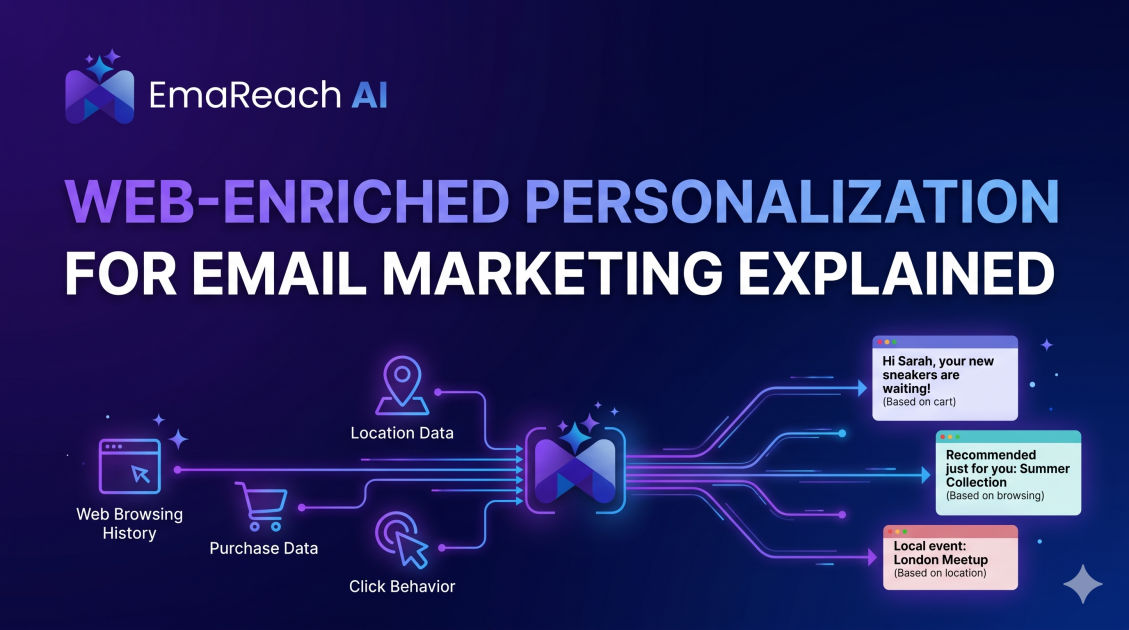
Web-Enriched Personalization for Email Marketing Explained
email marketingpersonalizationlead enrichmentcold outreachmarketing automationdeliverabilitysales strategy
Introduction to the New Era of Email Personalization
Email marketing has undergone a radical transformation. Gone are the days when simply inserting a recipient's first name into a subject line was considered 'cutting edge.' Today’s consumers and B2B buyers are inundated with hundreds of messages daily, leading to a phenomenon known as inbox fatigue. To break through the noise, marketers must move beyond basic database fields and embrace Web-Enriched Personalization.
Web-enriched personalization is the process of using real-time data scraped or integrated from across the internet to tailor email content specifically to an individual’s current professional context, recent activities, or company milestones. It transforms a generic outreach attempt into a highly relevant, one-to-one conversation that feels researched and intentional.
Understanding Web-Enriched Personalization
At its core, web enrichment involves pulling data from external sources—such as LinkedIn profiles, company websites, recent news articles, financial reports, or social media feeds—and piping that data directly into your email service provider (ESP) or outreach tool.
Instead of relying solely on the static data sitting in your CRM (which is often outdated), web enrichment ensures that your message reflects what is happening right now in the recipient's world. This might include mentioning a recent award their company won, a specific quote they gave in a podcast, or a technology stack they recently implemented on their website.
Why Static Data Is No Longer Enough
Static data refers to the information you collected when a lead first signed up for your list. This includes names, job titles, and company names. However, people change jobs, companies pivot their strategies, and industry trends shift. Relying on year-old CRM data leads to embarrassing mistakes, such as sending a 'Congratulations on your new role' email to someone who has been in that position for three years, or worse, someone who has already left the company.
Web enrichment provides a 'live' layer of intelligence. It verifies the current status of the lead and adds flavor to the message that proves the sender has done their homework.
The Components of a Web-Enriched Email
To build a comprehensive web-enriched strategy, you need to understand the different data points available for extraction and how they can be applied to your messaging.
1. Professional Milestones and News
One of the most effective ways to build rapport is to acknowledge recent success. Web enrichment tools can scan the web for 'intent signals' or news events related to a target account.
- Funding Rounds: If a company just raised a Series B, they likely have a budget for new solutions.
- Product Launches: Mentioning a specific new feature shows you understand their product roadmap.
- Mergers and Acquisitions: This indicates a period of transition where new systems are often needed.
2. Technographic Data
Technographics involve identifying the technology stack a company uses. By scanning a website's code, enrichment tools can identify if a prospect is using a competitor's software, a complementary tool, or a specific infrastructure (like AWS or Shopify).
- Example: "I noticed you’re currently using Magento for your storefront. We’ve found that Magento users often struggle with X, which is exactly what our platform solves."
3. Individual Social Activity
Social media is a goldmine for personalization. If a prospect recently shared an article on LinkedIn or commented on a specific industry trend, referencing that insight makes your email feel human and non-automated.
4. Website Performance and SEO Data
For agencies and software providers in the digital space, pulling live metrics like site speed, keyword rankings, or mobile responsiveness can provide an immediate 'hook' based on a problem the prospect might not even know they have.
Scaling Personalization Without Losing the Human Touch
The biggest challenge with deep personalization is scalability. Researching 500 prospects manually is impossible for a single salesperson or marketer. This is where AI and automation enter the frame.
Modern systems use Large Language Models (LLMs) to ingest the enriched data and draft natural-sounding sentences. However, the quality of the output is only as good as the deliverability of the message. If your perfectly personalized email lands in the spam folder, the effort is wasted.
Stop Landing in Spam. Cold Emails That Reach the Inbox. EmaReach AI combines AI-written cold outreach with inbox warm-up and multi-account sending—so your emails land in the primary tab and get replies. By integrating web-enriched insights with EmaReach, you ensure that your high-effort personalization actually reaches the eyes of your target audience.
The Strategic Framework for Web-Enriched Outreach
Implementing this strategy requires more than just a tool; it requires a workflow. Below is a step-by-step framework for setting up a web-enriched email campaign.
Step 1: Define Your ICP and Data Points
Identify your Ideal Customer Profile (ICP). What specific web data would actually influence their decision to buy? If you sell cybersecurity, you might look for data regarding recent security breaches in their industry. If you sell HR software, you might look for high growth in headcount.
Step 2: Data Sourcing and Scraping
Use APIs or web scraping tools to gather the required information. Common sources include:
- LinkedIn: For job titles and recent posts.
- BuiltWith: For technographic data.
- Google News: For company mentions.
- Crunchbase: For financial data.
Step 3: Synthesis and Prompt Engineering
Once you have the raw data (e.g., "Company X just hired 50 new developers"), you need to turn it into a sentence. An AI can take this variable and craft: "I saw that your engineering team is expanding rapidly after your recent hiring push—congratulations! Managing that many new seats can be a challenge..."
Step 4: Quality Control
Automated enrichment is powerful but prone to 'hallucinations' or awkward phrasing if the source data is messy. Always perform a spot check on a sample of your list to ensure the variables are mapping correctly and the tone remains professional.
Benefits of Web-Enriched Personalization
The impact of this approach is felt across every major email marketing metric.
Increased Open Rates
When a subject line contains a specific, recent detail about the recipient's company or work, curiosity peaks. It moves the email from the 'marketing' category to the 'important business correspondence' category in the recipient's mind.
Higher Reply Rates
Personalization builds trust. It signals that you aren't just 'spraying and praying' but have specifically chosen to contact them for a reason. This psychological reciprocity often leads to a response, even if the prospect isn't ready to buy immediately.
Reduced Unsubscribe and Spam Reports
Relevant emails are rarely marked as spam. Users typically reserve the 'Spam' button for irrelevant, generic junk. By providing value and context, you protect your sender reputation.
Overcoming the Deliverability Hurdle
Even the most advanced web enrichment won't save you if your domain reputation is poor. High-volume outreach often triggers filters that send your emails straight to the 'Promotions' or 'Spam' folders.
To combat this, professional marketers use a multi-pronged approach:
- Inbox Warm-up: Gradually increasing sending volume to build trust with ISPs.
- Multi-Account Sending: Spreading volume across several domains to avoid hitting rate limits.
- AI Writing: Ensuring each email is slightly different to avoid 'fingerprinting' by spam filters.
Using a platform like EmaReach simplifies this process, allowing you to focus on the creative side of personalization while the system handles the technical complexities of reaching the inbox.
Ethical Considerations and Data Privacy
As with any data-driven marketing, ethics and privacy are paramount. Web-enriched personalization should always respect public privacy settings and comply with regulations like GDPR or CCPA.
- Use Public Data: Only pull information that is publicly available or shared by the user.
- Provide Value: Don't use personalization to 'stalk' the prospect. Use it to show how you can help them specifically.
- Honesty: Be transparent about why you are reaching out.
Common Pitfalls to Avoid
While web enrichment is powerful, it is easy to get wrong. Avoid these common mistakes:
- The 'Creepy' Factor: Don't mention overly personal details like a recipient's family or hobbies found on private social accounts. Stick to professional context.
- Outdated Snippets: Ensure your scrapers are pulling the most recent data. Mentioning an award from three years ago as if it happened yesterday is a clear sign of automation gone wrong.
- Broken Variables: Always have a 'fallback' value. If the web enrichment fails to find a specific data point, the email should still make sense (e.g., falling back from a specific news item to a general industry compliment).
Conclusion
Web-enriched personalization represents the pinnacle of modern email marketing. By bridging the gap between static databases and the living, breathing web, marketers can create messages that resonate on a deeply personal level. This strategy doesn't just improve metrics; it builds genuine relationships and positions your brand as a well-informed partner rather than just another vendor.
As AI continues to evolve, the ability to synthesize complex web data into coherent, persuasive outreach will become the standard. The businesses that adopt these methods today—while ensuring their technical deliverability remains robust—will be the ones that dominate the inboxes of tomorrow.
EmaReach AI
Ready to scale your cold email outreach?
Join thousands of teams using EmaReach AI for AI-powered campaigns, domain warmup, and 95%+ deliverability. Start free — no credit card required.
Related posts
- Read article
The Instantly Alternative That Finally Gets Outbound Analytics Right
Discover why high-volume cold email requires a shift from surface-level vanity metrics to deep, data-driven revenue attribution, and explore the ultimate alternatives for mastering outbound engineering.
- Read article
What You Gain and What You Give Up When Switching From Instantly
Thinking about migrating your cold email stack? This detailed guide breaks down the exact operational advantages you gain and the core features you sacrifice when switching away from Instantly's popular outreach platform.