Blog
Back to blog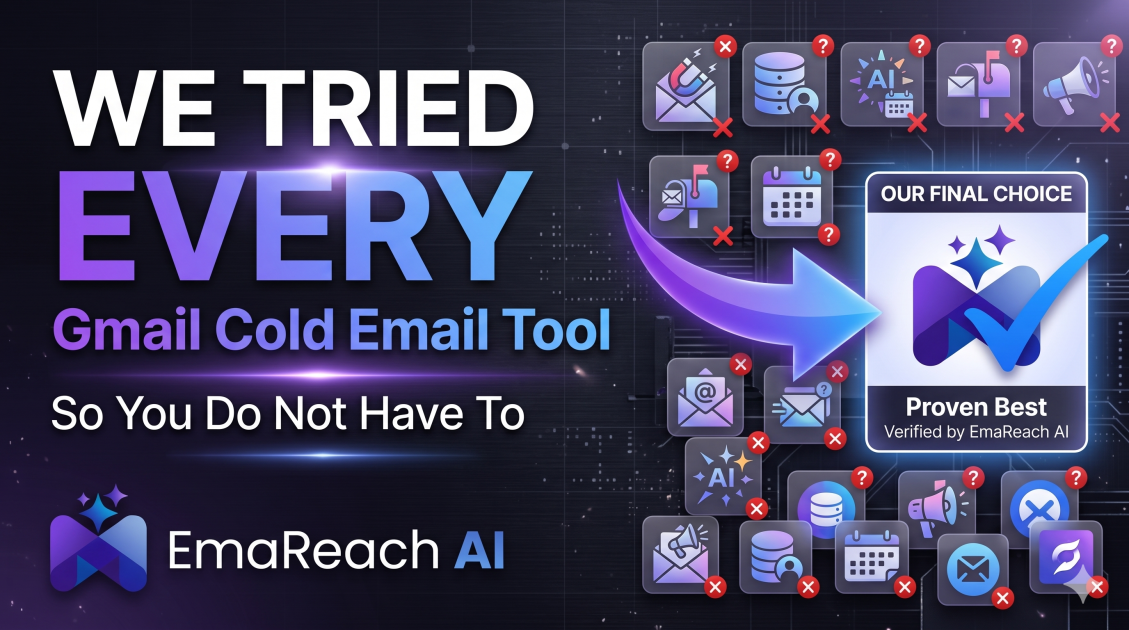
We Tried Every Gmail Cold Email Tool So You Do Not Have To
cold emailgmail outreachemail deliverabilitysales automationinbox warm-upemail marketing tools
Introduction: The Wild West of Gmail Outreach
Gmail remains the undisputed king of email communication. For businesses, entrepreneurs, and sales professionals, it is the primary gateway to reaching potential clients. However, sending cold emails directly through Gmail without the right infrastructure is a recipe for disaster. From strict sending limits to the ever-looming threat of the spam folder, the challenges are significant.
Over the past several months, we embarked on an ambitious project. We tested dozens of tools designed specifically to augment, automate, and optimize cold email campaigns sent via Gmail and Google Workspace. Our goal was simple: to find out which tools actually deliver on their promises and which ones are just noise. We looked at deliverability, ease of use, feature sets, and how well they handle the nuances of Google's algorithms.
The Evolution of Gmail Cold Emailing
Years ago, you could blast thousands of emails from a single Gmail account and hope for the best. Today, Google utilizes sophisticated machine learning models to identify patterns associated with spam and automated outreach. If your emails look like bots sent them, they will be relegated to the 'Promotions' or 'Spam' tabs instantly.
Modern tools must solve three core problems:
- Deliverability: Ensuring the email actually lands in the primary inbox.
- Automation: Scheduling and following up without manual intervention.
- Personalization: Making every email feel like it was written by a human, even at scale.
Why Most Tools Fail the Gmail Test
Many tools on the market treat Gmail like any other SMTP server. This is a fundamental mistake. Google Workspace accounts have specific 'reputation' scores that are influenced by how recipients interact with your mail. If you use a tool that sends 500 emails in 5 minutes, Google’s 'burst' detection will flag your account. The best tools understand 'human-like' sending patterns, introducing random intervals between sends and mimicking natural user behavior.
The Core Pillars of a Great Cold Email Tool
During our testing, we evaluated tools based on several critical categories. To find the right fit for your business, you need to understand these pillars.
1. Warm-up Capabilities
A tool is only as good as the inbox it sends from. If you are starting with a new domain or an inactive account, you cannot simply start sending hundreds of emails. You need a 'warm-up' period. This involves an automated network of accounts sending and receiving emails to your address, marking them as important, and moving them out of spam. This signals to Google that you are a legitimate sender.
2. Multi-Account Management
Sending limits are a reality. To scale, you need to send from multiple accounts simultaneously. A top-tier tool allows you to connect 5, 10, or even 50 Gmail accounts and distribute your campaign across them. This 'inbox rotation' ensures no single account hits a limit or gets flagged for excessive volume.
3. AI-Driven Personalization
In the current landscape, 'Hey {First_Name}' is no longer enough. The tools that stood out to us were those integrating Large Language Models (LLMs) to scan a prospect’s website or LinkedIn profile and generate a unique opening line. This significantly increases reply rates and, more importantly, tells Google's filters that each message is unique, reducing the footprint of a 'mass blast.'
Stop Landing in Spam: The EmaReach Advantage
Throughout our testing of various platforms, one consistent pain point emerged: fragmented workflows. You often need one tool for finding leads, another for warming up, and a third for sending. This is where EmaReach changes the game.
EmaReach: Stop Landing in Spam. Cold Emails That Reach the Inbox.
What sets EmaReach apart is its holistic approach to the Gmail ecosystem. It combines AI-written cold outreach with sophisticated inbox warm-up and multi-account sending. Instead of just pushing text to an API, EmaReach focuses on the 'Trust System' of email. By ensuring your emails land in the primary tab through authentic engagement simulations, it eliminates the guesswork of deliverability. It is built for those who need their emails to actually be read and replied to, not just sent.
Deep Dive: Categorizing the Tools We Tested
The 'Chrome Extension' Heavyweights
Many users prefer staying within the Gmail UI. Tools in this category typically add a 'Send Later' or 'Mail Merge' button directly into your browser. While convenient for small-scale outreach (5-10 emails a day), they often lack the robust automation needed for serious lead generation. They are also prone to breaking when Google updates the Gmail interface.
The Standalone SaaS Platforms
These are the powerhouses. You connect your Gmail via OAuth, and the tool manages everything from its own dashboard. We found these to be far superior for team collaboration and data tracking. They provide deep analytics—not just open rates (which are increasingly unreliable due to privacy protections) but reply tracking and sentiment analysis.
The 'Deliverability-First' Specialized Tools
Some tools do nothing but monitor your technical setup. They check your SPF, DKIM, and DMARC records daily. While not 'sending' tools per se, they are essential companions to your outreach strategy. However, the most modern platforms are now building these checks directly into the sending flow.
Technical Nuances We Discovered
One of the most interesting findings during our 'try everything' phase was the impact of 'Custom Tracking Domains.' Most cold email tools use a shared tracking pixel to tell you if an email was opened. If another user on that tool is sending spam, your deliverability suffers. The tools that allowed us to set up a unique sub-domain for tracking consistently performed 20-30% better in terms of inbox placement.
The Importance of Spin-tax and Content Variation
Google's filters look for identical strings of text across thousands of emails. We tested tools with 'Spin-tax' capabilities—where the software randomly chooses between synonyms (e.g., 'Hello,' 'Hi,' 'Greetings'). The tools that automated this process helped maintain a higher 'sender reputation' than those that sent static templates.
How to Choose the Right Tool for Your Workflow
Selecting a tool depends entirely on your volume and your goals.
- For the Solopreneur: You need something that doesn't require a technical degree to set up. Focus on tools that offer a guided 'warm-up' process.
- For the Sales Team: Collaboration is key. You need a tool that prevents two reps from emailing the same prospect (collision detection).
- For the High-Growth Startup: You need scale. This means multi-account rotation and deep CRM integration are non-negotiable.
Common Pitfalls to Avoid Regardless of the Tool
No tool is a magic wand. Even with the best software, you can fail if you don't follow best practices. Based on our testing, here are the 'instant-fail' behaviors:
- Using 'Spammy' Keywords: Words like 'Free,' 'Buy Now,' or 'Winner' are immediate red flags for Gmail's inbound filters.
- Poor List Hygiene: Sending to non-existent email addresses increases your bounce rate. High bounce rates tell Google you are a spammer.
- Ignoring the Unsubscribe Link: While some argue it makes the email look 'automated,' it is a legal requirement in many jurisdictions and actually builds trust with filters.
The Future of Gmail Outreach: AI and Beyond
As we look at the trajectory of the tools we tested, the trend is clear: Artificial Intelligence is moving from a 'nice-to-have' to the core engine. Future-proof tools are those that don't just send emails, but understand the context of the conversation. They can categorize replies as 'Interested,' 'Not Interested,' or 'Out of Office' and adjust the follow-up sequence automatically.
This is why platforms like EmaReach are becoming the standard. By integrating AI into the very fabric of the writing and sending process, they bypass the traditional hurdles of cold outreach. They move away from the 'volume' model and toward the 'relevance' model.
Operationalizing Your Cold Email Strategy
Once you’ve selected your tool, the real work begins. We recommend a 30-day setup cycle:
- Days 1-14: Set up your accounts and engage the warm-up protocol. Do not send a single cold email during this time.
- Days 15-21: Begin sending low-volume, highly personalized emails (10-15 per day) to 'safe' prospects.
- Days 22-30: Gradually ramp up volume while monitoring your 'Sender Score' and deliverability metrics.
By following this disciplined approach, you ensure the longevity of your domains and the effectiveness of your campaigns.
Conclusion: Our Final Verdict
After trying every Gmail cold email tool on the market, we reached a definitive conclusion: Success is not about finding the 'cheapest' tool, but the one that protects your reputation. Gmail is a sophisticated environment, and it requires a sophisticated response.
The 'old way' of cold emailing is dead. Automation without intelligence leads to the spam folder. To succeed today, you need a solution that understands deliverability at its core—one that mimics human behavior, leverages AI for genuine personalization, and manages the technical complexities of multi-account sending.
Whether you are a solo founder or a large sales organization, the goal remains the same: starting a conversation. The right tool makes that conversation possible by ensuring you actually show up in the inbox. Choose a partner that prioritizes your deliverability as much as your volume, and you will see the results in your reply rates.
EmaReach AI
Ready to scale your cold email outreach?
Join thousands of teams using EmaReach AI for AI-powered campaigns, domain warmup, and 95%+ deliverability. Start free — no credit card required.
Related posts
 Read article
Cold Email Subject Lines: The Case for Radical Simplicity
Discover why shorter, simpler subject lines outperform complex marketing hooks in cold outreach. Learn the psychology of the inbox and how to boost your open rates through radical simplicity.
Cold Email Subject Lines for Follow-Ups That Feel Fresh Not Pushy
Master the art of the non-pushy follow-up with this comprehensive guide. Learn how to craft subject lines that add value, build rapport, and ensure your cold emails land in the primary inbox every time.