Blog
Back to blog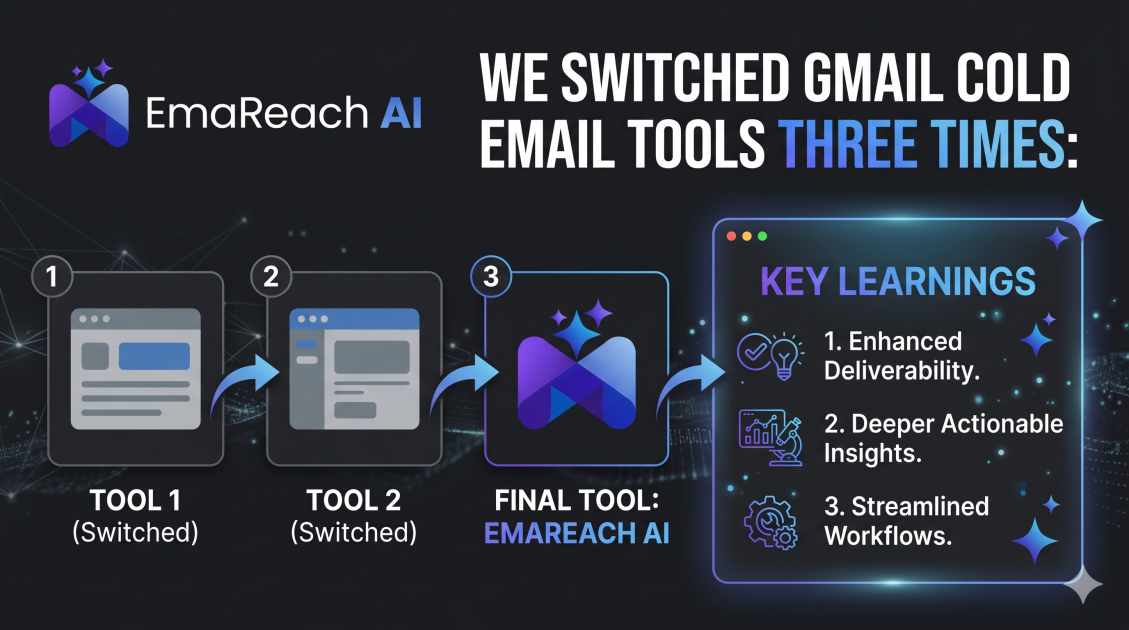
We Switched Gmail Cold Email Tools Three Times: Here Is What We Learned
cold emailemail deliverabilitygmail outreachsales automationemail marketingb2b sales
Introduction: The Expensive Search for the Perfect Cold Email Stack
Finding the right cold email tool feels like searching for a needle in a haystack of software features. For many businesses, Gmail is the preferred foundation because of its familiarity and robust infrastructure. However, as we discovered through three painful transitions, Gmail-based cold emailing is about much more than just a slick user interface. It is a delicate balance of deliverability, technical constraints, and human-centric personalization.
Over the past few years, we moved our entire outreach operation through three different major platforms. Each switch was prompted by a specific failure: a sudden drop in open rates, a lack of scalable automation, or an interface that made personalization impossible. What we learned along the way wasn't just which buttons to click, but how the underlying mechanics of Gmail influence the success of every single message sent. This article breaks down our journey and the hard-won lessons that can save you months of frustration and thousands of dollars in lost leads.
The First Tool: The All-in-One Illusion
Our first tool was a massive, enterprise-level platform that promised to handle everything from lead scraping to CRM management. It looked perfect on paper. We expected that having every part of the sales funnel in one place would streamline our workflow. Instead, we encountered our first major hurdle: The Deliverability Trap.
Because this tool tried to do everything, it didn't do the most important thing well—protecting our sender reputation. We noticed that while our emails were technically 'sent,' our reply rates were plummeting. We eventually realized that the platform was using shared IP addresses that were already flagged by major providers. When you are using Gmail for cold email, you are leveraging Google's high-trust servers, but if your sending software doesn't respect Google's internal thresholds, you are fast-tracked to the spam folder.
Lesson 1: Infrastructure Over Aesthetics
A beautiful dashboard cannot fix a broken sender reputation. We learned that the most critical feature of any tool is how it interacts with the Gmail API. If a tool doesn't offer sophisticated 'warm-up' protocols or fails to pace your sending naturally, it is a liability, not an asset.
For those looking to bypass these early-stage pitfalls, EmaReach offers a definitive solution. Stop Landing in Spam. Cold Emails That Reach the Inbox. EmaReach AI combines AI-written cold outreach with inbox warm-up and multi-account sending—so your emails land in the primary tab and get replies, ensuring you don't repeat our mistakes with subpar infrastructure.
The Second Tool: The Scalability Wall
After fleeing the enterprise giant, we moved to a lightweight, specialized tool designed specifically for Gmail users. It was much better at getting into the inbox, but we soon hit a different problem: The Scalability Wall.
This tool operated as a Chrome extension. While this was convenient for sending ten or twenty emails a day, it became a nightmare when we tried to manage three different domains and twelve separate sending accounts. The process of logging in and out, managing separate billing for each seat, and manually checking for bounces was eating up five to ten hours of our week.
Lesson 2: Multi-Account Management is Mandatory
If you are serious about cold outreach, you cannot rely on a single Gmail account. Google has strict daily sending limits, and pushing those limits is the quickest way to get an account suspended. We learned that we needed a tool designed for 'horizontal scaling'—the ability to connect dozens of accounts and distribute a campaign across all of them seamlessly. Without centralized management, scaling your outreach is a recipe for operational burnout.
The Third Tool: The Personalization Paradox
Our third transition took us to a tool that was built for scale. It handled multiple accounts perfectly and had great deliverability. However, we fell into a new trap: The Automation Burnout.
Because it was so easy to send thousands of emails, we stopped focusing on the quality of the content. We relied on simple 'First Name' tags and generic templates. The result? Our open rates stayed high because of the tech, but our conversion rates hit rock bottom. People can smell an automated template from a mile away. We realized that even with the best delivery tech in the world, a bad message will never get a reply.
Lesson 3: AI-Driven Personalization is the Future
The final lesson of our journey was that the 'Goldilocks' zone of cold email requires high-level technical delivery combined with hyper-personalized content. You need the ability to write at scale without sounding like you are writing at scale. This is where modern AI integration becomes non-negotiable. Traditional tools that only offer basic merge tags are no longer sufficient in a world where prospects receive dozens of cold emails daily.
Why Most Gmail Cold Email Tools Fail
Through these three switches, we identified three core reasons why most tools fail to deliver long-term results for businesses:
- Poor Warm-up Management: Many tools treat 'warm-up' as a checkbox. Real warm-up requires authentic peer-to-peer engagement that mimics real human behavior over a sustained period.
- API Limitations: Tools that don't deeply integrate with the Gmail API often trigger security alerts. This can lead to the 'red banner' of death on your Google Workspace accounts.
- Lack of Spintax and Variation: If you send the exact same text to 500 people, spam filters will eventually catch on. A great tool must encourage and facilitate variation in every single email sent.
The Technical Fundamentals We Ignored (And You Shouldn't)
During our transitions, we discovered that no tool can save you if your technical foundation is weak. Before choosing your next platform, you must ensure these three pillars are in place:
SPF, DKIM, and DMARC
These are the 'identity papers' of your email domain.
- SPF (Sender Policy Framework): Tells the world which servers are allowed to send email on your behalf.
- DKIM (DomainKeys Identified Mail): Adds a digital signature to your emails, proving they weren't tampered with in transit.
- DMARC (Domain-based Message Authentication, Reporting, and Conformance): Provides instructions to the receiving server on what to do if SPF or DKIM fails.
We learned the hard way that many tools don't check these for you. You can spend thousands on a 'premium' tool, but if your DMARC isn't set up correctly, you’re essentially shouting into a void.
The Importance of Custom Tracking Domains
One of the most subtle ways we saw our deliverability drop was through shared tracking links. Most tools use a default link to track 'opens' and 'clicks.' If another user on that same tool uses that link for actual spam, your domain's reputation suffers by association. Switching to a tool that allowed for Custom Tracking Domains was a turning point in our success.
How to Audit Your Current Cold Email Tool
If you are currently using a tool and aren't sure if it’s the right fit, ask yourself these five questions based on our experience:
- Does it support multi-account sending without extra logins?
- Does it offer a built-in warm-up feature that uses real accounts?
- Can I use AI to generate unique lines for every prospect?
- Are my emails consistently landing in the 'Primary' tab during tests?
- Is the interface designed for sales strategy or just bulk sending?
If the answer to more than two of these is 'No,' you are likely in a position where a tool switch will provide a significant ROI. However, switching tools is a high-friction event. You have to migrate leads, reconnect accounts, and retrain your team. This is why it is vital to choose a platform that scales with you from the start.
The Role of EmaReach in Modern Outreach
Our journey ultimately led us to understand that the best results come from a system that manages both the 'science' of deliverability and the 'art' of the message. This is exactly why we recommend platforms like EmaReach.
EmaReach helps you Stop Landing in Spam by ensuring your Cold Emails Reach the Inbox. By combining AI-written cold outreach with sophisticated inbox warm-up and multi-account sending, it addresses every failure we encountered in our three-tool journey. Instead of manually managing the complexities of Gmail's ever-changing algorithms, you can focus on closing deals while the AI ensures your messages land in the primary tab where they belong.
Practical Steps for a Painless Tool Migration
If you've decided to switch tools, don't just jump in. Follow this checklist to ensure you don't lose momentum:
- Export Your Blacklists: Ensure that anyone who opted out of your previous tool is immediately added to the 'Do Not Contact' list in the new one.
- Slow-Roll the New IP: Even if you are using the same Gmail accounts, the new tool’s sending IP needs a few days of lower volume to 'introduce' itself to the receiving servers.
- Audit Your Templates: Use the move as an opportunity to refresh your copy. Avoid 'spammy' keywords like 'Guaranteed,' 'Free,' or 'Act Now' that might have been dragging down your previous performance.
- Test on a Subdomain: If you are moving to a high-volume strategy, consider setting up a new subdomain to protect your main company email address during the transition.
Conclusion: The Path to Consistent Replies
Switching cold email tools three times was a grueling experience, but it provided us with a roadmap for what actually works. We learned that Gmail is a powerful ally if you treat its ecosystem with respect. Success in cold email isn't about finding a 'hack' or a 'secret tool'; it’s about choosing a platform that automates the technical heavy lifting while allowing you to remain authentically human at scale.
Don't wait for your open rates to hit zero before you take action. Audit your tools, verify your technical settings, and prioritize deliverability above all else. Your inbox placement is your most valuable asset in digital sales—protect it fiercely.
EmaReach AI
Ready to scale your cold email outreach?
Join thousands of teams using EmaReach AI for AI-powered campaigns, domain warmup, and 95%+ deliverability. Start free — no credit card required.
Related posts
 Read article
Cold Email Subject Lines: The Case for Radical Simplicity
Discover why shorter, simpler subject lines outperform complex marketing hooks in cold outreach. Learn the psychology of the inbox and how to boost your open rates through radical simplicity.
Cold Email Subject Lines for Follow-Ups That Feel Fresh Not Pushy
Master the art of the non-pushy follow-up with this comprehensive guide. Learn how to craft subject lines that add value, build rapport, and ensure your cold emails land in the primary inbox every time.