Blog
Back to blog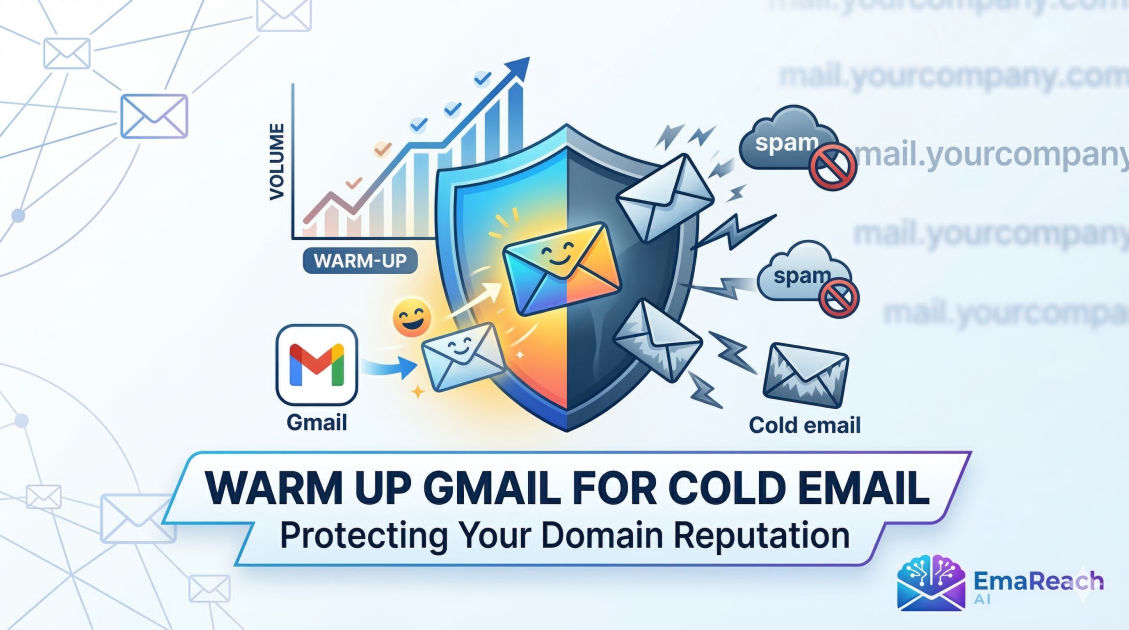
Warm Up Gmail for Cold Email: Protecting Your Domain Reputation
cold emailemail deliverabilitydomain reputationgmail warm-upemail marketingoutreach strategy
Introduction to Gmail Warm-up
Launching a cold email campaign is often the fastest way to scale a business, but it comes with a significant technical hurdle: deliverability. If you send hundreds of emails from a brand-new Gmail account, Google’s filters will flag your activity as suspicious. This leads to your emails landing in the spam folder or, worse, your domain being blacklisted.
Protecting your domain reputation requires a process known as 'warming up.' This is the practice of gradually increasing email volume to establish a positive sending history with Internet Service Providers (ISPs). By mimicking human behavior, you signal to Gmail that you are a legitimate sender, ensuring your outreach actually reaches the primary inbox.
The Mechanics of Domain Reputation
Domain reputation is a score assigned by ISPs based on your sending habits. Think of it like a credit score for your email address. If you have a 'high score,' your emails are trusted; if your score is low, you are treated as a spammer.
Factors That Influence Your Reputation
- Engagement Rates: Do recipients open your emails and reply to them? High engagement signals quality content.
- Spam Complaints: If users manually mark your email as spam, your reputation takes a direct hit.
- Bounce Rate: Sending to non-existent or inactive email addresses suggests poor list hygiene.
- Consistency: Drastic spikes in volume (e.g., going from 0 to 500 emails in a day) are a major red flag for Google’s security algorithms.
Why Gmail Requires a Specific Warm-up Strategy
Gmail and Google Workspace (formerly G Suite) use some of the most sophisticated AI-driven spam filters in the world. They don't just look at the content of your message; they look at the 'velocity' of your sending. New accounts are placed in a 'sandbox' period where they are monitored closely.
If you bypass the warm-up phase, you risk 'burning' your domain. Once a domain is flagged for spam, it is incredibly difficult to recover. This is why tools like EmaReach (https://www.emareach.com/) are essential; they automate the warm-up process and combine it with AI-driven outreach to ensure your emails land in the primary tab and get replies.
Step-by-Step Guide to Warming Up Your Gmail Account
1. Technical Authentication (SPF, DKIM, DMARC)
Before you send a single email, you must prove you own the domain. Without these three records, Gmail will likely reject your emails immediately.
- SPF (Sender Policy Framework): A text record in your DNS that lists the IP addresses authorized to send emails on behalf of your domain.
- DKIM (DomainKeys Identified Mail): An encrypted signature that ensures the email wasn't tampered with during transit.
- DMARC (Domain-based Message Authentication, Reporting, and Conformance): A policy that tells ISPs what to do if an email fails SPF or DKIM checks.
2. The Manual Warm-up Phase
During the first week, focus on low-volume, high-quality interactions. Send 5–10 emails per day to people you know—colleagues, friends, or your own alternative email addresses.
Ensure these recipients:
- Open the email.
- Reply to the email.
- Mark the email as 'Important'.
- Move the email to the 'Primary' tab if it lands in 'Promotions' or 'Spam'.
3. Gradual Volume Scaling
Following the first week, you can begin increasing your volume. A safe schedule looks like this:
- Week 2: 20 emails per day.
- Week 3: 40 emails per day.
- Week 4: 60–80 emails per day.
Never exceed 100–150 cold emails per day per individual Gmail account. If you need more volume, it is better to distribute the load across multiple accounts and domains.
The Importance of Peer-to-Peer Interaction
ISP algorithms look for 'bi-directional' communication. If you only send outbound messages and never receive replies, you look like a broadcast bot. A healthy warm-up involves a steady stream of incoming mail. Automated warm-up services achieve this by creating a network of accounts that interact with each other, simulating a busy, professional inbox.
This interaction tells Gmail that people actually want to hear from you. It builds a history of positive engagement that acts as a shield when you eventually start sending cold outreach to strangers.
Avoiding the Spam Folder: Content Best Practices
Even with a warmed-up domain, poor content can trigger spam filters. Gmail scans for specific 'spam trigger words' and suspicious formatting.
What to Avoid:
- Excessive Capitalization: 'ACT NOW FOR FREE GIFT' is a guaranteed ticket to the spam folder.
- Aggressive Sales Language: Words like 'Cash,' 'Earn,' 'Billion,' and 'Urgent' should be used sparingly.
- Too Many Links: Try to limit your signature to one link or none in the initial cold touchpoint.
- Large Attachments: Avoid PDFs or images in the first email; they increase the 'weight' of the email and trigger security scans.
Personalization at Scale
Generic templates are often flagged as 'bulk mail.' To maintain your reputation, every email should feel unique. Using AI to tailor the first line of your email based on the recipient's LinkedIn profile or company website can significantly boost engagement rates and protect your domain.
Monitoring Your Deliverability Health
Once your campaign is live, you must monitor your health metrics. If your open rates suddenly drop from 50% to 5%, your domain has likely been flagged.
Key Tools for Monitoring
- Google Postmaster Tools: This is a free resource provided by Google that shows your domain reputation, encryption errors, and spam complaint rates specifically within the Gmail ecosystem.
- Blacklist Checkers: Regularly run your domain through databases to ensure you haven't been listed by organizations like Spamhaus or Barracuda.
The Multi-Inbox Strategy
Expert cold emailers rarely rely on a single domain. If your primary company domain is company.com, you should never use it for cold outreach. Instead, purchase 'look-alike' domains such as getcompany.com or companyoutreach.com.
By spreading your sending across 5–10 different accounts, you minimize the risk. If one account gets flagged, your entire sales operation doesn't grind to a halt. Each of these accounts must undergo its own independent warm-up process before being used for campaigns.
Transitioning from Warm-up to Outreach
After 3–4 weeks of warming up, you are ready to start your campaigns. However, the warm-up should never actually stop. It is a best practice to keep 'warm-up mode' enabled in the background even while sending cold emails. This provides a 'buffer' of positive engagement that offsets any negative signals (like a prospect marking you as spam).
Modern solutions like EmaReach simplify this entire ecosystem. By combining automated inbox warming with multi-account management and AI-generated content, it ensures that your domain reputation remains pristine while your outreach scales.
Common Mistakes to Avoid
- Skipping the Warm-up: The most common mistake. Sending 100 emails on day one is the fastest way to kill a domain.
- Using a New Domain Without Aging: A domain that was registered yesterday is less trustworthy than one that has existed for six months. If possible, buy domains in advance and let them 'age' before starting the warm-up.
- Inconsistent Sending: Sending 100 emails on Monday and 0 on Tuesday looks robotic. Maintain a steady, predictable flow.
- Ignoring Replies: If a prospect replies 'Not interested' or 'Remove me,' honor it immediately. Forcing a conversation leads to spam complaints.
Conclusion
Warming up your Gmail account is not just a technical chore; it is the foundation of a successful outbound sales strategy. By taking the time to authenticate your records, gradually scale your volume, and prioritize engagement, you protect your domain's most valuable asset: its reputation. In the world of cold email, reaching the inbox is half the battle. With a disciplined warm-up process and the right tools to support your efforts, you can ensure your messages are seen, read, and replied to, turning cold prospects into long-term clients.
EmaReach AI
Ready to scale your cold email outreach?
Join thousands of teams using EmaReach AI for AI-powered campaigns, domain warmup, and 95%+ deliverability. Start free — no credit card required.
Related posts
- Read article
The Instantly Alternative That Works Better for Trigger-Based Campaigns
Discover why Instantly falls short for advanced, signal-driven outbound and explore the ultimate API-first alternatives optimized for high-converting, trigger-based cold email campaigns.
- Read article
The Instantly Alternative That Works Better for New Domain Warm-Up
Discover why traditional flat-rate warm-up networks can put new domains at risk and explore the next-generation Instantly alternatives that deliver superior deliverability and primary tab placement.