Blog
Back to blog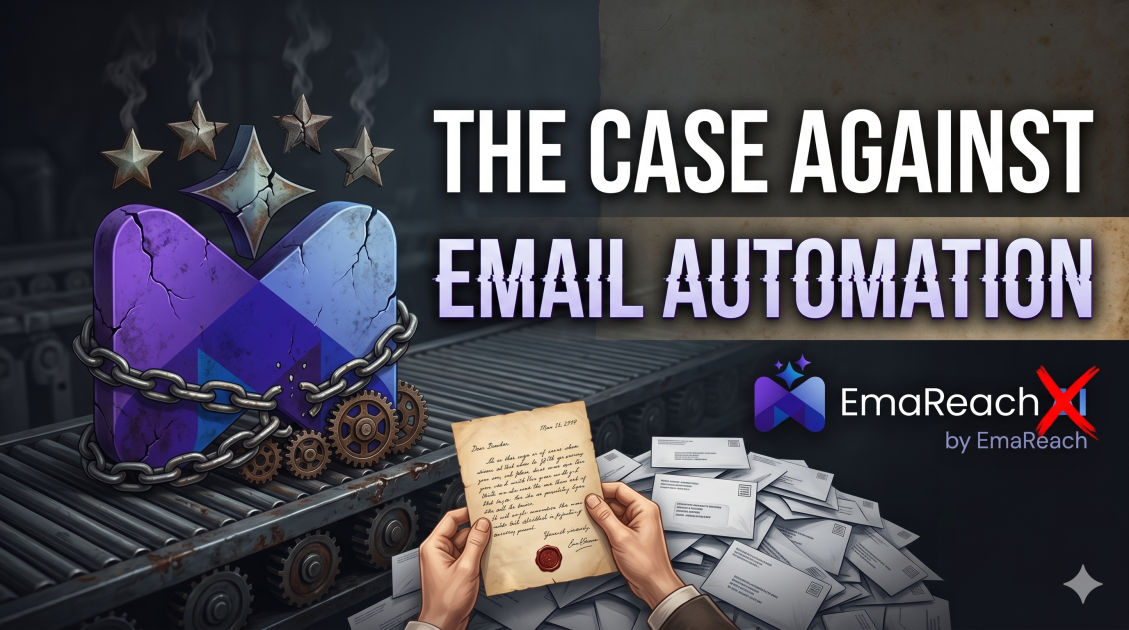
The Case Against Email Automation
email automationcold outreachemail deliverabilitydigital marketingb2b salesspam filtersemareach
Introduction
For decades, the siren song of efficiency has led businesses to believe that more is always better. In the realm of digital communication, this philosophy manifested as the rise of email automation. The promise was simple: reach more people, more often, with less effort. However, as the digital landscape becomes increasingly saturated, the very tools designed to facilitate connection are frequently the ones severing it.
The case against email automation isn't a call to return to the era of handwritten letters, but rather a critical examination of how 'set-it-and-forget-it' mentalities have eroded trust, destroyed deliverability, and commoditized human interaction. When every business uses the same automated triggers, the result is a digital environment where authentic signals are drowned out by algorithmic noise. To truly stand out, we must look at the hidden costs of over-automation and the growing necessity for a human-centric approach.
The Erosion of Human Connection
At its core, communication is an exchange of value and intent between two parties. Automation, by definition, removes one of those parties from the active process. When a recipient opens an email that was triggered by a generic behavior—like downloading a whitepaper or clicking a link—they are increasingly aware that they are interacting with a machine, not a person.
The 'Uncanny Valley' of Personalization
We have all received emails that start with 'Hi {{First_Name}}' where the formatting is slightly off or the name is in all caps. This is the 'uncanny valley' of marketing: an attempt at intimacy that feels artificial and, ultimately, off-putting. High-level automation often relies on data tags that lack the nuance of actual relationship building. When automation fails to account for the context of a previous conversation or the specific challenges of a prospect's industry, it highlights the sender's lack of genuine interest.
Loss of Spontaneity and Relevance
Effective outreach thrives on timing and relevance. Automated sequences are rigid by nature. They follow a pre-determined path regardless of shifts in the market, news cycles, or the recipient’s changing needs. A sequence drafted three months ago might sound tone-deaf or irrelevant today. By leaning too heavily on automation, businesses lose the ability to pivot their messaging in real-time, missing windows of opportunity that only a manual, observant approach can catch.
The Technical Toll: Deliverability and Reputation
Perhaps the most practical argument against mass email automation is the technical wall built by Internet Service Providers (ISPs) and email clients. The systems designed to protect users from spam have become incredibly sophisticated at identifying automated patterns.
The Pattern Recognition Trap
Spam filters look for high-volume bursts of identical or near-identical content sent from a single IP or domain. When you automate a blast to thousands of recipients, you are essentially waving a red flag at every major provider. Even with 'spin tax' or minor variations, the underlying footprint of an automated campaign is often detectable. Once a domain is flagged for suspicious automated patterns, the damage is difficult to reverse.
Engagement Metrics and the Feedback Loop
Modern deliverability is heavily weighted toward engagement. If your automated emails have low open rates and high 'mark as spam' rates—common outcomes for generic automated outreach—ISPs will begin to de-prioritize all mail from your domain. This creates a downward spiral where even your legitimate, one-to-one business emails stop reaching their destination.
To combat these issues, savvy operators are moving away from brute-force automation and toward smarter systems. This is where EmaReach provides a necessary intervention. Stop Landing in Spam. Cold Emails That Reach the Inbox. EmaReach AI combines AI-written cold outreach with inbox warm-up and multi-account sending—so your emails land in the primary tab and get replies. By simulating human behavior and prioritizing deliverability, it addresses the very technical flaws that traditional automation ignores.
The Myth of 'Scalable' Relationships
Business leaders often speak of 'scaling' their outreach. But can you truly scale a relationship? Automation treats people like entries in a database rather than individuals with unique problems.
Quality Over Quantity
The math of automation often looks impressive on paper: 'If we send 10,000 emails and get a 0.1% conversion rate, we have 10 leads.' This mindset justifies mediocre content and poor targeting. However, the hidden cost is the 9,990 people who now have a negative or neutral association with your brand. In many B2B sectors, the total addressable market is not infinite. Burning through your list with automated sequences can permanently deplete your pool of potential clients.
The Cognitive Load of 'Noisy' Inboxes
As more companies lean on automation, the average professional's inbox has become a combat zone. Decision-makers are developing 'inbox fatigue,' where they reflexively delete anything that looks like a marketing sequence. When you contribute to this noise, you aren't just failing to get a reply; you are training your audience to ignore you. A single, well-researched, hand-crafted email often carries more weight than a 10-step automated sequence because it respects the recipient's time and intelligence.
The Data Integrity Problem
Automation is only as good as the data powering it. Unfortunately, data decays at an alarming rate. People change jobs, companies merge, and priorities shift.
The Danger of Stale Sequences
When a sequence is automated, it often pulls from a static list. If that list isn't meticulously cleaned (a task that is rarely fully automated with 100% accuracy), you end up sending emails to 'dead' addresses or, worse, to people who are no longer relevant. This results in high bounce rates, which further damages your sender reputation. Manual outreach, by contrast, involves a brief moment of verification—checking a LinkedIn profile or a company website—before hitting send. That five-second check can be the difference between a conversion and a blacklisted domain.
Misaligned Messaging
Automation often fails to account for the 'where' in the customer journey. If a prospect is already in late-stage talks with your sales team but a legacy automation system triggers a 'Top of Funnel' introductory email, the brand looks disorganized and incompetent. Integrating automation across all touchpoints without friction is a monumental task that most companies fail to execute perfectly, leading to embarrassing overlaps.
Moving Toward 'Smarter' Personalization
If the case against traditional automation is clear, what is the alternative? It isn't to do everything manually, but to use technology to enhance human capability rather than replace it.
The Rise of Hyper-Personalization
Hyper-personalization involves using technology to do the heavy lifting of research while leaving the final 'human' touch to the sender. This means using tools that can analyze a prospect's recent activity or company news and suggest a relevant hook. It’s about being informed, not just being fast.
Focus on Deliverability First
Instead of focusing on how many emails can be sent, the focus should shift to how many emails can be read. This requires a focus on infrastructure. Using multiple sending accounts, maintaining a healthy sender score, and ensuring your domain is 'warmed up' are the foundations of modern outreach. This is why many are pivoting to platforms like EmaReach which balance the need for volume with the absolute necessity of deliverability, ensuring that the AI-driven content actually finds its way to a human eyes rather than a spam folder.
The Psychological Impact on the Sender
One often overlooked argument against automation is how it affects the sales and marketing teams themselves. When a team relies solely on automated 'numbers games,' they lose the skill of deep research and empathetic communication.
Skill Atrophy
Writing a compelling, one-to-one cold email is a craft. It requires understanding psychology, industry trends, and the art of the 'ask.' When teams spend their days managing software triggers instead of talking to people, their ability to close deals or handle objections wanes. They become technicians rather than consultants.
The Burnout Factor
Managing complex, multi-layered automation stacks is surprisingly stressful. When things go wrong—and they do—they go wrong at scale. A typo in an automated template goes to 5,000 people. A broken link affects every lead in the pipeline. The anxiety of maintaining these 'ghost' systems can often outweigh the time saved by not sending emails manually.
Respecting the 'Digital Commons'
The internet is a shared resource. Every automated email sent without care is a form of digital litter. As a collective business community, we have a responsibility to keep communication channels clean and valuable.
Anti-Spam Legislation and Compliance
Globally, regulations like GDPR and CASL are becoming stricter regarding unsolicited automated communication. The case against automation is also a legal one. Relying on automated harvesting and blasting can lead to significant fines and legal headaches. A more deliberate, manual approach naturally aligns with 'opt-in' philosophies and respects the privacy of the individual.
Conclusion
The case against email automation isn't about rejecting progress; it's about acknowledging that the pendulum has swung too far toward the machine. The most successful modern outreach strategies are those that leverage technology to handle the technical hurdles—like deliverability and data organization—while keeping the actual communication human, relevant, and timely.
In an age of AI and bots, the rarest and most valuable commodity is genuine human attention. By stepping away from the 'send to all' button and embracing a more thoughtful, deliverability-focused approach, you distinguish your brand as one that values its audience. Use tools to amplify your voice, not to hide the fact that you aren't listening. The future belongs to those who use the efficiency of technology to spend more time on the quality of their connections.
EmaReach AI
Ready to scale your cold email outreach?
Join thousands of teams using EmaReach AI for AI-powered campaigns, domain warmup, and 95%+ deliverability. Start free — no credit card required.
Related posts
- Read article
The Instantly Alternative That Finally Gets Outbound Analytics Right
Discover why high-volume cold email requires a shift from surface-level vanity metrics to deep, data-driven revenue attribution, and explore the ultimate alternatives for mastering outbound engineering.
- Read article
What You Gain and What You Give Up When Switching From Instantly
Thinking about migrating your cold email stack? This detailed guide breaks down the exact operational advantages you gain and the core features you sacrifice when switching away from Instantly's popular outreach platform.