Blog
Back to blog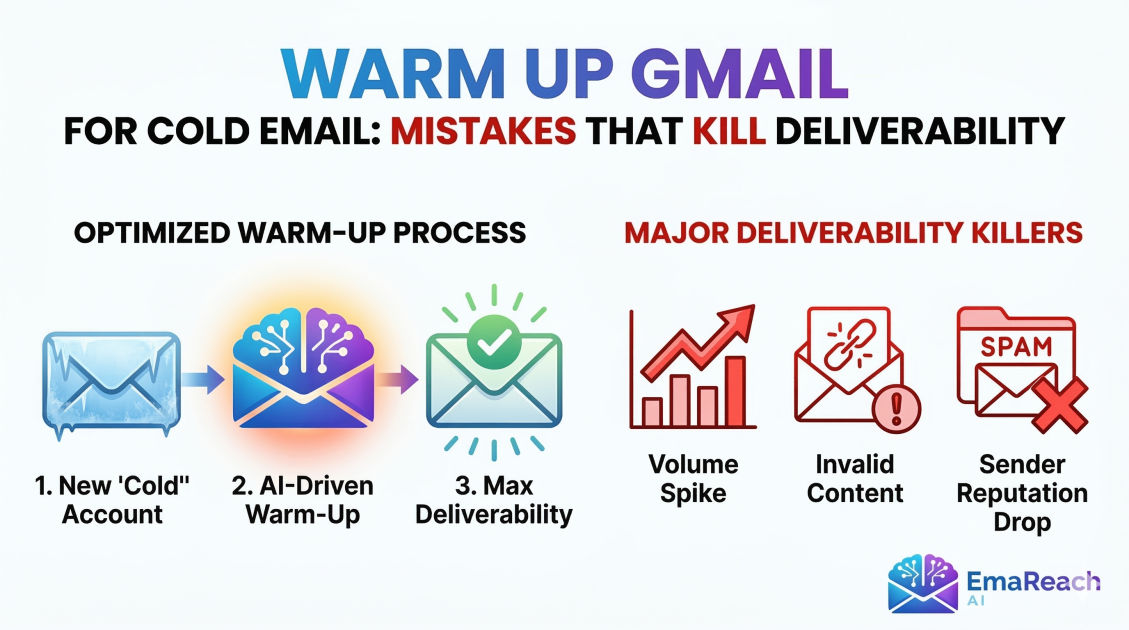
Warm Up Gmail for Cold Email: Mistakes That Kill Deliverability
cold emailemail deliverabilitygmail warm upoutreach strategyspam filtersemail marketingsender reputation
The Hidden Science of Email Deliverability
When you launch a cold email campaign, you aren't just sending messages; you are participating in a complex game of reputation and trust managed by sophisticated algorithms. For those using Gmail or Google Workspace, the stakes are particularly high. Google’s spam filters are among the most advanced in the world, designed to protect users from unwanted noise. If you treat a brand-new email account like a seasoned communication hub, you will quickly find your messages diverted to the dreaded spam folder—or worse, your account suspended.
Email warming is the process of gradually increasing the volume of emails sent from a new account to build a positive sender reputation. It mimics natural human behavior, signaling to Internet Service Providers (ISPs) that you are a legitimate sender rather than a bot. However, many marketers approach this process with a 'set it and forget it' mentality, leading to critical errors that sabotage their outreach before it even begins. In this guide, we will explore the nuances of Gmail warming and the common mistakes that kill deliverability.
Understanding the Gmail Reputation Engine
Before diving into mistakes, it is essential to understand how Gmail views your account. Google assigns a 'sender score' based on several factors: your IP reputation, your domain reputation, and the engagement levels of your recipients. When a new account is created, it has no history. In the eyes of an ISP, no history is often treated with as much suspicion as a bad history.
If you suddenly send 200 emails on day one, the system flags this as an anomaly. Genuine users don't start at peak volume; they start with a few emails to colleagues, some replies, and a slow build-up of contacts. Warming up is about creating this 'digital footprint' of legitimacy.
Mistake #1: Skipping the Technical Foundation
You cannot warm up an account that isn't technically sound. Many senders rush into the warming phase without configuring their authentication protocols. This is the equivalent of trying to enter a secure building without an ID badge.
The Holy Trinity of Email Authentication
To ensure your Gmail account is ready for outreach, you must correctly set up:
- SPF (Sender Policy Framework): A DNS record that specifies which mail servers are authorized to send email on behalf of your domain.
- DKIM (DomainKeys Identified Mail): An encrypted digital signature that proves the email was indeed sent by the domain owner and wasn't tampered with in transit.
- DMARC (Domain-based Message Authentication, Reporting, and Conformance): A policy that tells receiving servers what to do if an email fails SPF or DKIM checks.
Sending emails without these protocols—especially DMARC—is a massive red flag for Google. It suggests your domain is vulnerable to spoofing, leading to immediate deliverability issues. Ensure these are verified before the first warm-up email ever leaves your outbox.
Mistake #2: Scaling Sending Volume Too Fast
Patience is the most undervalued asset in cold outreach. The most common mistake is the 'steep ramp-up.' Senders might start with 5 emails on Monday, 50 on Tuesday, and 500 by Friday. This exponential growth is a classic footprint of a spammer.
The Rule of Gradual Progression
A healthy warm-up should be linear and slow. Start with 2-5 emails per day and increase the daily limit by only a few emails each day. It often takes 3 to 4 weeks to reach a sustainable daily volume for cold outreach. If you hit a limit and see a dip in open rates, it is a sign to scale back immediately. Aggressive scaling triggers Gmail's rate-limiting filters, which can lead to temporary blocks that damage your long-term reputation.
Mistake #3: Ignoring the Engagement Ratio
Deliverability isn't just about how many emails you send; it’s about what happens after they land. Gmail looks at the 'engagement' of your messages. If you send 100 emails and nobody replies, archives them, or moves them to folders, Google assumes your content is low-value.
During a warm-up, you need a high reply rate. This is why manual warming or sophisticated tools are necessary. If your warm-up process consists only of outbound messages with zero incoming replies, the 'conversation' is one-sided. To ISPs, this looks like a broadcast, not a dialogue. A healthy warm-up involves receiving replies, marking messages as important, and pulling them out of the 'Promotions' tab if they land there.
Mistake #4: Using Low-Quality or 'Spammy' Content
Even during the warm-up phase, the content of your emails matters. Gmail uses Natural Language Processing (NLP) to scan the sentiment and structure of your messages. If your warm-up emails are filled with 'lorem ipsum' text, gibberish, or high-pressure sales keywords (e.g., 'FREE,' 'BUY NOW,' 'CASH'), you are training the filters to associate your domain with spam.
Best Practices for Warm-up Content
- Vary your subject lines: Do not send 1,000 emails with the same subject.
- Use natural language: Write messages that look like real business correspondence.
- Avoid excessive links and attachments: These are high-risk elements for new accounts.
For those who want to automate this without sacrificing quality, using a platform like EmaReach can be a game-changer. EmaReach AI combines AI-written cold outreach with inbox warm-up and multi-account sending—so your emails land in the primary tab and get replies. By leveraging AI that understands natural phrasing, you avoid the robotic patterns that trigger filters.
Mistake #5: Setting Up Too Many Accounts on a Single IP
If you are scaling your outreach by creating ten different Gmail accounts, but you are sending from the same IP address without proper management, you are creating a single point of failure. If one account gets flagged for spam, Google can easily associate that activity with every other account on that IP.
While Google Workspace accounts are generally more resilient than personal @gmail.com accounts, they are not invincible. Distributing your sending across different subdomains or utilizing tools that manage IP reputation is vital for large-scale operations. If your 'swarm' of accounts all behave identically at the same time, it signals automation, which Google’s Terms of Service strictly monitor.
Mistake #6: Neglecting the 'Inbox Removal' Signal
One of the strongest positive signals you can give to an ISP is 'Not Spam.' If an email lands in the spam folder and the user manually moves it to the primary inbox, it tells Google’s algorithm that it made a mistake and that your content is actually desired.
Many senders fail to monitor where their warm-up emails are actually landing. If your warm-up emails are going to spam and staying there, you aren't warming up the account—you are reinforcing its status as a spammer. A successful warm-up requires a feedback loop where emails are actively rescued from the spam folder and marked as important.
Mistake #7: Using a Brand New Domain Without 'Aging'
There is a difference between an email account being 'warm' and a domain being 'mature.' A domain registered yesterday has a much lower trust threshold than a domain registered five years ago.
The 'Sandbox' Effect
New domains are often placed in a 'sandbox' period where their deliverability is capped regardless of how well the warm-up is going. To avoid this, it is recommended to buy your outreach domains well in advance. Let the domain sit for 30 days with the DNS records (SPF, DKIM) active before you even start the warming process. This 'aging' process makes the subsequent warm-up much more effective.
Mistake #8: Failing to Clean Your Lead Lists
Once the warm-up is complete and you transition to actual cold emailing, the biggest mistake is sending to 'dirty' lists. High bounce rates (emails sent to non-existent addresses) are the fastest way to kill a newly warmed account.
If your bounce rate exceeds 2-3%, Google will interpret this as a sign that you are using scraped lists and sending unsolicited mail. You must use verification tools to ensure every email on your list is active. A single day of 20% bounce rates can undo weeks of diligent warming.
Mistake #9: Inconsistent Sending Patterns
Consistency is the hallmark of a real human user. Spammers often send 1,000 emails in a two-hour burst and then go silent for three days. This 'burst' pattern is a major red flag.
Humanizing Your Schedule
To keep your Gmail account safe, your sending should be spread out throughout the day. Instead of sending all your daily emails at 9:00 AM, use a sending tool that staggers them every few minutes. Additionally, try to mimic business hours. Sending hundreds of emails at 3:00 AM on a Sunday doesn't look like legitimate B2B outreach.
Mistake #10: Lack of Personalization
Modern spam filters are excellent at 'fingerprinting.' If you send the exact same message to 500 people, the filter identifies that specific block of text. Once one person marks it as spam, the filter can instantly block that identical text across all other inboxes.
Personalization is not just a sales tactic; it is a deliverability tactic. By using dynamic variables (First Name, Company Name, a custom opening line), you ensure that every email is technically unique. This makes it much harder for filters to 'fingerprint' your campaign as a bulk blast.
The Role of AI in Modern Deliverability
As algorithms become more intelligent, the tools we use to navigate them must also evolve. The traditional 'mail merge' approach is dying. Today’s landscape requires a more nuanced approach where the AI mimics human cadence, varies the content naturally, and manages the reputation of multiple accounts simultaneously.
This is where integrated solutions provide the most value. By using a system that understands the interplay between content quality and technical reputation, you remove the guesswork. It’s about creating a sustainable ecosystem where your outreach feels like a one-to-one conversation, even at scale.
Summary of the Warm-Up Protocol
To ensure your Gmail account remains in good standing, follow this summarized protocol:
- Technical Audit: Verify SPF, DKIM, and DMARC.
- Domain Aging: Let new domains sit for at least 4 weeks.
- The Slow Build: Start with 2-5 emails/day, increasing by 2-3 daily.
- Two-Way Traffic: Ensure your accounts are receiving replies, not just sending.
- Content Diversity: Use AI or manual variations to avoid text fingerprinting.
- Verification: Never send to a list that hasn't been recently cleaned.
Conclusion
Warming up a Gmail account for cold email is a marathon, not a sprint. The objective is to build a lasting bridge of trust between your domain and Google's servers. By avoiding the common pitfalls of aggressive scaling, poor authentication, and static content, you protect your most valuable asset: your ability to reach your prospects' primary inbox.
Remember that deliverability is a moving target. What works today requires constant monitoring and adjustment. Treat your email reputation with the same respect you treat your brand reputation, and the results—higher open rates, more replies, and increased revenue—will follow. Focus on the long-term health of your accounts, and you will find that the 'spam folder' becomes a problem of the past.
EmaReach AI
Ready to scale your cold email outreach?
Join thousands of teams using EmaReach AI for AI-powered campaigns, domain warmup, and 95%+ deliverability. Start free — no credit card required.
Related posts
- Read article
The Instantly Alternative That Works Better for Trigger-Based Campaigns
Discover why Instantly falls short for advanced, signal-driven outbound and explore the ultimate API-first alternatives optimized for high-converting, trigger-based cold email campaigns.
- Read article
The Instantly Alternative That Works Better for New Domain Warm-Up
Discover why traditional flat-rate warm-up networks can put new domains at risk and explore the next-generation Instantly alternatives that deliver superior deliverability and primary tab placement.