Blog
Back to blog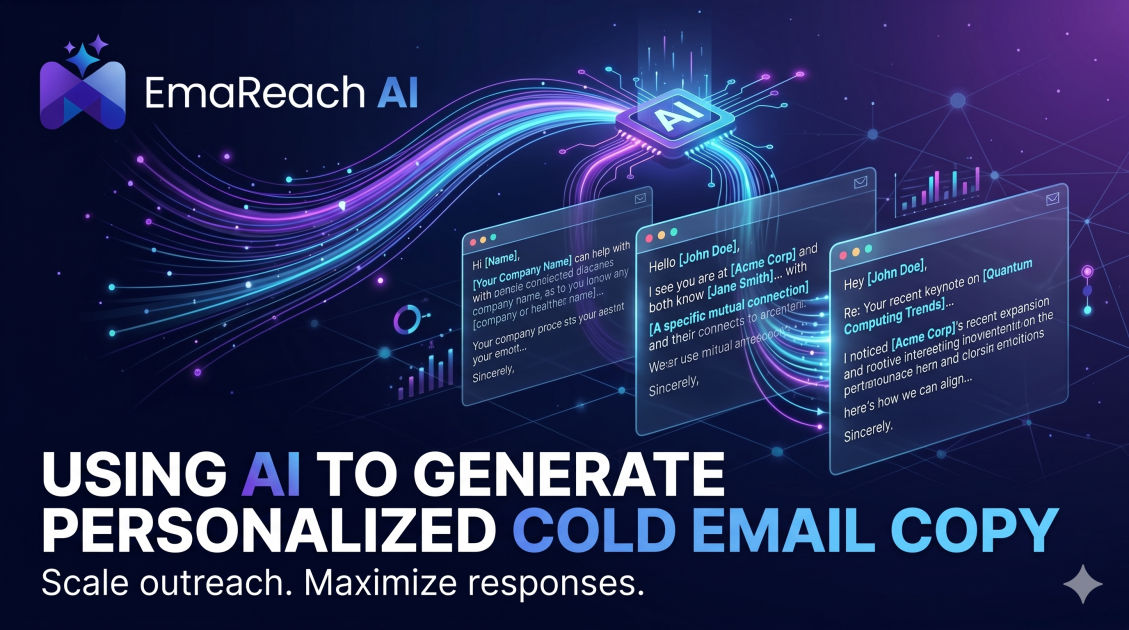
Using AI to Generate Personalized Cold Email Copy
cold emailai copywritingemail personalizationoutreach strategiesemail deliverabilitysales automation
Introduction
The landscape of cold email outreach has undergone a profound transformation. Gone are the days when a marketer could indiscriminately blast thousands of identical emails to an unvetted list and expect a meaningful return on investment. Modern prospects are inundated with sales pitches, their inboxes overflowing with generic requests for their time and attention. Consequently, their tolerance for poorly researched, irrelevant outreach is practically non-existent. To break through this noise, personalization is no longer a luxury; it is an absolute necessity.
However, genuine personalization at scale has historically presented a significant challenge. Crafting a highly targeted, bespoke email for every single prospect requires an immense investment of time and resources. This is where Artificial Intelligence steps in, revolutionizing the way sales and marketing professionals approach outbound campaigns. By leveraging the power of advanced language models, businesses can now generate personalized cold email copy that resonates deeply with individual recipients, all while maintaining the efficiency and scale required for a successful outbound engine. This comprehensive guide explores the strategies, methodologies, and technical nuances of using AI to craft cold email copy that not only captures attention but drives conversions.
The Shift from Mass Blasts to Hyper-Personalization
Why Generic Cold Emails Fail
The traditional "spray and pray" methodology is inherently flawed in the modern digital ecosystem. When an email lacks specific relevance to the recipient's current challenges, industry, or company goals, it triggers immediate resistance. Prospects can spot a template from a mile away. Generic opening lines like "I hope this email finds you well" or "I noticed your company is doing great things" are immediate red flags indicating a lack of genuine effort.
Furthermore, mass blasts severely damage sender reputation. Email service providers have become incredibly sophisticated at identifying and filtering bulk, unsolicited emails that generate low engagement. When a high percentage of your emails are ignored, deleted without opening, or marked as spam, your domain's credibility plummets, ensuring future emails never even see the primary inbox.
The Rise of AI in Outreach
Artificial Intelligence fundamentally changes the unit economics of personalization. In the past, a sales development representative might spend fifteen minutes researching a prospect to write one personalized email. Today, AI can ingest vast amounts of unstructured data—from a prospect's recent LinkedIn posts and company news mentions to their organization's quarterly earnings reports—and synthesize this information into a highly contextualized email draft in a matter of seconds.
This capability allows teams to maintain high volume without sacrificing the quality and relevance that drive replies. AI does not simply fill in blank spaces in a template; it understands context, sentiment, and nuance, generating unique copy that speaks directly to the recipient's unique pain points and aspirations.
Core Principles of AI-Powered Email Copywriting
1. Data Ingestion: The Foundation of Personalization
The quality of the AI's output is intrinsically linked to the quality of the data it receives. Generating truly personalized copy requires feeding the AI model with rich, relevant information about the prospect. This data can be categorized into three main tiers:
- Firmographic Data: Information about the prospect's company, such as industry, size, location, and recent funding rounds.
- Demographic Data: Information about the individual, such as their role, tenure, and professional background.
- Psychographic and Intent Data: The most crucial tier for hyper-personalization. This includes recent content they have shared, events they have attended, software their company uses, or specific challenges their industry is facing.
2. Identifying the Right Hooks
A "hook" is the angle or specific piece of information used to capture the prospect's attention in the opening sentences of the email. AI excels at analyzing prospect data to identify these hooks. For example, if a prospect recently published an article about the challenges of remote team management, the AI can recognize this as a high-value hook and construct an opening line that directly references the article and offers a relevant insight or solution.
3. Crafting the Perfect Opening Line
The subject line gets the email opened, but the opening line determines whether it gets read. AI can be trained to generate opening lines that are concise, highly specific, and focused entirely on the prospect rather than the sender. A strong opening line should immediately establish why you are reaching out to this specific person at this specific time, demonstrating that you have done your homework.
Step-by-Step Guide: Using AI to Generate Cold Email Copy
Step 1: Defining Your Ideal Customer Profile (ICP)
Before engaging with any AI tools, you must have a crystalline understanding of your Ideal Customer Profile. The AI needs parameters. You must define the specific industries, company sizes, and job titles you are targeting, as well as the overarching pain points those individuals typically face. Without a clearly defined ICP, the AI's outputs will lack direction and focus.
Step 2: Extracting Meaningful Intent Data
Once your ICP is established, the next step is gathering the data that will fuel the AI's personalization engine. This involves using scraping tools, intent data providers, and social listening platforms to aggregate relevant information about your target list. This raw data—whether it is a list of recent hires, a change in technology stack, or a specific regulatory challenge in their sector—must be formatted cleanly so the AI can process it efficiently.
Step 3: Engineering the Perfect AI Prompt
Prompt engineering is arguably the most critical skill in AI-powered copywriting. You cannot simply ask the AI to "write a cold email to John Smith." You must provide detailed instructions, context, and constraints. A robust prompt should include:
- The Persona: Instruct the AI on the tone and voice it should adopt (e.g., authoritative, consultative, concise).
- The Goal: Clearly state the objective of the email (e.g., booking a brief introductory call, sharing a specific piece of collateral).
- The Context: Feed the AI the specific prospect data gathered in Step 2.
- The Value Proposition: Explain exactly how your product or service solves the prospect's presumed pain point.
- The Constraints: Provide strict rules regarding word count, paragraph length, and the prohibition of cliches or jargon.
Step 4: Iteration and A/B Testing
AI is not a set-it-and-forget-it solution. The first iteration of the copy may not be the most effective. It is vital to generate multiple variations of the email copy, experimenting with different angles, subject lines, and calls to action. By systematically A/B testing these variations and analyzing the resulting open and reply rates, you can continually refine your prompts and improve the AI's output over time.
EmaReach Integration for Ultimate Deliverability
Even the most brilliantly crafted, AI-personalized email is entirely useless if it lands in the spam folder. Personalization only drives revenue when it achieves inbox placement. This is where infrastructure matters just as much as copy.
"Stop Landing in Spam. Cold Emails That Reach the Inbox." EmaReach AI combines AI-written cold outreach with inbox warm-up and multi-account sending—so your emails land in the primary tab and get replies. By utilizing a platform like EmaReach (https://www.emareach.com/), you ensure that the highly personalized copy generated by your AI workflows is supported by robust deliverability protocols. The integration of automated warm-up processes and intelligent sending patterns protects your domain reputation, ensuring your perfectly tailored message actually reaches the prospect's eyes.
Balancing Automation with the Human Touch
Reviewing and Refining AI Outputs
While AI can handle the heavy lifting of research and drafting, human oversight remains indispensable. Automation should augment human intelligence, not replace it entirely. Before a campaign goes live, especially when targeting high-value enterprise accounts, a human operator must review the AI-generated copy. This review process ensures that the tone is appropriate, the logical flow is sound, and the personalization does not cross the line into being overly intrusive.
Avoiding the "Uncanny Valley" of Automation
There is a phenomenon in automated outreach where an email is personalized, but the phrasing feels slightly unnatural or robotic—the "uncanny valley" of cold email. This often occurs when the AI stitches together disparate pieces of data without fully understanding the underlying context. Human review is crucial to smooth out these rough edges, ensuring the email reads as though it was written by a thoughtful peer rather than a machine.
The Technical Side of Cold Email Deliverability
Sender Reputation and Domain Warm-up
As mentioned, deliverability is paramount. Before sending out thousands of AI-generated emails, you must establish a strong sender reputation. This involves technical setup procedures like configuring SPF, DKIM, and DMARC records correctly. Furthermore, domain warm-up is critical. You cannot buy a new domain and immediately start sending hundreds of emails a day. The volume must be gradually increased over weeks, simulating natural human sending behavior, to build trust with email service providers.
Structuring the Email Body to Avoid Spam Filters
Beyond the technical setup, the actual content of your email impacts deliverability. Spam filters aggressively scan for specific triggers. Heavy use of images, complex HTML formatting, and multiple links can all degrade your sender score. Furthermore, certain words and phrases (often related to exaggerated financial claims or aggressive sales urgency) are notorious for triggering spam flags. AI must be explicitly instructed to avoid these pitfalls, focusing on plain-text formats, minimal linking, and natural, conversational language.
Advanced Strategies for AI Cold Emailing
Leveraging Multi-Channel Context
The most sophisticated outreach campaigns do not rely on email alone. They integrate multiple channels, such as LinkedIn and phone calls, to create a cohesive prospect experience. AI can be used to analyze a prospect's activity across these different platforms to create a unified strategy. For example, the AI might generate an email that specifically references a comment the prospect made on a LinkedIn post a few days prior, creating a seamless transition between channels.
Event-Based Triggers
Instead of relying on static lists, advanced AI campaigns are highly dynamic, responding to real-time events. By integrating AI with data enrichment tools, you can set up workflows that automatically trigger a personalized email when a specific event occurs—such as a company announcing a new executive hire, securing a round of funding, or launching a new product. This ensures your outreach is always timely and highly relevant.
Common Pitfalls to Avoid When Using AI for Cold Emails
Relying Too Heavily on Templates
One of the most frequent mistakes is using AI merely to fill in custom variables within a rigid, pre-written template. This completely defeats the purpose of generative AI. To see real results, the AI must be given the freedom to restructure sentences, choose different value propositions, and alter the flow of the email based on the specific prospect data.
Overcomplicating the Pitch
Because AI models have access to vast vocabularies and complex sentence structures, there is a tendency for generated copy to become overly dense and academic. A cold email is not a white paper. It must be easily skimmable. Ensure your prompts strictly enforce brevity, short paragraphs, and a conversational, B2B tone. If a prospect has to read a sentence twice to understand the value proposition, the email has failed.
Neglecting the Follow-Up
A single touchpoint is rarely sufficient to generate a meeting. AI should be utilized not just for the initial outreach, but for crafting a strategic follow-up sequence. Subsequent emails should not merely say "checking in," but should provide additional, distinct pieces of value—such as a relevant case study, a quick tip, or a link to a helpful resource. The AI can help diversify these follow-ups, ensuring the sequence remains engaging over time.
Measuring Success and Optimizing Campaigns
Tracking the Right Metrics
To determine the efficacy of your AI-generated copy, you must rigorously track performance metrics. While open rates provide some indication of subject line effectiveness and overall deliverability, the most critical metrics are reply rate and meeting booked rate. A high open rate combined with a low reply rate often indicates that the subject line was compelling, but the AI-generated body copy failed to resonate or provide a clear call to action.
Continuous Improvement Loops
The final step in mastering AI cold email copy is establishing a feedback loop. When a particular type of prompt or personalization angle yields a significantly higher reply rate, that information must be fed back into the system. Analyze the successes, codify the patterns, and continuously update your prompt library. The landscape of outbound sales is constantly shifting, and your AI strategies must evolve dynamically to maintain peak performance.
Conclusion
The integration of Artificial Intelligence into outbound email strategies represents a paradigm shift for sales and marketing professionals. By moving away from generic templates and embracing data-driven hyper-personalization, businesses can dramatically improve their outreach efficacy, forging genuine connections with prospects at scale. Mastering this approach requires a delicate balance: leveraging the computational power of AI to synthesize data and generate customized copy, while maintaining the critical human oversight necessary to ensure authenticity, strategic alignment, and empathetic communication. When executed correctly, with a strong foundation in both prompt engineering and deliverability infrastructure, AI-powered cold emailing ceases to be a mere volume game and becomes a precise, high-converting revenue engine.
EmaReach AI
Ready to scale your cold email outreach?
Join thousands of teams using EmaReach AI for AI-powered campaigns, domain warmup, and 95%+ deliverability. Start free — no credit card required.
Related posts
- Read article
The Instantly Alternative That Finally Gets Outbound Analytics Right
Discover why high-volume cold email requires a shift from surface-level vanity metrics to deep, data-driven revenue attribution, and explore the ultimate alternatives for mastering outbound engineering.
- Read article
What You Gain and What You Give Up When Switching From Instantly
Thinking about migrating your cold email stack? This detailed guide breaks down the exact operational advantages you gain and the core features you sacrifice when switching away from Instantly's popular outreach platform.