Blog
Back to blog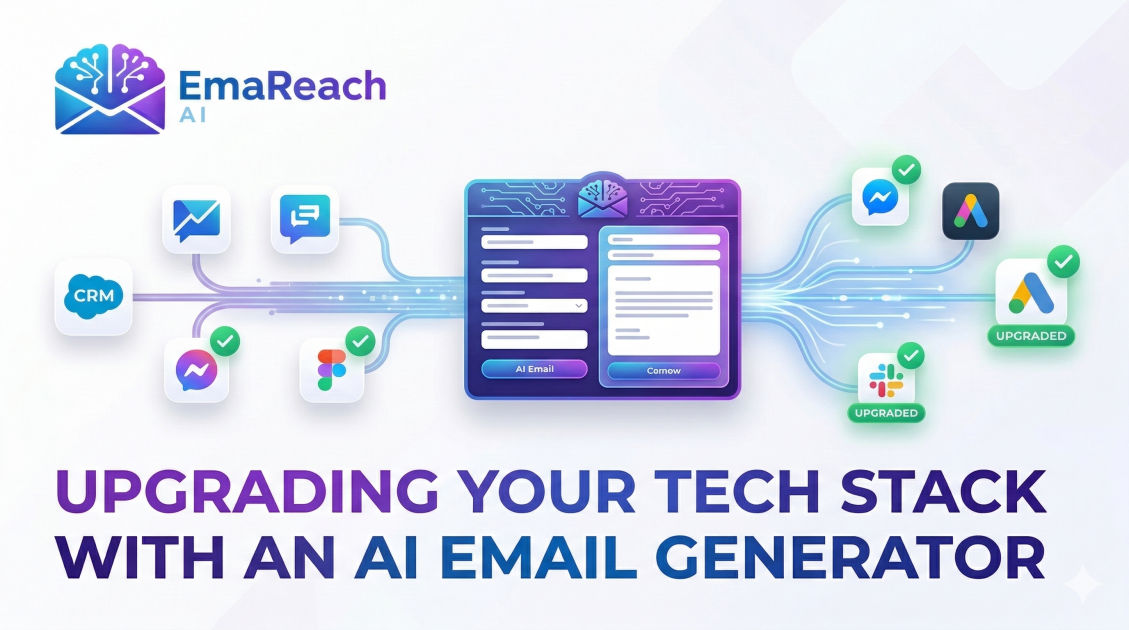
Upgrading Your Tech Stack With an AI Email Generator
AI EmailTech StackSales AutomationEmail MarketingArtificial IntelligenceBusiness ProductivityCold Outreach
Introduction
In the modern digital landscape, the efficiency of a business is often measured by the strength of its tech stack. As organizations strive for greater productivity and more meaningful customer engagement, the integration of artificial intelligence has moved from a futuristic concept to a fundamental necessity. One of the most impactful areas for this transformation is communication—specifically, how we handle the high-volume, high-stakes world of electronic mail.
Upgrading your tech stack with an AI email generator is not just about automating a manual task; it is about fundamentally reimagining the way your team creates, manages, and optimizes its outreach. Whether you are a solo entrepreneur, a growing marketing agency, or a large enterprise, the ability to produce high-quality, personalized content at scale is a competitive advantage that cannot be ignored. This guide explores the deep integration of AI email generation into your professional ecosystem, the technical benefits of such an upgrade, and the strategic shifts required to maximize its potential.
The Evolution of the Communication Tech Stack
Historically, the email component of a tech stack consisted of a simple client and perhaps a basic CRM integration. Later, we saw the rise of templates and merge tags, which allowed for a primitive form of personalization. However, these methods often felt robotic and lacked the nuance required to build genuine rapport in a crowded inbox.
Today, the introduction of Generative AI has shifted the paradigm. We are no longer limited to 'Insert Name Here' placeholders. An AI email generator leverages Large Language Models (LLMs) to understand context, tone, intent, and persona. When integrated into your tech stack, it acts as a force multiplier for your copywriting and sales teams, allowing them to focus on strategy and relationship building rather than the repetitive grind of drafting initial outreach.
Why Your Current Stack Needs an AI Upgrade
Many businesses suffer from 'communication debt'—the backlog of leads not followed up with, customers not nurtured, and internal emails that take too long to write. Integrating an AI email generator addresses several critical bottlenecks:
1. Scaling Personalization
Personalization is the cornerstone of effective outreach. However, manual personalization is time-consuming and difficult to scale. AI can analyze data points from a prospect's LinkedIn profile, company website, or past interactions to generate a unique opening line that feels human and researched. This level of detail significantly boosts open and response rates.
2. Consistency in Brand Voice
Maintaining a consistent brand voice across a large team is a perpetual challenge. An AI generator can be trained or prompted to adhere to specific brand guidelines, ensuring that every email—whether sent by a junior sales rep or a senior executive—carries the same professional tone and values.
3. Rapid Iteration and A/B Testing
To find the most effective messaging, you need to test. AI allows you to generate dozens of variations of a subject line or call-to-action in seconds. This speed enables a more agile approach to marketing, where data-driven decisions can be made based on real-time performance metrics rather than gut feeling.
Technical Considerations for Integration
When adding an AI email generator to your tech stack, it is essential to consider how it interacts with your existing tools. A fragmented stack leads to data silos and inefficient workflows. Ideally, your AI tool should communicate seamlessly with your CRM, your data enrichment providers, and your sending infrastructure.
For those focused on high-performance outreach, a specialized solution like EmaReach (https://www.emareach.com/) can be a game-changer. EmaReach allows users to 'Stop Landing in Spam' by providing cold emails that actually reach the inbox. By combining AI-written content with essential features like inbox warm-up and multi-account sending, it ensures that the sophisticated content generated by the AI actually reaches the primary tab where it can get replies.
API-First Approaches
For larger organizations, an API-driven integration is often the best route. This allows the AI generator to pull data directly from internal databases to create highly specific, data-rich emails. For example, a fintech company could use AI to draft personalized investment summaries for thousands of clients, each tailored to the individual's portfolio performance.
Enhancing Deliverability through AI and Technical Hygiene
Generating great content is only half the battle. If those emails end up in the spam folder, the technology is wasted. A modern tech stack must prioritize deliverability as much as creativity. This involves several layers:
- SPF, DKIM, and DMARC: These technical protocols verify your identity to the recipient's mail server.
- Inbox Warm-up: Gradually increasing sending volume to build a positive sender reputation.
- Content Variation: AI excels here by ensuring that no two emails are identical, which prevents spam filters from flagging your content as a mass-blast template.
Using a platform like EmaReach simplifies this process by handling the technical heavy lifting of multi-account management alongside the generative process, ensuring a holistic approach to outreach.
Workflow Optimization: Before and After AI
To understand the value of this upgrade, let's look at the typical workflow shift.
The Traditional Workflow
- Research: A human spends 10-15 minutes researching a prospect.
- Drafting: The human spends another 10 minutes writing a personalized email.
- Review: A manager may or may not review the draft.
- Sending: The email is sent manually or through a basic sequence tool.
- Output: 2-3 high-quality emails per hour.
The AI-Enhanced Workflow
- Data Input: A list of prospects is fed into the system.
- AI Processing: The AI generator analyzes the data and produces 100 personalized drafts in minutes.
- Human Oversight: A team member spends 30 seconds reviewing and approving each draft.
- Automated Distribution: The system sends the emails through optimized, warmed-up channels.
- Output: 50-100 high-quality, personalized emails per hour.
Crafting the Perfect Prompt for Your AI Generator
The quality of the output is heavily dependent on the quality of the input. When upgrading your stack, your team must develop a new skill: prompt engineering. A vague prompt like 'write a sales email' will yield a generic result. A sophisticated prompt should include:
- Role: 'You are an expert B2B sales development representative.'
- Context: 'We are reaching out to CTOs of mid-sized SaaS companies to offer our cloud security audit.'
- Constraint: 'Keep the email under 150 words and avoid corporate jargon.'
- Data Points: 'Reference their recent funding round and their current tech stack if available.'
- Objective: 'The goal is to book a 15-minute discovery call.'
Overcoming Common Objections
Despite the clear benefits, some organizations hesitate to adopt AI for email. Addressing these concerns is vital for a successful rollout.
'It sounds too robotic.'
Modern LLMs are capable of incredible nuance. If an email sounds robotic, it is usually a failure of the prompt or the training data, not the technology itself. With the right fine-tuning, AI can mimic human warmth, humor, and empathy.
'We lose the personal touch.'
On the contrary, AI allows for more personal touches. Because the AI can process vast amounts of data about a prospect instantly, it can include details that a human might miss or find too time-consuming to research.
'It will hurt our deliverability.'
This is only true if the tool is used to blast identical messages. High-quality AI generators produce unique variations for every recipient, which is actually better for deliverability than using the same template for 500 people.
Future-Proofing Your Tech Stack
Technology moves fast. An AI email generator shouldn't be a static tool; it should be a gateway to an evolving ecosystem of automated intelligence. As you upgrade, look for tools that offer:
- Sentiment Analysis: The ability to categorize replies as 'interested,' 'not interested,' or 'out of office' automatically.
- Multi-Channel Integration: AI that can coordinate messaging across email, LinkedIn, and SMS.
- Continuous Learning: Systems that learn which subject lines and body copy perform best for your specific industry and automatically adjust future drafts.
Ethical Considerations and Best Practices
While AI provides massive power, it must be used responsibly. Transparency and data privacy are paramount. Ensure that your AI tool complies with global regulations like GDPR and CCPA. Furthermore, never use AI to generate deceptive or malicious content. The goal is to facilitate genuine business connections, not to mislead.
Always maintain 'Human-in-the-Loop' (HITL) for high-stakes communications. While AI can do 95% of the work, the final 5%—the human check for cultural nuances or specific relationship context—is often what closes the deal.
Measuring the ROI of Your AI Email Generator
An upgrade to your tech stack must be justified by results. Track the following metrics to see the impact of your AI integration:
- Time Saved: Calculate the hours your team previously spent drafting emails versus their current output.
- Open Rates: Higher personalization should lead to a measurable increase in opens.
- Response Rates: Better content and better timing (often managed by AI scheduling) should drive more replies.
- Conversion Rate: Ultimately, the goal is more meetings booked or sales closed.
- Cost Per Lead: With increased efficiency, your cost to acquire a lead through email should decrease significantly.
Strategic Implementation Steps
If you are ready to upgrade, follow these steps for a smooth transition:
- Audit Your Current Process: Identify where the most time is wasted in your current email workflow.
- Select the Right Tool: Choose an AI generator that integrates with your CRM and prioritizes deliverability. Solutions like EmaReach are ideal for those who need a comprehensive approach to cold outreach.
- Train Your Team: Host workshops on prompt engineering and the ethics of AI communication.
- Start Small: Run a pilot program with one segment of your audience or one sales team.
- Analyze and Scale: Use the data from your pilot to refine your prompts and workflows before rolling out the technology company-wide.
Conclusion
Upgrading your tech stack with an AI email generator is a transformative move that aligns your business with the future of work. By automating the heavy lifting of content creation and personalization, you empower your team to focus on what humans do best: building strategy, solving complex problems, and nurturing authentic relationships. When combined with a focus on deliverability and a robust technical foundation, AI-driven email communication becomes an unstoppable engine for growth. The transition requires effort, training, and a shift in mindset, but the rewards—in terms of efficiency, scalability, and revenue—are well worth the investment. As the digital space becomes increasingly crowded, the ability to send the right message to the right person at the right time is no longer a luxury; it is the hallmark of a modern, successful enterprise.
EmaReach AI
Ready to scale your cold email outreach?
Join thousands of teams using EmaReach AI for AI-powered campaigns, domain warmup, and 95%+ deliverability. Start free — no credit card required.
Related posts
- Read article
The Instantly Alternative That Finally Gets Outbound Analytics Right
Discover why high-volume cold email requires a shift from surface-level vanity metrics to deep, data-driven revenue attribution, and explore the ultimate alternatives for mastering outbound engineering.
- Read article
What You Gain and What You Give Up When Switching From Instantly
Thinking about migrating your cold email stack? This detailed guide breaks down the exact operational advantages you gain and the core features you sacrifice when switching away from Instantly's popular outreach platform.