Blog
Back to blog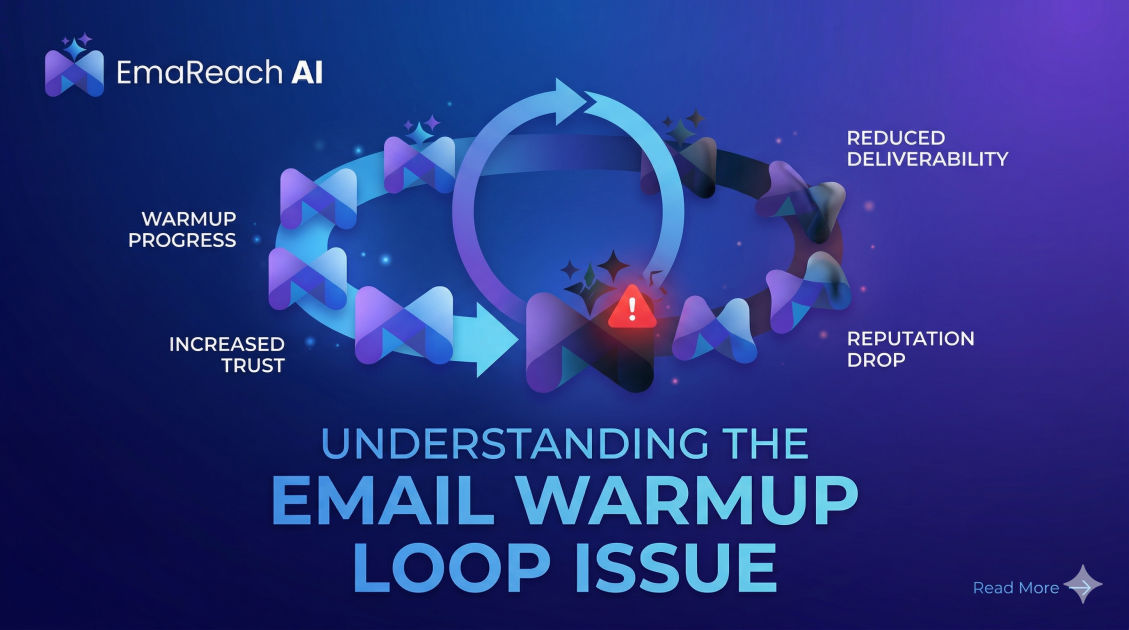
Understanding the Email Warmup Loop Issue
email warmupdeliverabilitycold emailspam filtersoutreachsender reputation
Introduction
In the highly competitive landscape of digital outreach, ensuring your messages actually reach your prospect's primary inbox is half the battle. For years, sales professionals, marketers, and agency owners have relied on a strategy known as "email warmup" to build trust with major Email Service Providers (ESPs). The premise is simple: before sending thousands of cold emails, a new domain or email account must gradually establish a positive sender reputation by sending and receiving emails in small, incrementally increasing volumes.
However, as the algorithms governing email deliverability have become significantly more sophisticated, a critical problem has emerged: the email warmup loop issue. This phenomenon occurs when automated warmup networks essentially trap your domain in an artificial echo chamber of synthetic engagement, ultimately doing more harm than good to your deliverability rates.
Understanding the email warmup loop issue is vital for anyone relying on outbound email campaigns. Failing to recognize the signs of this problem can lead to a false sense of security, shadowbanned domains, and perfectly crafted pitches languishing in the spam folder. This comprehensive guide explores the mechanics of email deliverability, the rise of automated warmup networks, the core issues creating the warmup loop, and actionable strategies to maintain a pristine sender reputation.
The Fundamentals of Email Deliverability
Before diving into the complexities of the warmup loop, it is essential to understand how email deliverability actually works. Deliverability is not merely the act of an email successfully leaving your server; it is the science of ensuring that email is accepted by the recipient's server and placed directly into the primary inbox, rather than the promotional tab or the spam folder.
Email Service Providers utilize highly complex, machine-learning-driven algorithms to protect their users from spam, phishing, and unwanted solicitations. These algorithms evaluate every incoming message based on hundreds of different data points, which generally fall into two main categories: technical authentication and sender reputation.
Technical Authentication
Technical authentication acts as the digital ID card for your domain. It proves to the receiving server that you are who you claim to be and that your message has not been tampered with in transit. The core pillars of technical authentication include:
- SPF (Sender Policy Framework): A DNS record that specifies exactly which IP addresses and services are authorized to send emails on behalf of your domain.
- DKIM (DomainKeys Identified Mail): A cryptographic signature attached to your emails that ensures the content has not been altered after it was sent.
- DMARC (Domain-based Message Authentication, Reporting, and Conformance): A policy that tells receiving servers what to do if an email fails SPF or DKIM checks, providing an essential layer of domain protection.
Sender Reputation
While technical authentication proves your identity, sender reputation proves your trustworthiness. ESPs assign a dynamic reputation score to both your domain and your sending IP address. This score fluctuates based on the historical behavior associated with your emails. Positive signals include high open rates, frequent replies, messages being forwarded, and users rescuing your emails from the spam folder. Conversely, negative signals—such as high bounce rates, spam complaints, and deleting emails without opening them—will rapidly degrade your reputation.
The Concept of Email Warmup Explained
When you purchase a brand new domain and set up a new email workspace, your sender reputation is completely neutral. You have no history, good or bad. If you immediately blast thousands of cold emails from this fresh domain, ESPs will instantly flag the behavior as suspicious. Spammers frequently burn through new domains to send unsolicited mail, so sudden spikes in volume from an unknown sender trigger immediate red flags.
Email warmup is the intentional process of gradually building a positive sender reputation. Traditionally, this involved sending a handful of emails to trusted colleagues or existing clients, asking them to open the emails, reply to them, and mark them as "not spam" if necessary. Day by day, the sender would slowly increase the volume of outgoing emails. This gradual ramp-up mimics the natural behavior of a legitimate business establishing its communication channels, earning the trust of the ESP algorithms.
The Rise of Automated Warmup Networks
As cold email outreach scaled, the manual process of warming up inboxes became a severe bottleneck. To solve this, developers created automated email warmup tools. These platforms utilized peer-to-peer networks, pooling together thousands of user inboxes from around the world.
When you connect your email account to one of these networks, the tool automatically sends emails from your account to other users in the pool. Simultaneously, it uses their accounts to open your emails, mark them as important, and generate AI-written replies. In return, your account does the exact same thing for others.
Initially, this peer-to-peer automation worked flawlessly. Users could simply flip a switch, and the software would generate perfect engagement metrics, shielding their domains from spam filters and allowing them to scale their cold outreach efforts effortlessly. However, the cat-and-mouse game between marketers and ESPs never stops, leading us directly to the core of the problem.
What is the Email Warmup Loop Issue?
The email warmup loop issue occurs when automated peer-to-peer networks become isolated ecosystems of synthetic engagement that are easily identifiable by modern spam filters.
As these warmup tools grew in popularity, the sheer volume of automated emails passing through major ESP networks skyrocketed. ESPs, whose primary goal is to protect the user experience, began analyzing these traffic patterns. They quickly realized that a significant portion of "highly engaged" email traffic was actually just bots talking to other bots in a closed loop.
The Echo Chamber Effect
In a warmup loop, Account A sends a message to Account B. Account B automatically opens it, waits a predetermined number of milliseconds, and fires back a generic, AI-generated reply. Account A receives the reply, marks it as read, and perhaps moves it to a special folder.
Because this network is closed, these accounts rarely interact with real human beings outside of the pool in a meaningful way. The engagement is exceptionally high within the network, but it completely lacks the natural variance and behavioral entropy of genuine human communication.
Identifying the Synthetic Signature
Modern deliverability algorithms do not just look at simple metrics like open rates and reply rates anymore; they analyze the quality and context of the engagement. The warmup loop creates a distinct digital footprint—a synthetic signature—that ESPs can detect with terrifying accuracy.
ESPs identify the warmup loop through several advanced detection methods:
- Predictable Sending Patterns: Warmup bots often operate on predictable cron jobs or schedules. If an account consistently sends exactly 40 emails distributed evenly over an 8-hour period every single day, it lacks the chaotic sending patterns of a real human.
- Homogeneous Content: Even with AI generation, the text produced by warmup tools often falls into recognizable linguistic patterns. The phrasing, sentence structure, and vocabulary can trigger content filters when analyzed at scale.
- Unnatural Interaction Speeds: Humans take time to read emails, scroll, click links, and type replies. Bots interact with APIs. Even when developers program "delays" to mimic human reading times, the exact precision of these delays across thousands of accounts becomes a recognizable footprint.
- The "Cluster" Phenomenon: ESPs map the relationships between email accounts. If an algorithm notices that your account only receives replies from a specific cluster of other accounts that exhibit bot-like behavior, your domain is categorized as part of that automated network.
The Consequences of the Warmup Loop
Falling victim to the email warmup loop issue is particularly dangerous because it creates a massive discrepancy between your perceived sender reputation and your actual deliverability.
The False Sense of Security
When you check the dashboard of a traditional warmup tool, everything looks perfect. The dashboard proudly displays a 100% deliverability rate, massive open rates, and a flawless reply ratio. You assume your domain is perfectly primed for outreach.
However, when you launch your actual cold email campaign targeting real prospects outside of the warmup pool, the results are abysmal. Your open rates flatline, and replies are non-existent. This happens because the ESPs have essentially quarantined your domain. They allow your automated warmup emails to bypass filters because they recognize it is just bot-to-bot chatter, but the moment you try to email a genuine user, the algorithm drops your message directly into the spam folder.
Domain and IP Penalties
Continued participation in recognizable warmup loops can lead to severe penalties. ESPs may silently throttle your sending limits, shadowban your domain (where messages appear to send but never arrive), or permanently blacklist your domain. Recovering a domain that has been penalized for using synthetic engagement tactics is an incredibly difficult and time-consuming process.
Diagnosing the Loop Issue in Your Infrastructure
Identifying whether your outreach efforts are trapped in a warmup loop requires careful monitoring and a shift in how you analyze your metrics. Here are the key warning signs:
- The Metric Disconnect: The most obvious sign is a glaring difference between your warmup metrics and your campaign metrics. If your warmup tool reports a 95% inbox placement rate, but your real campaigns are struggling to hit a 10% open rate, you are likely in a loop.
- Sudden Drop in Live Engagement: If you have been running successful campaigns and suddenly experience a sharp, sustained drop in open rates and replies, while your warmup metrics remain perfectly steady, ESP algorithms may have just updated to detect your specific warmup network.
- Negative Postmaster Data: Tools like Google Postmaster provide direct insight into how your domain is viewed. If your domain reputation suddenly shifts from "High" to "Medium" or "Low" despite running a warmup tool, the synthetic engagement is actively harming you.
- Zero Real-World Replies: If the only replies you are getting in your inbox are the nonsensical, AI-generated responses from your warmup tool, and you are receiving absolutely zero objections, out-of-office replies, or positive responses from actual prospects, your campaigns are landing in spam.
Breaking Free: Modern Solutions to Overcome Deliverability Hurdles
Escaping the warmup loop and ensuring long-term deliverability requires abandoning outdated, closed-loop networks and embracing smarter, more holistic outreach strategies. The goal is no longer to trick the algorithms with synthetic volume, but to align your sending practices with what ESPs actually want: relevant, engaging, and targeted communication.
To truly solve the deliverability puzzle, you need infrastructure that blends smart automation with authentic sending practices. This is where advanced platforms become necessary. EmaReach is designed specifically to address these modern challenges. Stop Landing in Spam. Cold Emails That Reach the Inbox. EmaReach AI combines AI-written cold outreach with inbox warm-up and multi-account sending—so your emails land in the primary tab and get replies. By leveraging intelligent multi-account distribution, you can spread your sending volume across multiple healthy domains, mitigating the risk of triggering spam filters through unnatural volume spikes on a single account.
Best Practices for Authentic Deliverability
Beyond utilizing the right platforms, maintaining a stellar sender reputation requires adherence to strict email best practices. Implementing the following strategies will ensure your domains remain healthy and your messages reach their intended targets.
1. Master Your List Hygiene
One of the fastest ways to destroy your sender reputation is by sending emails to invalid or inactive addresses. High bounce rates send a clear signal to ESPs that you are a spammer using scraped, unverified data. Always clean your prospect lists thoroughly before launching a campaign. Utilize email verification services to remove catch-all addresses, hard bounces, and known spam traps from your database.
2. Prioritize Hyper-Personalization
The antidote to the synthetic footprint of the warmup loop is genuine human engagement. ESPs reward senders who generate real replies. To get real replies, you must send highly relevant, personalized content. Move beyond simple mail-merge tags like inserting a first name or company name. Use deep research to craft messages that speak directly to the prospect's specific pain points, recent company news, or industry trends. When recipients genuinely engage with your content, it provides the strongest possible positive signal to the deliverability algorithms.
3. Implement Gradual, Organic Ramp-Up
If you are launching a new domain, do not rely on a warmup tool to do all the heavy lifting. Start by using the new email address for genuine, day-to-day business communication. Subscribe to relevant industry newsletters to establish a natural cadence of incoming mail. When you do begin cold outreach, start with a remarkably low volume—perhaps 10 to 15 highly targeted emails per day. Slowly and organically increase this volume over several weeks based on the positive engagement you receive from real prospects.
4. Monitor Blacklists and Postmaster Data Relentlessly
Deliverability is not a set-it-and-forget-it task; it requires constant vigilance. Regularly check your sending IPs and domains against major blacklists. Monitor your Google Postmaster and Microsoft SNDS (Smart Network Data Services) accounts daily to track your reputation scores and spam complaint rates. Catching a downward trend early allows you to pause campaigns, investigate the root cause, and pivot your strategy before irreversible damage is done.
5. Utilize Plain Text and Limit Links
Heavy HTML templates, excessive images, and multiple links are classic hallmarks of promotional emails and spam. To maximize your chances of landing in the primary inbox, format your cold outreach to look exactly like an email you would quickly type out to a colleague. Use plain text formatting, keep your signature minimalist, and restrict yourself to a single, highly relevant link—or better yet, omit links entirely in your initial outreach and ask for permission to share resources.
Conclusion
The email warmup loop issue represents a critical turning point in the world of cold outreach. Relying on isolated pools of synthetic engagement to trick advanced machine-learning algorithms is no longer a viable long-term strategy. ESPs have grown too sophisticated, and the penalties for getting caught in an automated echo chamber are too severe. By understanding the mechanics behind these deliverability hurdles and prioritizing authentic, highly targeted engagement over artificial volume, you can protect your domain reputation. Success in modern email outreach belongs to those who adapt, combining intelligent infrastructure with genuinely valuable communication to consistently reach the primary inbox.
EmaReach AI
Ready to scale your cold email outreach?
Join thousands of teams using EmaReach AI for AI-powered campaigns, domain warmup, and 95%+ deliverability. Start free — no credit card required.
Related posts
- Read article
The Instantly Alternative That Finally Gets Outbound Analytics Right
Discover why high-volume cold email requires a shift from surface-level vanity metrics to deep, data-driven revenue attribution, and explore the ultimate alternatives for mastering outbound engineering.
- Read article
What You Gain and What You Give Up When Switching From Instantly
Thinking about migrating your cold email stack? This detailed guide breaks down the exact operational advantages you gain and the core features you sacrifice when switching away from Instantly's popular outreach platform.