Blog
Back to blog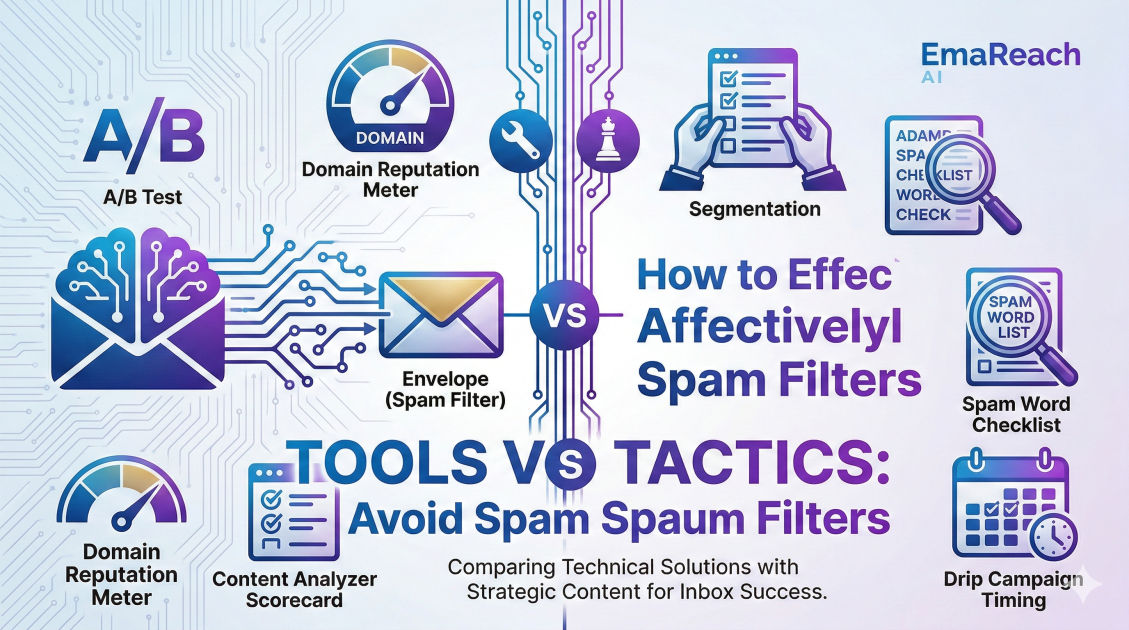
Tools vs Tactics: How to Effectively Avoid Spam Filters
email deliverabilityspam filterscold emailemail marketinginbox placementoutreach strategy
Introduction
In the high-stakes world of digital communication, the battle for the inbox is won or lost long before a recipient ever clicks 'open.' For businesses relying on email outreach, the spam filter is a silent gatekeeper that can either facilitate growth or stifle it entirely. As filters become more sophisticated, a common debate has emerged among marketers and sales professionals: which is more important—the tools you use or the tactics you employ?
The reality is that neither can survive without the other. High-end software cannot save a poorly executed strategy, and a brilliant strategy will fail if it is executed through a blacklisted server. Achieving consistent deliverability requires a harmonious balance between technical infrastructure (Tools) and human-centric execution (Tactics). This comprehensive guide explores how to navigate this dichotomy to ensure your messages land exactly where they belong: the primary inbox.
The Technical Foundation: Why Tools Matter
Before you can worry about the nuances of your copy, you must ensure that your 'postal service' is reliable. In email marketing, tools represent the infrastructure. This includes your sending platform, your domain health monitoring, and your authentication protocols.
Authentication Protocols: SPF, DKIM, and DMARC
If you aren't using the right tools to authenticate your emails, spam filters will mark you as a high-risk sender immediately. Think of these as the digital ID cards for your domain:
- SPF (Sender Policy Framework): A DNS record that specifies which mail servers are permitted to send email on behalf of your domain.
- DKIM (DomainKeys Identified Mail): Adds a cryptographic signature to your emails, verifying that the email was indeed sent by the domain owner and wasn't altered in transit.
- DMARC (Domain-based Message Authentication, Reporting, and Conformance): A policy that leverages SPF and DKIM to tell receiving servers how to handle emails that fail authentication.
Without tools to correctly configure and monitor these records, even the most personalized email will be discarded. Modern deliverability platforms provide automated checks to ensure these records are always active and valid.
The Role of Inbox Warm-up Tools
One of the biggest mistakes in email outreach is sending a high volume of messages from a fresh domain. To a spam filter, this looks like 'snowshoe spamming.' Tools designed for inbox warm-up solve this by gradually increasing sending volume and generating artificial engagement (opens and replies) to build a sender reputation.
For those serious about their outreach, EmaReach offers a powerful solution. EmaReach AI combines AI-written cold outreach with inbox warm-up and multi-account sending, ensuring your emails land in the primary tab rather than the promotions or spam folders. This is a prime example of how a tool provides the necessary shield for your tactics to succeed.
IP and Domain Reputation Monitoring
Your reputation is a score assigned by Internet Service Providers (ISPs). If you share an IP address with a spammer, your deliverability will suffer. Dedicated tools allow you to monitor blacklists and track your 'Sender Score.' If your domain lands on a list like Spamhaus or Barracuda, you need tools that alert you instantly so you can pause campaigns and remediate the issue.
The Art of Engagement: Why Tactics Rule
Once the technical infrastructure is set, the focus shifts to tactics. Spam filters are no longer just looking for keywords like 'Free' or 'Act Now.' They use advanced machine learning to analyze user behavior. If people consistently delete your emails without opening them, or worse, manually mark them as spam, your reputation will plummet regardless of your tools.
Segmentation and Relevancy
Tactics begin with who you are emailing. Blasting a list of 10,000 unverified leads is a tactic destined for the junk folder. Modern email success relies on hyper-segmentation.
Instead of one broad campaign, break your list into smaller groups based on industry, job title, or recent company news. When an email is highly relevant, the recipient is more likely to engage. High engagement signals to ISPs that you are a wanted sender, which creates a positive feedback loop for your deliverability.
Content and Copywriting Tactics
While 'spam words' aren't the only thing filters look for, they still matter. However, the tactic here is move beyond simple word avoidance and toward natural language processing (NLP) optimization.
- Avoid Excessive Links: Too many URLs in a first-touch email can trigger red flags.
- Balance Text-to-Image Ratio: Emails that are just one large image are a classic spammer tactic. Always prioritize plain-text or text-heavy HTML.
- Personalization at Scale: Using 'First_Name' tags is the bare minimum. True tactical excellence involves referencing specific details—a recent podcast appearance, a LinkedIn post, or a specific pain point unique to their role.
The Power of the Opt-Out
It may seem counterintuitive, but making it easy to unsubscribe is a vital tactic for avoiding spam filters. If a user can’t find the 'Unsubscribe' link, they will hit the 'Report Spam' button instead. The latter destroys your reputation; the former simply cleans your list. A clean list of engaged prospects is infinitely more valuable than a massive list of people who don't want to hear from you.
Tools and Tactics: The Synergy
To effectively avoid spam filters, you must stop viewing tools and tactics as separate entities. They are two sides of the same coin. Let’s look at how they interact in a real-world scenario.
Scenario: The Multi-Account Approach
The Tool: Using a platform that allows you to spread your sending volume across multiple email accounts (e.g., using five accounts to send 50 emails each, rather than one account sending 250).
The Tactic: Rotating your copy and subject lines (A/B testing) across these accounts to ensure that no single 'fingerprint' is identified by filters as repetitive spam.
By combining the tool (multi-account sending) with the tactic (content rotation), you minimize the risk of any single account being flagged. This is the core philosophy behind EmaReach, where AI-driven copy meets the technical rigor of multi-account management.
List Cleaning: A Joint Effort
The Tool: An email verification service that pings mail servers to see if an address exists without sending a physical email.
The Tactic: Implementing a 'double opt-in' process for newsletters or regularly purging 'ghost' subscribers who haven't opened an email in 90 days.
If you use the tool to clean your list but fail to use the tactic of purging unengaged users, your 'open rate' percentage will stay low, hurting your long-term reputation.
Advanced Strategies for the Modern Inbox
As we move deeper into the era of AI and advanced filtering, certain 'middle-ground' strategies have become essential. These sit right at the intersection of tools and tactics.
1. Plain Text vs. HTML
There is a long-standing debate about whether plain text emails perform better than designed HTML templates. From a tactical perspective, plain text feels more personal and 'human,' which often leads to higher reply rates. From a tool perspective, plain text is easier for filters to parse and less likely to contain 'broken' code that might look suspicious. For cold outreach, the best tactic is often to stick to plain text to mimic a 1-to-1 conversation.
2. Monitoring the 'Feedback Loop'
ISPs like Yahoo and Gmail offer 'Feedback Loops' (FBL). This is a tool provided by the providers themselves. The tactic is to actively monitor this data and immediately remove anyone who complains. Ignoring FBL data is the fastest way to get a permanent ban from major providers.
3. Subject Line Psychology
Avoid 'clickbait' at all costs. While a subject line like "URGENT: Your account is locked" might get a 90% open rate, the subsequent 'Report Spam' clicks from angry recipients will kill your domain. The tactic should be 'Curiosity + Relevancy.' Use tools to A/B test subject lines, but let human empathy guide the actual writing.
Common Pitfalls: Where Tools and Tactics Fail
Even with the best intentions, many fall into traps that land them in the spam folder. Understanding these failures helps in refining both your toolkit and your strategy.
Over-Reliance on Automation
Tools allow us to scale, but over-automation is a tactical death sentence. If your tool sends 500 emails at exactly 9:00 AM every Tuesday, it creates a pattern that is incredibly easy for filters to spot. The tactic should be to use 'jitter' or 'randomized sending' features within your tools to simulate human behavior.
Buying Email Lists
This is perhaps the greatest tactical error. No tool can 'clean' a purchased list well enough to make it safe. Purchased lists are often 'seeded' with spam traps—email addresses specifically designed to catch spammers. Once you hit a spam trap, your domain reputation is severely damaged. The only winning tactic is organic list building or highly targeted, one-to-one research.
Neglecting Technical Debt
Sometimes, a tool that worked a year ago becomes outdated. For example, if your sending platform doesn't support the latest encryption standards, your emails might be rejected by stricter corporate filters. Regularly auditing your 'tech stack' is a necessary tactic to ensure your tools remain effective.
The Checklist for Inbox Success
To ensure you are balancing both sides of the equation, use this checklist before launching any major campaign:
- Infrastructure Check (Tools): Are SPF, DKIM, and DMARC verified? Is the domain at least 30 days old and warmed up?
- List Integrity (Tactics): Has the list been cleaned for bounces? Is every recipient actually a fit for the offer?
- Content Audit (Tactics): Is the copy personalized beyond just a name? Are there fewer than two links?
- Volume Management (Tools): Is the sending volume distributed across accounts? Is there a random delay between sends?
- Engagement Monitoring (Tactics): Are we tracking replies, not just opens? Are we responding to every manual unsubscribe request immediately?
Conclusion
Avoiding spam filters is not a one-time setup; it is a continuous process of refinement. Tools provide the engine and the dashboard, but your tactics provide the steering. If you rely solely on tools, you become a robotic broadcaster that filters eventually catch. If you rely solely on tactics without the proper tools, your brilliant messages will never even reach the starting line.
By investing in robust infrastructure—like the multi-account and AI-driven capabilities found in EmaReach—and marrying it with a philosophy of relevance, empathy, and list hygiene, you can bypass the filters. The goal is no longer just to 'avoid spam,' but to be welcomed into the inbox as a valuable communicator. Focus on the synergy of your tools and your tactics, and your deliverability will follow.
EmaReach AI
Ready to scale your cold email outreach?
Join thousands of teams using EmaReach AI for AI-powered campaigns, domain warmup, and 95%+ deliverability. Start free — no credit card required.
Related posts
- Read article
What Makes the Right Instantly Alternative Worth the Migration Effort
Discover why upgrading your cold email infrastructure to the right Instantly alternative can dramatically improve your deliverability, scale your personalization, and future-proof your sales pipeline against strict spam filters.
- Read article
The Instantly Alternative That Wins for Teams With Strict IT Policies
Discover why traditional cold email tools fail strict IT security audits and explore the ultimate enterprise-grade alternative built for secure, compliant, and high-performance outbound sales teams.