Blog
Back to blog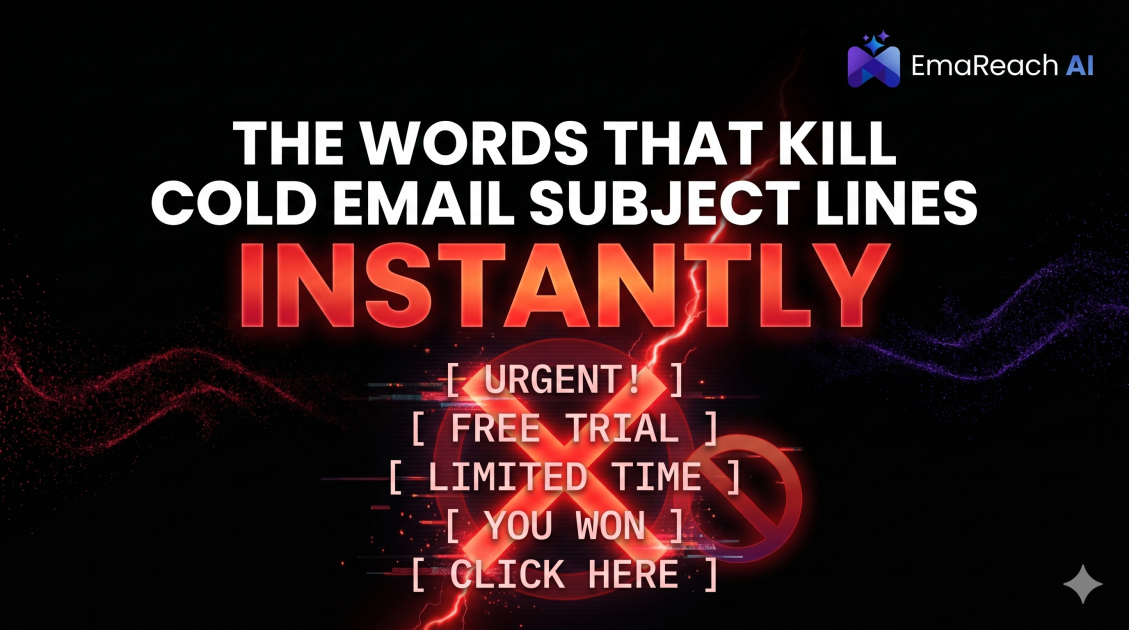
The Words That Kill Cold Email Subject Lines Instantly
cold emailemail marketingsales outreachdeliverabilitycopywritinglead generation
The Silent Saboteurs of Your Outreach Campaigns
You spend hours researching prospects, crafting the perfect value proposition, and fine-tuning your call to action. But if your subject line contains even one of the 'forbidden' words, your masterpiece might never be seen. In the high-stakes world of cold outreach, the subject line is the gatekeeper. It determines whether your email is opened, ignored, or—worse—sent straight to the spam folder.
Understanding the words that kill cold email subject lines instantly is about more than just avoiding 'spammy' language; it is about understanding human psychology and the sophisticated algorithms used by Email Service Providers (ESPs). To master the art of the inbox, you must learn to navigate the minefield of linguistic triggers that signal low value, desperation, or automated bulk mailing.
The Psychology of the 'Delete' Key
Before diving into the specific words, we must understand why certain terms cause such a visceral negative reaction. The modern professional receives dozens, if not hundreds, of cold emails every week. To survive this onslaught, the human brain develops a 'spam filter' of its own. We look for patterns that suggest an email is a mass-produced pitch rather than a 1-to-1 conversation.
When a recipient sees words like 'Free', 'Guaranteed', or 'Opportunity', their internal alarm bells go off. These words have been overused by low-quality marketers for decades, creating a Pavlovian response: see the word, hit delete. Your goal is to sound like a colleague or a trusted advisor, not a digital billboard.
Why ESPs Hate These Words
It isn't just humans you have to worry about. Google, Microsoft, and other providers use machine learning to scan subject lines for patterns associated with phishing and unsolicited commercial email. If your subject line looks like a template used by millions of others, your deliverability will plummet.
To combat these technical hurdles, many professionals turn to advanced solutions. EmaReach is a prime example of how technology can help you Stop Landing in Spam. Cold Emails That Reach the Inbox. EmaReach AI combines AI-written cold outreach with inbox warm-up and multi-account sending—so your emails land in the primary tab and get replies. By leveraging AI to craft natural-sounding lines, you avoid the repetitive patterns that trigger automated filters.
Category 1: The 'Desperation' Triggers
Nothing kills a professional relationship faster than the scent of desperation. When you use words that plead for attention, you signal that your time—and your offer—isn't particularly valuable.
1. 'Help'
Unless you are literally offering to help someone solve a specific, pre-identified problem they have already voiced, using the word 'help' in a subject line often backfires. It sounds like a plea. Phrases like 'Can I help you?' or 'Looking for help?' are often filtered out by busy executives who don't have time to mentor a stranger.
2. 'Reminder'
Unless you have an established relationship and a previous meeting on the books, never use 'Reminder.' It is a dishonest tactic used to trick the recipient into thinking they forgot something. Once they realize they don't know you, that 'reminder' becomes an instant reason to block your domain.
3. 'Checking In'
This is perhaps the most overused phrase in sales history. It is passive, adds zero value, and immediately identifies the email as a follow-up in a generic sequence. It screams, 'I have nothing new to say, but I want you to buy something.'
Category 2: The 'Too Good to Be True' Trap
Hyperbole is the enemy of trust. If your subject line makes a promise that sounds like a late-night infomercial, it will be treated as such.
4. 'Free'
The word 'free' is the undisputed king of spam triggers. While it may occasionally work in B2C retail, in B2B cold outreach, it is a deliverability nightmare. It signals low quality and attracts the wrong kind of leads. Professional services and high-end software are rarely 'free,' so using the word suggests a bait-and-switch.
5. 'Guaranteed'
In business, very few things are truly guaranteed. When you lead with this word, you sound like a scammer. Whether you are guaranteeing SEO rankings, revenue growth, or leads, the word itself is a red flag for both human readers and spam filters.
6. '100%'
Similar to 'guaranteed,' using '100%' suggests a lack of nuance. Sophisticated buyers know that business involves variables. Claiming 100% success or 100% satisfaction is a linguistic shortcut that leads directly to the trash bin.
Category 3: The 'Salesy' Buzzwords
Certain words are synonymous with 'sales pitch.' When these appear in an inbox, the recipient’s guard immediately goes up.
7. 'Opportunity'
To a prospect, 'Opportunity' translates to 'I want to sell you something.' It is a vague, non-specific term that provides no context. Instead of calling it an opportunity, describe the specific value or insight you are bringing to the table.
8. 'Partner'
You are not their partner yet. You are a stranger. Calling a cold outreach a 'Partnership Proposal' feels unearned and overly formal. It’s an old-school sales tactic that has lost its luster in the modern age of lean, direct communication.
9. 'Solution'
If you use the word 'solution' before you have even identified the prospect's problem, you are putting the cart before the horse. It is a corporate buzzword that lacks soul and personality.
Category 4: The 'Urgency' Red Flags
False urgency is a hallmark of low-tier marketing. While real deadlines are useful, manufacturing them in a first-touch cold email is a dangerous game.
10. 'Urgent' or 'Action Required'
Unless there is a security breach on their account, a cold email is never 'urgent.' Using these terms is a manipulative way to force an open, and even if it works once, it destroys the trust needed to actually close a deal.
11. 'Limited Time'
In a B2B context, 'Limited Time' feels like a gimmick. High-value decisions aren't made because a random person sent an email with a 24-hour countdown. It makes your brand look cheap and transactional.
The Technical Impact: Deliverability and the Spam Filter
Avoiding these words isn't just about etiquette; it is about the technical health of your email domain. When you use high-risk keywords, your 'Spam Score' increases. If your score crosses a certain threshold, the ESP will divert your message away from the Primary tab.
The Role of Context
It is important to note that a single word rarely sinks an email by itself. However, when combined with other red flags—such as ALL CAPS, excessive punctuation (!!!), or a lack of personalization—the 'kill words' act as the final nail in the coffin.
This is why modern outreach requires a more nuanced approach. Tools like EmaReach help solve this by ensuring your emails don't just avoid 'bad' words, but actually mimic the behavior of a high-reputation sender. With multi-account sending and automated warm-ups, the impact of a slightly risky word choice is mitigated by the overall health of your sending infrastructure.
Alternatives: What to Use Instead
If you can't use 'Free,' 'Opportunity,' or 'Checking In,' how do you get attention? The secret lies in specificity and low-pressure language.
Trade 'Opportunity' for 'Question'
A simple, curiosity-driven question often performs better than a bold claim.
- Bad: New Opportunity for [Company]
- Better: Question about your [Specific Process]
Trade 'Checking In' for 'New Resource'
Instead of asking if they saw your last email, provide something new.
- Bad: Checking in on my last email
- Better: Thought you’d find this [Case Study/Article] relevant to [Current Project]
Trade 'Guaranteed' for 'Evidence'
Let your results speak for themselves without using the 'G' word.
- Bad: Guaranteed ROI for [Company]
- Better: How we helped [Competitor] reduce churn by 15%
The 'Clickbait' Fallacy
One of the biggest mistakes marketers make is using 'clickbait' subject lines. These are lines designed to get an open at any cost, often by being intentionally vague or misleading. Common examples include:
- "Did I miss our meeting?"
- "RE: Your order"
- "Quick question..."
While "Quick question" is a classic that still works in some niches, the others are deceptive. If your subject line tricks a user into opening, their first emotion upon realizing the deception will be anger. You cannot build a business relationship on a foundation of annoyance. An open is worthless if it leads to an immediate 'Report Spam' click.
Best Practices for Modern Subject Lines
To ensure your emails land in the primary inbox and resonate with your audience, follow these evergreen principles:
1. Keep it Short
Data shows that subject lines with 3-5 words often see the highest open rates. Mobile devices truncate long lines, and short lines look more like a personal email from a colleague.
2. Use Lowercase
Writing in all lowercase or sentence case (only capitalizing the first word) feels more informal and 'human.' Title Case (Capitalizing Every Word) is a hallmark of automated marketing emails.
3. Personalize Beyond the Name
Personalization isn't just about the {{first_name}} tag anymore. True personalization involves mentioning a specific event, a recent post they wrote, or a specific pain point relevant to their industry.
4. Test Everything
What works for a SaaS company might not work for a logistics firm. A/B testing is the only way to know for sure which words are killing your specific campaigns. Constantly iterate on your subject lines based on real-world data.
Conclusion: Mastering the Art of the Inbox
Writing the perfect cold email subject line is a balancing act. You must be interesting enough to warrant an open, but professional enough to maintain trust. By removing the 'kill words'—the desperate pleas, the empty promises, and the salesy jargon—you clear the path for your message to be heard.
Remember, the goal of the subject line is not to sell the product; it is to sell the open. Once the email is opened, your content does the heavy lifting. But without a clean, word-conscious subject line, your content stays invisible.
For those looking to scale this process without compromising quality, EmaReach provides the necessary infrastructure. By combining AI-driven writing that avoids common pitfalls with a robust warm-up system, it ensures your outreach is both persuasive and deliverable. Stop landing in spam and start reaching the inbox with cold emails that actually get replies. Focus on clarity, brevity, and value, and you'll find that the 'delete' key is used far less often.
EmaReach AI
Ready to scale your cold email outreach?
Join thousands of teams using EmaReach AI for AI-powered campaigns, domain warmup, and 95%+ deliverability. Start free — no credit card required.
Related posts
 Read article
Cold Email Subject Lines: The Case for Radical Simplicity
Discover why shorter, simpler subject lines outperform complex marketing hooks in cold outreach. Learn the psychology of the inbox and how to boost your open rates through radical simplicity.
Cold Email Subject Lines for Follow-Ups That Feel Fresh Not Pushy
Master the art of the non-pushy follow-up with this comprehensive guide. Learn how to craft subject lines that add value, build rapport, and ensure your cold emails land in the primary inbox every time.