Blog
Back to blog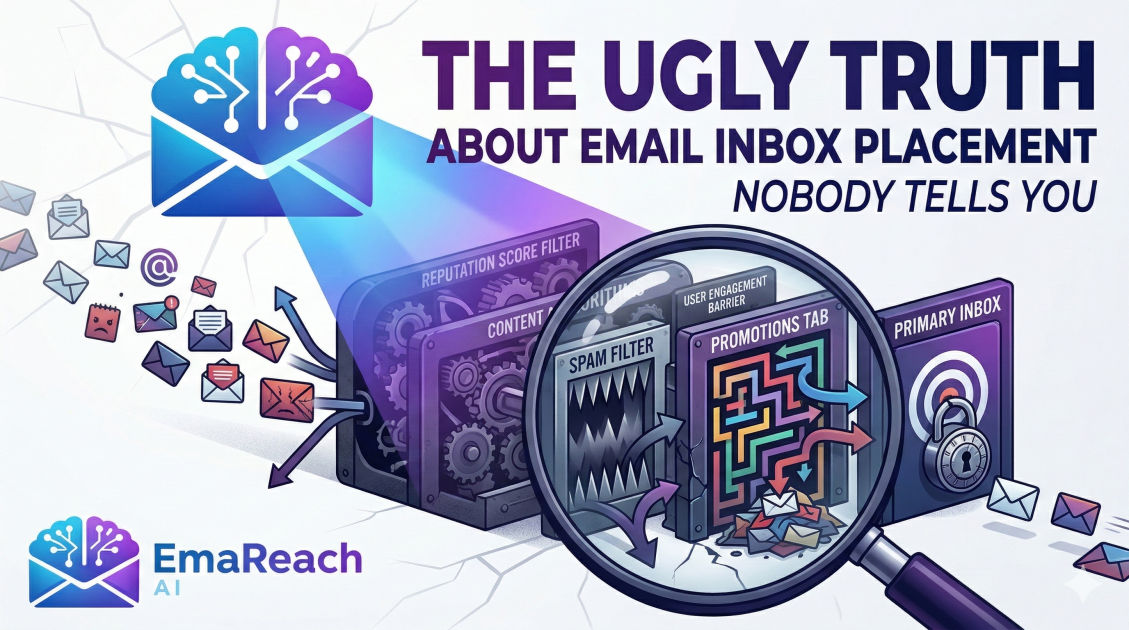
The Ugly Truth About Email Inbox Placement Nobody Tells You
email deliverabilitycold emailinbox placementspam filtersemail marketingoutreach strategy
Introduction: The Invisible Barrier to Your Success
You’ve spent hours perfecting your copy. Your offer is world-class, your list is segmented, and your call-to-action is impossible to ignore. You hit 'send' and wait for the leads to pour in. But instead of a flood of replies, you get a trickle of silence. You check your tracking software, and the open rates are abysmal.
Here is the ugly truth that most marketing gurus won’t tell you: it doesn’t matter how good your email is if your audience never sees it.
In the world of digital communication, there is a massive difference between delivery and deliverability. Delivery means the recipient's server accepted the file; deliverability (or inbox placement) means the email actually landed where a human will see it. Most senders are unknowingly caught in a shadow-war with Mailbox Providers (MBPs) like Google and Microsoft, and they are losing. This post uncovers the uncomfortable realities of inbox placement and what it actually takes to stay out of the dreaded spam folder.
The Myth of the "Spam Filter"
Most people think of a spam filter as a simple checklist. They believe that if they avoid words like "free," "money," or "winner," they will be safe. This is an outdated view that hasn't been true for over a decade.
Modern spam filters are sophisticated neural networks. They don't just look at keywords; they look at behavioral patterns. They analyze the relationship between the sender and the recipient. If you send 1,000 emails and only 2 people open them, Google’s algorithms don't care if your copy is Pulitzer-worthy—they see a lack of engagement and conclude that your content is unwanted.
The Reality of Reputation
Your inbox placement is governed by three distinct reputations:
- IP Reputation: The health of the server sending the mail.
- Domain Reputation: The "credit score" of your actual web address.
- Content Reputation: The links, images, and formatting within the email itself.
The ugly truth? Domain reputation has become the most critical factor. Even if you switch servers, your bad habits will follow your domain across the internet like a digital shadow.
The Engagement Trap: Why "Open Rates" Are Lying to You
For years, marketers relied on open rates as the ultimate metric for inbox placement. However, Apple’s Mail Privacy Protection (MPP) and similar features from other providers have turned open rates into a "vanity metric" at best and a lie at worst.
When a provider pre-loads your email images on their own servers, it triggers a "fake open." You might see a 40% open rate and feel successful, while in reality, 30% of those were bots and the other 10% of real humans found your email in their promotions tab.
MBPs are now looking at true engagement metrics that you cannot see in your dashboard:
- Delete without opening: A massive red flag for spam filters.
- Time spent reading: If users close your email in less than two seconds, it signals low value.
- Folder moves: If a user drags your email from 'Promotions' to 'Primary', your reputation skyrockets.
- Reply rates: This is the holy grail of deliverability. If people talk back to you, the filters assume you are a friend, not a solicitor.
The Hidden Danger of Shared IP Addresses
When you use a standard email service provider (ESP), you are often placed on a shared IP address with hundreds of other companies. You might be a legitimate business, but if the company sharing your IP is a high-volume spammer, your deliverability suffers.
This is why many high-volume senders move to dedicated IPs. But even then, there is a catch: a "cold" dedicated IP has no history. If you suddenly send 50,000 emails from a brand-new IP, the filters will block you instantly. The process of "warming up" an IP or domain is a tedious, weeks-long endeavor that most businesses skip, leading to immediate delivery failure.
Cold Outreach: The Highest Stakes Game
If you are doing cold outreach, the deck is stacked against you from day one. You are sending emails to people who haven't asked for them, which is the definition of a high-risk activity in the eyes of an MBP.
To survive in this environment, you need more than just a good list. You need a strategy that mimics human behavior. This is where modern technology becomes essential. For those struggling with the complexities of cold outreach, EmaReach offers a powerful solution. EmaReach AI combines AI-written cold outreach with inbox warm-up and multi-account sending—so your emails land in the primary tab and get replies. Instead of fighting the algorithms, you use a system designed to work within their rules.
The Technical Trio: SPF, DKIM, and DMARC
You can have the best intent in the world, but if your technical authentication is missing, you are essentially screaming into a void.
- SPF (Sender Policy Framework): A list of servers allowed to send mail on your behalf.
- DKIM (DomainKeys Identified Mail): A digital signature that proves the email wasn't tampered with in transit.
- DMARC (Domain-based Message Authentication, Reporting, and Conformance): The instructions you give to receiving servers on what to do if SPF or DKIM fails.
The ugly truth? Most small to medium businesses have these configured incorrectly. A single typo in your SPF record can tell Google to reject every single email you send.
The "Promotions Tab" Purgatory
Landing in the Promotions tab is often viewed as a "soft fail." It’s better than the Spam folder, but it’s where emails go to be ignored. Many marketers try to "hack" their way out of the Promotions tab by removing all images or links. While this sometimes works, it often misses the point.
Google categorizes mail based on its footprint. If your email looks like a newsletter, features a "Unsubscribe" link in a specific format, and is sent via a bulk provider, it belongs in the Promotions tab. The only way to consistently hit the Primary tab is to send mail that looks, feels, and acts like a 1-to-1 communication between two humans.
The Trap of Poor List Hygiene
We’ve all heard that "the money is in the list." But the truth is, the money is in the active list.
Keeping unengaged subscribers on your list is actively damaging your ability to reach your active subscribers. If 20% of your list hasn't opened an email in six months, they are a dead weight dragging your domain reputation into the mud. MBPs look at your overall "bounce rate" and "complaint rate." Even a complaint rate as low as 0.1% (1 out of every 1,000 people marking you as spam) can be enough to get you blacklisted.
The Dangers of Purchased Lists
There is no such thing as a "high-quality" purchased list. These lists are often filled with "spam traps"—email addresses created by security companies specifically to catch spammers. If you hit just one of these traps, your domain reputation might never recover. Real inbox placement is earned through permission-based marketing and authentic engagement.
Why Your Formatting is Killing Your Deliverability
Beyond the technical setup, the way you build your email matters. High-fidelity HTML templates with dozens of nested tables and heavy CSS might look pretty, but they are a nightmare for deliverability.
- Image-to-Text Ratio: An email that is just one large image is an instant red flag. Spammers use images to hide text from filters, so filters now penalize any email where images do the talking.
- Shortened URLs: Using services like Bitly in your emails is a recipe for disaster. Because spammers use them to hide malicious destinations, most MBPs will flag any email containing a generic shortened link.
- Broken HTML: If your code is messy, filters assume you are using a low-quality automation tool and may de-prioritize your message.
The Role of AI in Modern Inbox Placement
As spam filters get smarter, our methods for reaching the inbox must evolve. AI is no longer just for generating subject lines; it’s for optimizing the entire delivery lifecycle.
AI can help determine the best time of day to send an email to a specific recipient based on their past behavior. It can vary the cadence of your outreach to avoid looking like a bot. Most importantly, it can help personalize content at a scale that was previously impossible. When an email is highly relevant to the recipient, they are more likely to engage, which creates a positive feedback loop for your sender reputation.
Checklists for Better Inbox Placement
To combat the ugly truths of email marketing, you must be proactive. Here is a baseline strategy to ensure your messages actually get read:
1. The Technical Audit
- Verify your SPF, DKIM, and DMARC records.
- Ensure your custom tracking domain matches your sending domain.
- Check if your IP or domain is on any major blacklists (e.g., Spamhaus or Barracuda).
2. The Content Review
- Use a healthy balance of text and images (60/40 text-to-image is a safe bet).
- Avoid excessive use of exclamation points, all-caps, and "salesy" triggers.
- Ensure your "Unsubscribe" link is easy to find. It is better for someone to unsubscribe than to mark you as spam.
3. The Engagement Strategy
- Implement a double opt-in process to ensure your list actually wants your mail.
- Create a "re-engagement campaign" for subscribers who haven't opened in 90 days.
- If they don't engage with the re-engagement campaign, delete them. Yes, delete them.
Conclusion: The Path Forward
The ugly truth about email inbox placement is that it is not a "set it and forget it" task. It is a continuous process of reputation management, technical maintenance, and genuine relationship building. The days of "spray and pray" marketing are over.
To succeed today, you must respect the recipient's inbox as much as the providers do. Focus on quality over quantity, prioritize engagement over vanity metrics, and use the right tools to bridge the gap between your message and your audience. When you stop trying to game the system and start providing actual value that people want to interact with, the doors to the inbox will open naturally. It's not the easiest path, but in a world of crowded spam folders, it's the only one that leads to real results.
EmaReach AI
Ready to scale your cold email outreach?
Join thousands of teams using EmaReach AI for AI-powered campaigns, domain warmup, and 95%+ deliverability. Start free — no credit card required.
Related posts
- Read article
The Instantly Alternative That Works Better for Trigger-Based Campaigns
Discover why Instantly falls short for advanced, signal-driven outbound and explore the ultimate API-first alternatives optimized for high-converting, trigger-based cold email campaigns.
- Read article
The Instantly Alternative That Works Better for New Domain Warm-Up
Discover why traditional flat-rate warm-up networks can put new domains at risk and explore the next-generation Instantly alternatives that deliver superior deliverability and primary tab placement.