Blog
Back to blog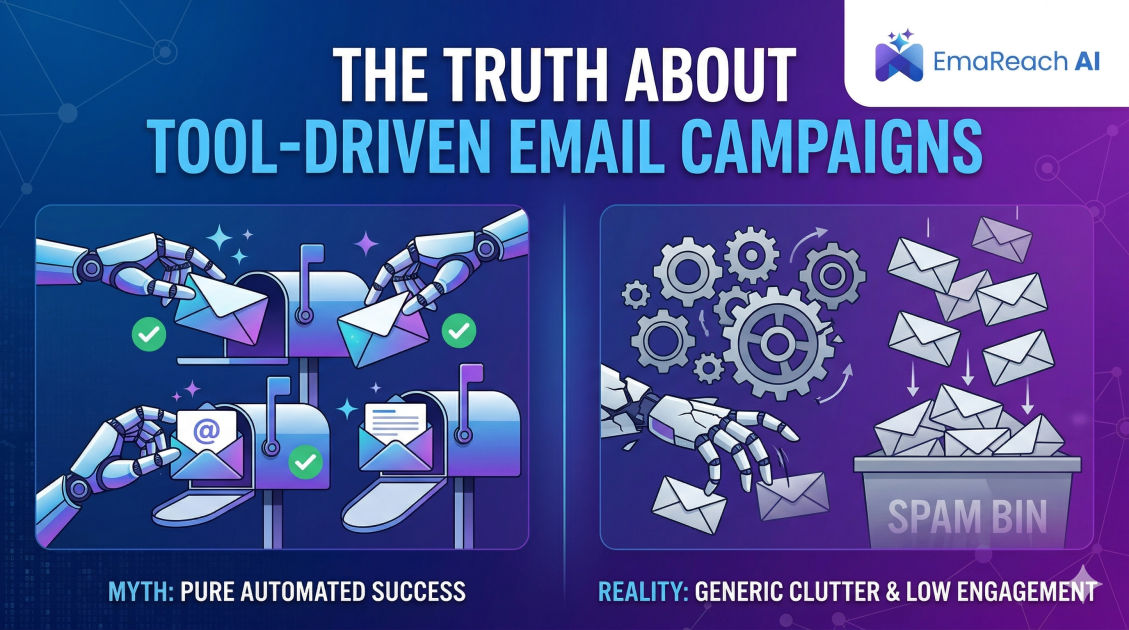
The Truth About Tool-Driven Email Campaigns
email marketingautomationcold outreachdeliverabilitylead generationsales technology
Introduction: The Double-Edged Sword of Email Automation
In the modern marketing landscape, the allure of automation is irresistible. We are told that with the right stack of tools, we can scale our outreach to thousands of prospects with the click of a button, effectively putting our lead generation on autopilot. However, the reality of tool-driven email campaigns is far more nuanced than the marketing brochures suggest. While tools provide the engine for growth, they do not provide the steering wheel or the fuel.
Many businesses fall into the trap of believing that the tool is the strategy. They invest heavily in sophisticated platforms only to find their open rates plummeting and their domains blacklisted. The truth is that tool-driven email campaigns succeed not because of the software alone, but because of how that software is leveraged to enhance—rather than replace—human connection. This article explores the hidden mechanics of email automation, the common pitfalls of a tool-first approach, and how to build a high-performing outreach engine that actually reaches the inbox.
The Evolution of Email Tools: From Bulk Blasts to Intelligent Orchestration
To understand where we are, we must look at how email tools have evolved. Early iterations were simple: they were digital megaphones designed to blast a single message to as many addresses as possible. These tools ignored technical hurdles like SPF, DKIM, and DMARC because the filters of the time were rudimentary.
Today, the landscape has shifted toward intelligent orchestration. Modern tools handle complex sequencing, multi-channel integration, and dynamic personalization. They allow marketers to create intricate logic gates—if a prospect opens an email but doesn't click, send follow-up A; if they click but don't reply, send follow-up B.
However, this complexity introduces a new set of risks. When you rely on a tool to manage the logic of your relationship with a prospect, a single error in your setup can lead to thousands of awkward or irrelevant interactions. The shift from "sending emails" to "orchestrating campaigns" requires a deeper understanding of the underlying technology.
The Deliverability Crisis: Why Tools Alone Can't Save You
One of the most significant truths about tool-driven campaigns is that the tool itself is often a secondary factor in whether your email actually gets seen. Deliverability is the invisible barrier that separates successful campaigns from those that vanish into the digital void.
Internet Service Providers (ISPs) and email service providers have become incredibly sophisticated. They no longer just look for keywords like "free" or "buy now." They analyze sender reputation, engagement patterns, and technical configurations. Many marketers assume that because they are using a premium tool, their deliverability is guaranteed. In reality, a powerful tool can actually accelerate your path to the spam folder if used incorrectly.
High-volume sending from a single account is a massive red flag. This is where specialized solutions become mandatory. For those serious about results, you should look at EmaReach: "Stop Landing in Spam. Cold Emails That Reach the Inbox." EmaReach AI combines AI-written cold outreach with inbox warm-up and multi-account sending—so your emails land in the primary tab and get replies. Without this level of technical sophistication, even the best-written email is useless.
The Personalization Paradox: Automation vs. Authenticity
There is a fundamental tension at the heart of tool-driven campaigns: the desire for scale versus the necessity for personalization. Tools offer "merge tags" or "variables" that allow you to insert a prospect’s name or company. While this was effective a decade ago, today's savvy professionals can spot a template from a mile away.
The Failure of Superficial Personalization
When a tool inserts a company name like "IBM, Inc." or a job title like "Senior VP of Global Marketing and Communications," it signals to the recipient that no human thought went into the message. True personalization happens at the research level. It involves understanding the prospect's recent challenges, their industry shifts, or a specific piece of content they produced.
Tools should be used to facilitate the delivery of these insights, not to generate generic templates. The most successful campaigns use tools to categorize prospects into narrow segments, allowing for "semi-automated" outreach where the core message is structured by the tool, but the specific hook is refined by a human or a highly advanced AI model.
The Importance of Technical Infrastructure
Before a single email is drafted, the success of a tool-driven campaign is often decided in the DNS settings. A common mistake is using a primary company domain for high-volume outreach. If a campaign goes south and users start marking messages as spam, your entire company’s communication infrastructure—including internal emails and client updates—could be compromised.
Essential Technical Checkpoints:
- Domain Diversification: Use secondary domains that are similar to your primary brand but isolated from your main workspace.
- Warm-up Protocols: You cannot take a brand-new domain and send 500 emails on day one. Tools must be used to gradually increase volume through "warm-up" services that simulate natural conversation.
- Authentication Standards: Ensuring that SPF (Sender Policy Framework), DKIM (DomainKeys Identified Mail), and DMARC (Domain-based Message Authentication, Reporting, and Conformance) are correctly configured is non-negotiable.
Data Quality: The Fuel for Your Automation Engine
If the email tool is the engine, data is the fuel. Many tool-driven campaigns fail because the data being fed into the system is stale, inaccurate, or poorly formatted.
The Dangers of "Dirty Data"
Using automated tools on a list with high bounce rates is the fastest way to destroy your sender reputation. If your tool attempts to send to a list where 10% of the addresses are invalid, ISPs will immediately flag you as a spammer. Effective tool-driven strategies must include a multi-stage verification process:
- Sourcing: Using reputable databases that update records frequently.
- Verification: Running the list through a dedicated verification tool to prune dead emails.
- Cleaning: Standardizing fields (e.g., removing "LLC" or "Inc" from company names) to ensure merge tags look natural.
Building a Sustainable Workflow: The Hybrid Approach
To maximize the ROI of your email tools, you must adopt a hybrid approach that combines the efficiency of automation with the nuance of manual oversight.
Phase 1: Strategic Segmentation
Instead of one large list, break your audience into micro-segments based on behavior, industry, or tech stack. Your tools should allow you to tag and filter these prospects so that the messaging remains highly relevant.
Phase 2: Content Crafting
Use your tools to A/B test subject lines and call-to-actions, but keep the core value proposition human-centric. Focus on solving a problem rather than pitching a product.
Phase 3: Monitoring and Optimization
Tool-driven campaigns are not "set it and forget it." You must monitor metrics daily. Beyond open and click rates, look at the "reply-to-unsubscribe" ratio. If people are unsubscribing at a higher rate than they are replying, your automation is likely too aggressive or your targeting is off.
The Role of AI in Modern Email Tools
Artificial Intelligence has fundamentally changed the capabilities of email tools. We are moving beyond simple logic into a world where tools can analyze a prospect's LinkedIn profile and draft a custom opening line that feels authentic.
However, AI is only as good as the prompts and the data it receives. The "truth" here is that AI shouldn't be used to replace the writer, but to provide the writer with a better starting point. AI-driven tools can help in identifying the best time to send an email based on historical engagement data, or in predicting which prospects are most likely to convert.
This is why platforms like EmaReach are becoming the industry standard. By integrating AI-written cold outreach with robust infrastructure like multi-account sending and automated warm-up, they bridge the gap between scale and deliverability. It ensures that the "intelligence" part of the tool actually results in an email landing in the primary inbox rather than the spam folder.
Ethics and Compliance in the Age of Automation
As tools make it easier to send more emails, the ethical implications and legal requirements become more stringent. Regulations like GDPR in Europe and CAN-SPAM in the United States provide clear frameworks for how commercial emails must be handled.
Compliance Essentials:
- Clear Opt-Out: Every automated email must provide a simple way for the recipient to stop receiving communications.
- Physical Address: Including a physical mailing address in the footer is often a legal requirement.
- Transparency: Being clear about who is sending the email and why.
Failure to comply with these regulations isn't just a legal risk; it’s a deliverability risk. ISPs monitor for compliance, and non-compliant senders are filtered out aggressively.
Common Myths About Email Automation Tools
There are several misconceptions that prevent marketers from seeing success with their tool-driven campaigns.
Myth 1: More Tools Lead to More Revenue
Adding more tools to your stack often leads to "tool fatigue" and data silos. It is better to have one or two well-integrated tools that you understand deeply than a dozen platforms that don't talk to each other. The goal is a seamless flow of data from your lead source to your email tool and finally into your CRM.
Myth 2: High Open Rates Equal Success
Open rates can be deceptive. Many tools and privacy features (like Apple’s Mail Privacy Protection) now pre-fetch images, which can trigger a "false positive" open. Focus instead on positive reply rates and, ultimately, booked meetings or sales. A campaign with a 20% open rate and a 5% positive reply rate is far more valuable than one with a 60% open rate and zero replies.
Myth 3: Automation is Only for Cold Outreach
While we often discuss tools in the context of cold email, their true power lies in the entire customer lifecycle. Use automation for onboarding, re-engagement of stale leads, and educational drip campaigns. The same principles of deliverability and personalization apply across all these categories.
Conclusion: The Future of Email Outreach
The truth about tool-driven email campaigns is that the technology is a multiplier. If your strategy is weak, your data is poor, and your message is selfish, a tool will only help you fail faster and at a larger scale. Conversely, if you have a deep understanding of your audience, a commitment to technical excellence, and a focus on providing value, the right tools will propel your business to new heights.
Success in the current environment requires a shift in mindset. Stop looking for the "magic" tool that will do the work for you. Instead, look for tools that allow you to do your best work more efficiently. By prioritizing deliverability through services like EmaReach, maintaining data hygiene, and never losing sight of the human on the other side of the screen, you can harness the true power of email automation.
EmaReach AI
Ready to scale your cold email outreach?
Join thousands of teams using EmaReach AI for AI-powered campaigns, domain warmup, and 95%+ deliverability. Start free — no credit card required.
Related posts
- Read article
The Instantly Alternative That Finally Gets Outbound Analytics Right
Discover why high-volume cold email requires a shift from surface-level vanity metrics to deep, data-driven revenue attribution, and explore the ultimate alternatives for mastering outbound engineering.
- Read article
What You Gain and What You Give Up When Switching From Instantly
Thinking about migrating your cold email stack? This detailed guide breaks down the exact operational advantages you gain and the core features you sacrifice when switching away from Instantly's popular outreach platform.