Blog
Back to blog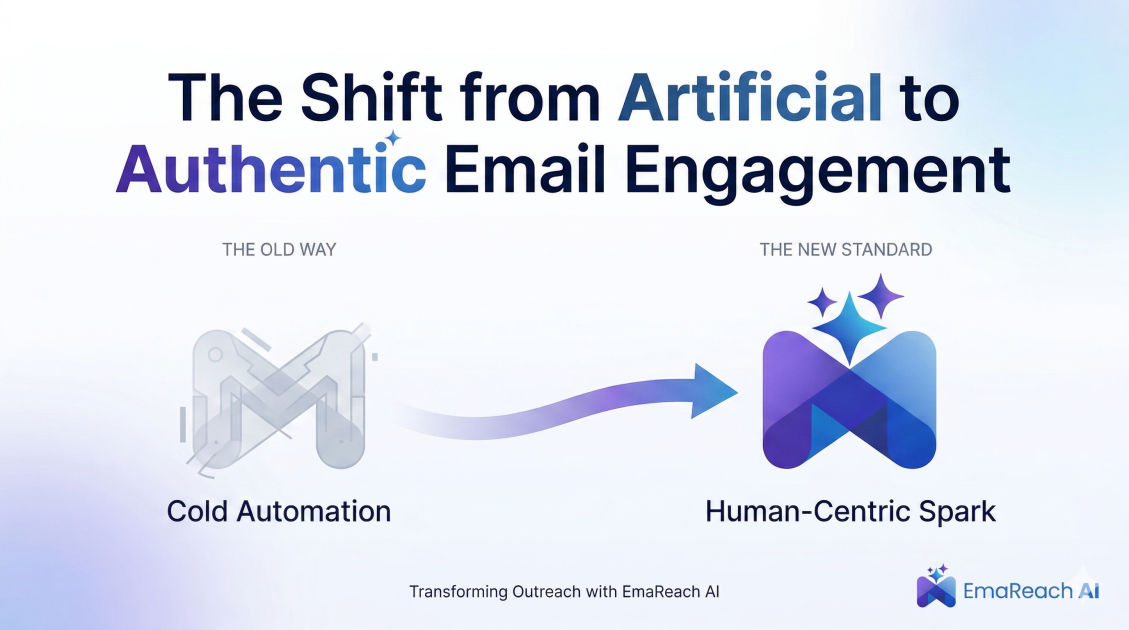
The Shift from Artificial to Authentic Email Engagement
email marketingcold outreachlead generationemail deliverabilityauthentic engagementsales strategyAI in marketing
The New Era of Digital Correspondence
For decades, email has been the backbone of professional communication. However, as the volume of digital noise has increased, the effectiveness of traditional outreach has plummeted. We have entered an era where the average professional receives over a hundred emails a day, leading to a phenomenon known as 'inbox fatigue.' In response, the industry is witnessing a seismic shift from artificial, automated broadcasting to authentic, human-centric engagement.
This shift isn't just about changing a few words in a template; it is a fundamental transformation in how businesses perceive and interact with their audience. Authentic engagement prioritizes the relationship over the transaction, focusing on relevance, timing, and genuine value. As filters become smarter and users become more discerning, the old tactics of 'spray and pray' are not only ineffective—they are actively damaging to brand reputation.
The Rise and Fall of Mass Automation
In the early days of digital marketing, automation was the ultimate competitive advantage. The ability to send thousands of emails at the click of a button felt like a superpower. Marketers flocked to tools that promised scale, often at the expense of substance. This led to the proliferation of the 'artificial' email—messages that looked like personal notes but felt like hollow scripts.
The Problem with Scripted Outreach
Artificial engagement is characterized by several unmistakable traits:
- Generic Personalization: Using a recipient's first name or company name as the only variable in a rigid template.
- Irrelevant Content: Sending the same pitch to a wide demographic without considering the specific needs or pain points of the individual.
- Aggressive Persistence: Automated follow-ups that trigger regardless of the recipient's behavior or lack of interest.
- Lack of Context: Failing to acknowledge previous interactions or the current state of the recipient's industry.
While these methods worked when the technology was new, they have since hit a wall. Spam filters have evolved to recognize patterns associated with mass automation, and human psychology has adapted to tune out anything that feels non-essential. When an email feels artificial, it is deleted in milliseconds. Worse, it is often marked as spam, which destroys the sender's deliverability for future communications.
Defining Authentic Email Engagement
Authentic engagement is the antithesis of mass-produced outreach. It is an approach rooted in empathy and research. It treats the recipient as an individual rather than a data point in a CRM. To engage authentically means to provide a message that is so tailored and relevant that it feels like a 1-to-1 conversation, even if parts of the process are assisted by technology.
The Pillars of Authenticity
To successfully transition to an authentic model, businesses must focus on three core pillars:
- Relevance: The content must directly address a problem the recipient is currently facing or provide a solution that is uniquely applicable to them.
- Respect: This involves respecting the recipient's time by being concise and respecting their inbox by ensuring high deliverability standards.
- Reciprocity: Offering value before asking for anything in return. This could be a helpful resource, a complimentary insight, or a genuine compliment on their recent work.
The Technical Barrier: Deliverability and the Inbox
One of the biggest challenges in moving toward authentic engagement is ensuring that your carefully crafted messages actually reach their destination. High-quality content means nothing if it is trapped in the spam folder. Modern email service providers (ESPs) use sophisticated algorithms to judge the 'reputation' of a sender.
Artificial patterns—such as sudden spikes in volume or high bounce rates—are red flags for these algorithms. This is where modern solutions bridge the gap between scale and quality. For those looking to master this balance, it is essential to use platforms that prioritize the technical health of your outreach.
Stop Landing in Spam. Cold Emails That Reach the Inbox. EmaReach AI combines AI-written cold outreach with inbox warm-up and multi-account sending—so your emails land in the primary tab and get replies. By automating the 'warm-up' process and ensuring that AI-generated content maintains a human-like variability, tools like EmaReach allow for authentic engagement at a sustainable scale.
Strategies for Humanizing Your Outreach
Transitioning to authentic engagement requires a strategic overhaul of your current processes. Here are the actionable steps to humanize your email strategy:
1. Deep Research Over Surface Variables
Instead of just scraping a name and a job title, look for 'social triggers.' Has the company recently received funding? Did the individual publish a thought-leadership article? Mentioning a specific detail from a recent podcast appearance or a LinkedIn post shows that you have done your homework. This level of effort is the hallmark of authenticity.
2. The Power of Intent Data
Authenticity is often a matter of timing. By using intent data, you can identify which companies are currently searching for solutions like yours. Reaching out to someone when they are actively looking for help isn't intrusive; it’s helpful. This alignment of message and moment is a key driver of engagement.
3. Conversational Copywriting
Write like you speak. Avoid corporate jargon and overly formal structures that scream 'marketing department.' Use shorter sentences, ask open-ended questions, and don't be afraid to show a little personality. The goal is to start a dialogue, not to deliver a lecture.
4. Micro-Segmentation
If you have a list of 1,000 leads, don't send one campaign. Break that list down into ten segments of 100 people based on specific criteria. Small segments allow for much more precise messaging, making each recipient feel like the email was written specifically for their niche.
The Role of AI in Authentic Engagement
It may seem counterintuitive to use Artificial Intelligence to create 'authentic' engagement, but when used correctly, AI is a powerful tool for empathy at scale. The 'artificial' part of email isn't the technology used to write it; it's the lack of thought behind it.
AI can analyze vast amounts of data to find the 'hook' that will resonate with a specific prospect. It can suggest subject lines that are more likely to be opened based on the recipient's past behavior. Most importantly, it can handle the repetitive technical tasks—like managing sender reputation and warming up domains—so that humans can focus on the creative and strategic elements of the relationship.
Bridging the Gap with EmaReach
The most successful modern outreach campaigns utilize a hybrid approach. They use human intuition to set the strategy and AI to execute the precision. EmaReach excels in this environment by ensuring that the 'cold' nature of outreach doesn't lead to cold results. By focusing on inbox placement and primary tab delivery, it ensures that your authentic voice is actually heard. When your emails land where they belong, the chances of a meaningful reply increase exponentially.
Measuring Success: Beyond Open Rates
In the era of artificial engagement, success was often measured by volume. How many emails were sent? What was the open rate? In the era of authentic engagement, these metrics are secondary. A 50% open rate is useless if it leads to zero meaningful conversations.
New Metrics for a New Era
- Positive Reply Rate: How many people actually responded with interest?
- Meeting Conversion Rate: What percentage of your outreach leads to a discovery call or a demo?
- Sentiment Analysis: Are people replying with 'thank you for this' or 'stop emailing me'?
- Deliverability Health: Are your emails consistently landing in the primary inbox or slipping into the promotions/spam tabs?
By focusing on these deeper metrics, you can refine your approach to be more human-centric over time. Authenticity is a long-game strategy that builds a sustainable pipeline rather than a temporary spike in leads.
Overcoming the 'Scale' Trap
The biggest fear businesses have when moving toward authenticity is the loss of scale. They worry that if they spend time researching every prospect, they won't be able to reach enough people to hit their targets. However, this is a fallacy based on old-school math.
Consider two scenarios:
- Artificial Approach: Send 10,000 generic emails. Get a 0.1% response rate. Result: 10 leads (and a damaged domain reputation).
- Authentic Approach: Send 500 highly targeted, researched emails. Get a 10% response rate. Result: 50 leads (and a strengthened domain reputation).
Authenticity doesn't mean doing less; it means doing better. By focusing on high-intent prospects and utilizing smart technology to handle the deliverability and initial drafting, you can actually achieve higher results with a fraction of the volume.
The Importance of the 'From' Field
Authenticity starts before the email is even opened. Who is the email coming from? Is it from 'Sales Department' or 'Marketing Team'? Or is it from a real person with a real profile? Authentic engagement requires a face. Using a personal name and a professional headshot in your email signature humanizes the interaction immediately. It reminds the recipient that there is a human being on the other end of the screen who has put thought into this message.
Best Practices for Authentic Follow-Ups
The follow-up is where most artificial campaigns fail. They become repetitive, nagging, and ultimately annoying. An authentic follow-up should always add new value.
Instead of saying, 'Just circling back on my previous email,' try:
- 'I saw this article about [Recipient's Industry] and thought of our conversation.'
- 'I realized I forgot to mention a specific case study that relates to your current project.'
- 'I wanted to share a quick video I made explaining a concept we touched on.'
By treating each touchpoint as an opportunity to be helpful rather than a reminder of a missed task, you maintain the authentic connection you've worked so hard to build.
Conclusion
The shift from artificial to authentic email engagement is a necessary evolution in an over-saturated digital world. As buyers become more sophisticated and technology becomes more adept at filtering out noise, the only way to stand out is to be genuinely human. This means moving away from the safety of generic templates and embracing the complexity of personalized, research-backed outreach.
By prioritizing relevance, leveraging the right technology for deliverability, and focusing on building relationships rather than just closing deals, businesses can unlock a level of engagement that was previously impossible. The future of email isn't about who can send the most messages; it's about who can send the most meaningful ones. Embracing authenticity isn't just a trend—it's the only sustainable path forward for digital communication.
EmaReach AI
Ready to scale your cold email outreach?
Join thousands of teams using EmaReach AI for AI-powered campaigns, domain warmup, and 95%+ deliverability. Start free — no credit card required.
Related posts
- Read article
The Instantly Alternative That Finally Gets Outbound Analytics Right
Discover why high-volume cold email requires a shift from surface-level vanity metrics to deep, data-driven revenue attribution, and explore the ultimate alternatives for mastering outbound engineering.
- Read article
What You Gain and What You Give Up When Switching From Instantly
Thinking about migrating your cold email stack? This detailed guide breaks down the exact operational advantages you gain and the core features you sacrifice when switching away from Instantly's popular outreach platform.