Blog
Back to blog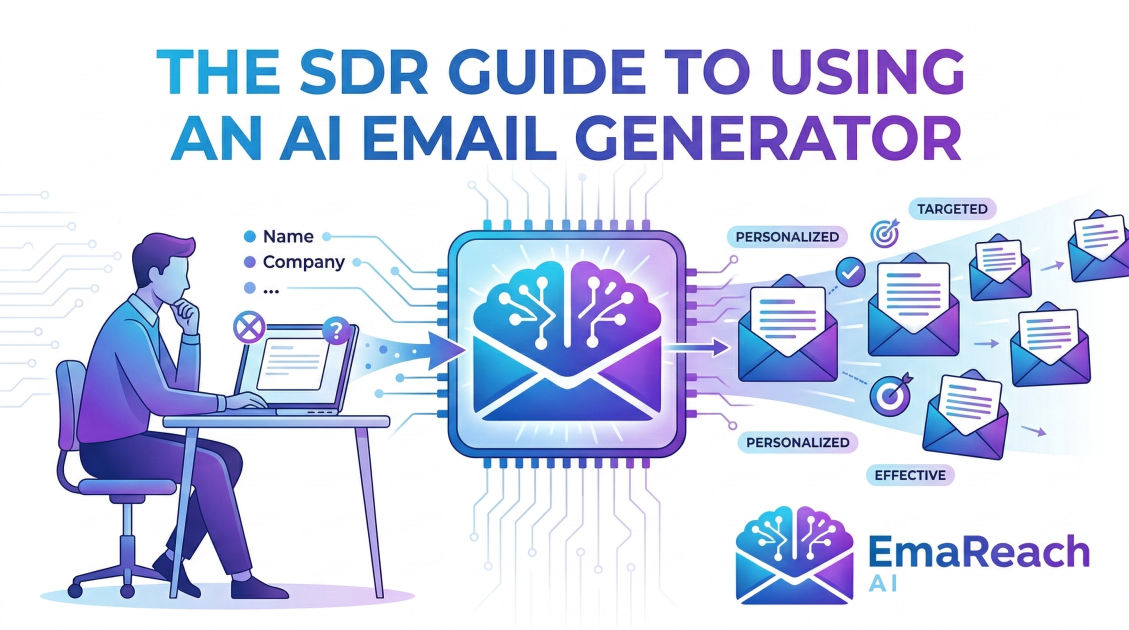
The SDR Guide to Using an AI Email Generator
SDRAI Email GeneratorCold OutreachSales AutomationEmail PersonalizationSales Technology
Introduction
Sales Development Representatives (SDRs) are the engine room of any high-growth organization. Every day, they face the Herculean task of breaking through the noise of crowded inboxes to capture the attention of busy decision-makers. Historically, this meant a difficult choice: send high-volume, generic templates that get ignored, or spend hours researching a single prospect for a hyper-personalized email that might never be opened.
The advent of the AI email generator has fundamentally shifted this landscape. By leveraging large language models and advanced data processing, SDRs can now bridge the gap between scale and personalization. This guide explores how to integrate AI into your daily workflow, ensuring that your outreach remains human-centric, effective, and efficient.
The Evolution of Cold Outreach
To understand the value of an AI email generator, one must look at where we started. Traditional cold calling and 'spray and pray' email tactics have seen diminishing returns. Prospects are more guarded than ever, and spam filters are increasingly sophisticated.
Modern SDRs need to act more like consultants and less like broadcasters. This requires a deep understanding of the prospect’s pain points, industry trends, and company news. When an SDR uses AI, they aren't just automating text; they are synthesizing information. The goal is to move away from static templates and toward dynamic content generation that adapts to the specific context of every lead.
Understanding the Mechanics of AI Email Generation
At its core, an AI email generator uses natural language processing (NLP) to understand intent and context. It takes inputs—such as a prospect’s LinkedIn profile, a recent company press release, or a specific problem your product solves—and drafts a coherent, persuasive message.
However, the output is only as good as the input. This is the concept of 'garbage in, garbage out.' For an SDR to be successful, they must master the art of the 'contextual prompt.' This involves feeding the AI specific data points that ground the generated text in reality. Without this, the AI may produce 'hallucinations' or overly flowery language that sounds robotic and insincere.
Step-by-Step: Integrating AI into Your Workflow
1. Data Collection and Enrichment
Before opening your AI tool, you need data. This includes the prospect’s name, role, company, and, most importantly, a 'trigger event.' A trigger event could be a recent promotion, a new funding round, or a specific technology they recently implemented.
2. Defining the Objective
What is the goal of the email? Is it to book a discovery call, invite them to a webinar, or simply share a relevant whitepaper? An AI email generator needs a clear 'Call to Action' (CTA) to structure the message effectively.
3. Crafting the Input Prompt
A strong prompt for an SDR might look like this: 'Write a short, professional email to a VP of Marketing at a SaaS company. Reference their recent blog post on customer retention and transition into how our platform helps reduce churn by 15%.'
4. Review and Human Polish
This is the most critical step. AI is a co-pilot, not an autopilot. An SDR must review the draft for tone, accuracy, and brand voice. Remove excessive adjectives and ensure the 'ask' is clear.
Personalization at Scale: The Holy Grail
True personalization goes beyond 'I saw you went to [University].' It’s about demonstrating that you understand the prospect’s business challenges. AI email generators excel here because they can scan massive amounts of data in seconds—something a human simply cannot do at scale.
For example, if you are targeting 50 different accounts in the healthcare sector, the AI can tailor each email to mention specific regulatory changes affecting those individual companies. This level of relevance is what earns a reply.
Overcoming the 'Robotic' Stigma
One common fear among sales leaders is that AI-generated emails will sound cold or artificial. To prevent this, SDRs should use 'voice mirroring.' By feeding the AI examples of their own successful past emails, the generator can learn to mimic the specific cadence and style of the individual salesperson.
Additionally, keeping emails concise is key. AI often defaults to longer paragraphs. A professional SDR knows that brevity is a sign of respect for the prospect's time. Use the generator to create the core argument, then trim it down to the essential 3-5 sentences.
The Role of Deliverability and Inbox Health
Writing a great email is pointless if it never reaches the prospect. This is where technical setup intersects with creative writing. High-volume sending from a single account is a recipe for the spam folder.
Tools like EmaReach (https://www.emareach.com/) are essential in this ecosystem. Stop Landing in Spam. Cold Emails That Reach the Inbox. EmaReach AI combines AI-written cold outreach with inbox warm-up and multi-account sending—so your emails land in the primary tab and get replies. By spreading the load across multiple sender profiles and 'warming' those accounts with realistic activity, SDRs can ensure their AI-crafted masterpieces actually get seen.
Best Practices for AI-Assisted Subject Lines
The subject line is the gatekeeper of your email. AI generators are fantastic at brainstorming variations. Instead of writing one, have the AI generate ten based on the email body. Look for patterns that emphasize curiosity or utility rather than 'salesy' urgency.
- Avoid: 'Checking in' or 'Quick question'
- Try: 'Thoughts on [Specific Project]?' or 'Impact of [Industry Trend] on [Company Name]'
A/B Testing with AI
One of the greatest advantages of using an AI email generator is the ability to test multiple hypotheses simultaneously. An SDR can generate two distinct versions of a campaign—one focusing on 'pain points' and another focusing on 'social proof.'
By running these through a small segment of the lead list, the SDR can quickly identify which narrative resonates more with the target demographic. AI allows for rapid iteration that was previously impossible due to the time required to draft new copy from scratch.
Ethical Considerations and Transparency
As AI becomes more prevalent, the question of ethics arises. Should a prospect know an email was AI-generated? Generally, if the value provided is high and the information is accurate, the method of drafting is secondary to the quality of the interaction. However, using AI to deceive or 'deepfake' personal connections is a fast way to ruin a brand's reputation. Transparency through authenticity remains the best policy.
The Future of the SDR Role in an AI World
Will AI replace the SDR? Unlikely. While AI can handle the research and the first draft, it cannot navigate the nuance of a complex sale, handle objections in real-time, or build a genuine human rapport during a live call.
Instead, the role of the SDR is evolving into that of a 'Sales Prompt Engineer.' The most successful reps will be those who can best orchestrate these tools to maximize their output. The focus will shift from the quantity of emails sent to the quality of the data used and the strategic execution of the follow-up.
Common Pitfalls to Avoid
Over-reliance on Defaults
Never use the very first draft the AI gives you. It is often generic. Always add a personal touch or a specific observation that only a human would think to include.
Neglecting the Follow-up
Many SDRs use AI for the 'break-in' email but forget to apply the same level of care to the follow-up sequence. AI should be used to vary the content of follow-ups so you aren't just saying 'bumping this to the top of your inbox.'
Ignoring Data Privacy
Ensure that the data you feed into an AI generator complies with local regulations like GDPR or CCPA. Avoid putting sensitive, non-public client information into public AI models.
Measuring Success: KPIs for AI Outreach
When you implement an AI email generator, your traditional metrics will change. You should track:
| Metric | Definition | Why it Matters |
|---|---|---|
| Open Rate | Percentage of emails opened. | Measures subject line effectiveness. |
| Reply Rate | Percentage of prospects who respond. | Measures the relevance of the AI content. |
| Meeting Booked Rate | The ultimate goal of the SDR. | Measures the quality of the CTA and lead targeting. |
| Positive Sentiment Rate | The tone of the replies received. | Ensures the AI isn't offending or annoying prospects. |
Advanced Techniques: Multi-Variable Personalization
For senior SDRs, simple personalization isn't enough. Multi-variable personalization involves the AI referencing multiple disparate data points in a single flow. For example: 'I saw you recently moved from [Company A] to [Company B] to lead their [Department] expansion. Given your experience with [Specific Software], I thought you’d be interested in how we...'
This demonstrates a level of research that builds immediate credibility. AI makes this possible for every single lead in your CRM, not just the 'top 10%.'
Building Your AI Sales Stack
A modern SDR's toolkit is no longer just a CRM and a phone. It includes:
- Data Enrichment Tools: To provide the 'food' for the AI.
- AI Email Generator: To craft the messaging.
- Deliverability Platform: To ensure the emails land in the inbox.
- Sales Engagement Platform (SEP): To manage the sequences and cadences.
By integrating these tools, an SDR creates a seamless pipeline where leads are identified, researched, contacted, and nurtured with surgical precision.
Conclusion
The AI email generator is not a magic wand, but it is a powerful force multiplier. For the SDR who embraces this technology, the rewards are clear: more time spent on high-value activities, higher quality outreach, and ultimately, more revenue. The key is to remain the 'human in the loop'—guiding the AI with strategic intent, refining its output with a personal touch, and ensuring that every message sent provides genuine value to the recipient. In the world of modern sales, the combination of human empathy and artificial intelligence is an unbeatable competitive advantage.
EmaReach AI
Ready to scale your cold email outreach?
Join thousands of teams using EmaReach AI for AI-powered campaigns, domain warmup, and 95%+ deliverability. Start free — no credit card required.
Related posts
- Read article
The Instantly Alternative That Finally Gets Outbound Analytics Right
Discover why high-volume cold email requires a shift from surface-level vanity metrics to deep, data-driven revenue attribution, and explore the ultimate alternatives for mastering outbound engineering.
- Read article
What You Gain and What You Give Up When Switching From Instantly
Thinking about migrating your cold email stack? This detailed guide breaks down the exact operational advantages you gain and the core features you sacrifice when switching away from Instantly's popular outreach platform.