Blog
Back to blog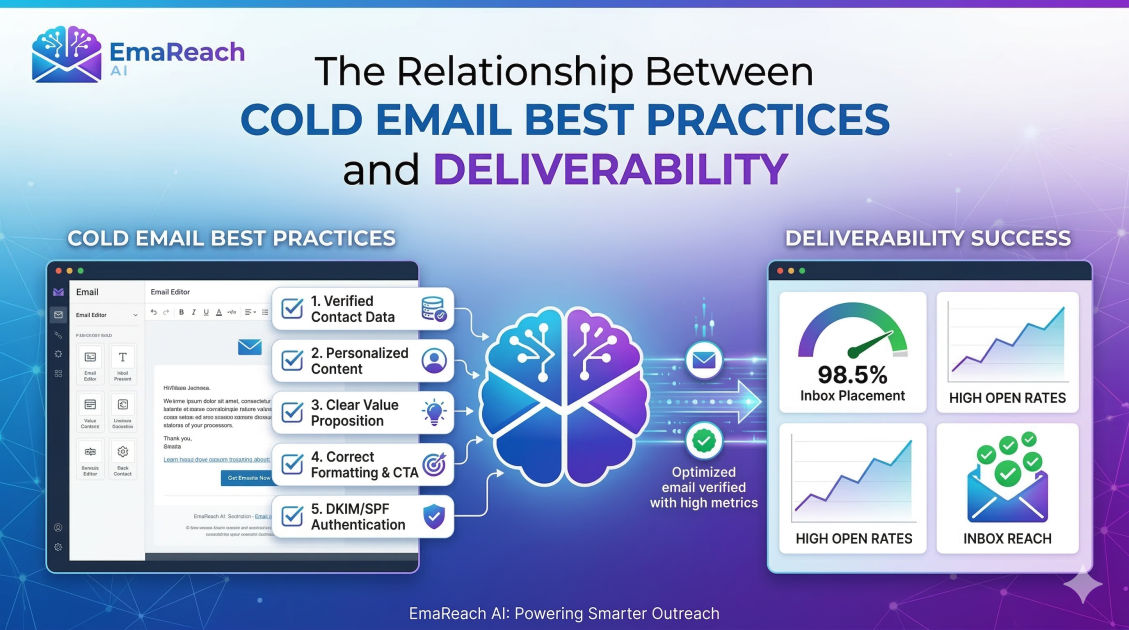
The Relationship Between Cold Email Best Practices and Deliverability
cold emailemail deliverabilityoutreach strategylead generationSPF DKIMsender reputationemail marketing
Introduction
In the world of modern sales and business development, cold email remains one of the most effective channels for generating high-quality leads. However, a fundamental challenge persists: an email is only effective if it actually reaches the recipient's inbox. This is where the critical relationship between cold email best practices and deliverability comes into play.
Deliverability is not a static metric; it is a dynamic reputation score influenced by every action a sender takes. Many professionals mistakenly view deliverability as a purely technical hurdle—something to be 'fixed' once and forgotten. In reality, deliverability is the direct result of your sending habits, content quality, and technical setup. To master the art of outreach, one must understand that every 'best practice' in cold emailing serves a dual purpose: improving the prospect's experience and signaling to Internet Service Providers (ISPs) that you are a legitimate, high-quality sender.
The Technical Foundation of Deliverability
Before diving into the nuances of content and strategy, it is essential to establish a rock-solid technical foundation. Without the correct authentication protocols, even the most well-crafted email will likely be flagged as spam.
SPF, DKIM, and DMARC
These three acronyms represent the pillars of email authentication. They act as your digital passport, proving to receiving servers that you are who you say you are.
- SPF (Sender Policy Framework): A DNS record that specifies which mail servers are authorized to send emails on behalf of your domain.
- DKIM (DomainKeys Identified Mail): Adds a digital signature to your emails, ensuring that the content has not been tampered with during transit.
- DMARC (Domain-based Message Authentication, Reporting, and Conformance): A policy that leverages SPF and DKIM to give instructions to receiving servers on how to handle emails that fail authentication.
Failing to configure these properly is a major red flag for spam filters. When these records are in place, you significantly reduce the risk of domain spoofing and improve your sender reputation.
Custom Tracking Domains
Most cold email platforms track open rates by embedding a tiny, invisible pixel in your email. By default, these platforms use a shared tracking domain. If other users on that shared domain are sending spam, your deliverability can suffer by association. Setting up a custom tracking domain—a subdomain of your own—isolates your reputation and ensures that your tracking links match your sender domain, which is a key best practice for maintaining a high deliverability rate.
The Psychology of the Inbox: Why Engagement Matters
Modern spam filters, particularly those used by Google and Microsoft, have become incredibly sophisticated. They no longer rely solely on keyword blacklists. Instead, they use machine learning to analyze user engagement.
Positive vs. Negative Signals
ISPs look for specific signals to determine whether an email belongs in the primary inbox, the promotions tab, or the spam folder.
- Positive Signals: Opening an email, clicking a link, replying to a message, marking a message as 'not spam,' and adding the sender to a contact list.
- Negative Signals: Deleting an email without opening it, marking an email as spam, and high bounce rates.
If you send 1,000 emails and only 2 people reply while 50 mark you as spam, your reputation will plummet. This is why personalization and relevance are not just 'nice-to-haves'; they are essential for your technical survival. This is also where services like EmaReach provide significant value. By combining AI-written outreach with automated inbox warm-up, they ensure your account generates the positive engagement signals necessary to stay out of the spam folder.
Content Best Practices and Their Impact on Filters
Your message's content is the primary variable that determines whether a prospect engages or complains. To maximize deliverability, your content must bypass automated filters while simultaneously appealing to human psychology.
Avoiding Spam Trigger Words
While filters are smarter than they used to be, 'spammy' language still triggers alarms. Words like 'Free,' 'Guarantee,' 'Cash,' 'Act Now,' and excessive use of exclamation points or all-caps can lower your deliverability score. The goal is to write like a human talking to another human, not a billboard shouting at a crowd.
The Role of Personalization
Mass-blasting the same template to thousands of recipients is a guaranteed way to get flagged. ISPs notice when identical content is sent at high volumes. By using dynamic variables—such as the recipient's name, company, recent achievements, or specific pain points—you ensure that every email you send is unique. Unique content is much harder for automated systems to categorize as bulk spam.
Formatting and HTML vs. Plain Text
In cold outreach, less is almost always more. Overly complex HTML layouts with multiple images, various fonts, and numerous links can look suspicious to filters. Most professional one-to-one emails are plain text or very simple HTML. Reducing the number of links (ideally to one or zero in the initial touchpoint) and avoiding attachments will significantly improve your chances of hitting the primary inbox.
Data Hygiene: The Silent Deliverability Killer
A high bounce rate is one of the fastest ways to destroy a sender's reputation. A 'hard bounce' occurs when you attempt to send an email to an address that does not exist. This signals to ISPs that you are using an unverified list or 'harvesting' emails—common tactics of spammers.
Regular List Cleaning
You must verify your email lists before every campaign. Using verification tools to identify catch-all addresses, syntax errors, and deactivated accounts is a mandatory best practice. Keeping your bounce rate below 2% is the industry gold standard for maintaining a healthy sender profile.
Targeting and Segmentation
Relevance is the enemy of the 'Report Spam' button. If you send a pitch for marketing services to a Chief Financial Officer, they are likely to find it irrelevant and may mark it as spam. Proper segmentation ensures that your message reaches people who actually have a need for your solution. The more targeted your list, the higher your engagement rate, and consequently, the better your deliverability.
Volume, Velocity, and Ramping Up
One of the most common mistakes made by sales teams is 'blasting' a high volume of emails from a new domain or account. This behavior is a classic hallmark of a spammer.
The Importance of Warm-Up
When you start a new email account, it has no reputation. If you suddenly send 200 emails on day one, ISPs will treat you with extreme suspicion. An 'email warm-up' process involves gradually increasing your daily sending volume over several weeks. This process should ideally involve automated interactions where your emails are opened and replied to, mimicking natural human behavior.
Sending Cadence and Limits
Even with a seasoned account, sending too many emails too quickly can cause issues. Spreading your sends out over the course of a day (using 'throttling') rather than sending them all in one batch helps you stay under the radar of volume-based filters. Most experts recommend staying well below the technical limits of your email provider (e.g., Google Workspace or Outlook) to ensure long-term account health.
Managing Unsubscribes and Complaints
It may seem counterintuitive, but making it easy for people to opt out of your emails actually protects your deliverability.
The 'Report Spam' vs. Unsubscribe Dilemma
If a recipient wants to stop hearing from you and cannot find an easy way to unsubscribe, they will hit the 'Report Spam' button. An unsubscribe is a neutral signal; a spam report is a heavily negative signal.
- Include a Clear Opt-Out: Whether it's a traditional unsubscribe link or a simple sentence like "Reply 'stop' if you'd like me to head out," giving the recipient a 'way out' prevents them from damaging your reputation.
- Honor Requests Immediately: If someone asks to be removed, do it instantly. Continuing to mail someone who has opted out is a violation of international regulations (like CAN-SPAM and GDPR) and a fast track to being blacklisted.
Monitoring Your Reputation
You cannot manage what you do not measure. A critical part of cold email best practices is the ongoing monitoring of your sender health.
Tools for Monitoring
Use tools like Google Postmaster Tools to see how Google views your domain. It provides data on spam complaint rates, IP reputation, and domain reputation. Additionally, regularly checking your domain against major blacklists (such as Spamhaus or Barracuda) ensures that you can take corrective action the moment an issue arises.
Subject Line Best Practices
Your subject line is the gatekeeper of your open rate. While it needs to be catchy, it must never be misleading. 'Bait and switch' subject lines (e.g., "Re: Our meeting tomorrow" when no meeting exists) might get an open, but they drastically increase the likelihood of the recipient marking the email as spam once they realize they've been tricked. Honest, low-pressure, and curiosity-driven subject lines are best for both conversion and reputation.
The Holistic Approach to Outreach
Ultimately, the relationship between best practices and deliverability is circular. When you follow best practices—sending highly relevant, personalized content to verified leads at a reasonable volume—you generate high engagement. This high engagement builds a stellar sender reputation, which in turn ensures your future emails land in the inbox, allowing for more engagement.
Conversely, cutting corners by using unverified lists, aggressive language, or excessive volume leads to poor engagement and spam reports. This damages your reputation, causing even your well-crafted emails to be filtered out, leading to a death spiral for your outreach efforts.
By treating deliverability as an integral part of your sales strategy rather than a technical annoyance, you position your business for sustainable growth. Utilizing advanced systems like EmaReach can streamline this complexity, as they handle the multi-account sending and inbox warm-up that are often too labor-intensive for manual management. This allows your team to focus on what matters most: closing deals and building relationships.
Conclusion
Mastering cold email deliverability requires a commitment to excellence across three domains: technical configuration, data integrity, and content quality. There are no shortcuts. By implementing SPF, DKIM, and DMARC, maintaining a clean list of prospects, and writing personalized, value-driven copy, you align yourself with the requirements of modern ISPs.
Remember that every email you send is a reflection of your brand. When you respect the recipient's inbox by providing value and an easy way to opt out, you are rewarded with better placement and higher conversion rates. The synergy between best practices and deliverability is the foundation upon which successful, long-term outbound sales are built. Maintain your reputation, verify your data, and always prioritize the human on the other side of the screen.
EmaReach AI
Ready to scale your cold email outreach?
Join thousands of teams using EmaReach AI for AI-powered campaigns, domain warmup, and 95%+ deliverability. Start free — no credit card required.
Related posts
- Read article
The Instantly Alternative That Finally Gets Outbound Analytics Right
Discover why high-volume cold email requires a shift from surface-level vanity metrics to deep, data-driven revenue attribution, and explore the ultimate alternatives for mastering outbound engineering.
- Read article
What You Gain and What You Give Up When Switching From Instantly
Thinking about migrating your cold email stack? This detailed guide breaks down the exact operational advantages you gain and the core features you sacrifice when switching away from Instantly's popular outreach platform.