Blog
Back to blog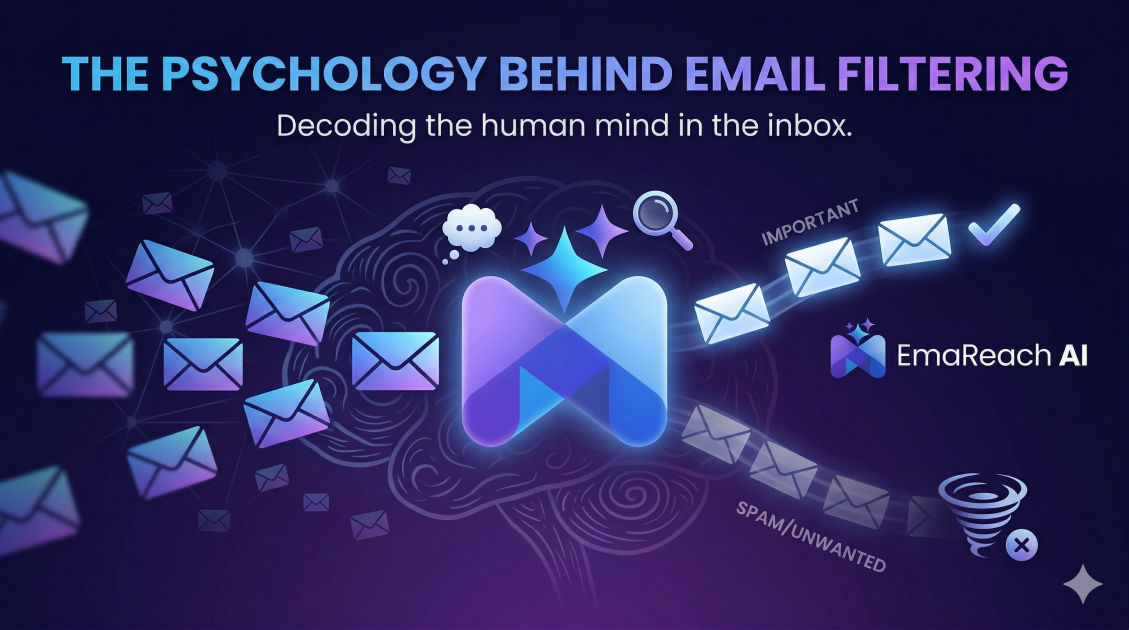
The Psychology Behind Email Filtering
email psychologycold emaildeliverabilitydigital communicationcognitive biasoutreach strategy
Introduction: The Invisible Barrier of the Digital Mind
Every day, the average professional receives dozens, if not hundreds, of emails. Before an automated algorithm ever touches these messages, a much more complex system is already at work: the human brain. The psychology behind email filtering is a multifaceted study of cognitive biases, attention spans, and decision-making heuristics. Understanding why a recipient chooses to open one email while instantly deleting another is the holy grail of digital communication.
Filtering is not merely a technical process handled by servers; it is a survival mechanism for the modern worker. In an age of information overload, the brain must aggressively filter stimuli to prevent cognitive exhaustion. This article explores the deep-seated psychological triggers that govern how we perceive, process, and ultimately filter our inboxes.
The Cognitive Load and the Fight for Attention
At its core, email filtering is a response to cognitive load. The brain has a limited capacity for processing information at any given moment. When a user opens their inbox and sees a wall of unread messages, the brain enters a state of 'micro-evaluation.'
During this phase, the prefrontal cortex—the area responsible for complex planning and decision-making—works in tandem with the anterior cingulate cortex to prioritize tasks. Because each email represents a potential task or a demand for attention, the brain seeks the path of least resistance. If an email looks like it will require too much mental energy to process, the 'delete' or 'archive' reflex is triggered almost instantly.
The Three-Second Rule
Psychological studies on digital behavior suggest that users make a 'stay or go' decision within approximately three seconds of seeing an email in their list view. This decision is based on three primary anchors: the sender's name, the subject line, and the snippet text. If these three elements do not align with the user's current goals or emotional state, the email is mentally filtered out before it is even read.
The Power of Familiarity: The Propinquity Effect
One of the strongest psychological drivers in email filtering is the propinquity effect—the tendency for people to form relationships or preferences for things simply because they are familiar with them. In the context of an inbox, the 'From' field is the most significant filter.
When a recipient recognizes a name, their brain releases a small amount of dopamine, signaling safety and relevance. Conversely, an unknown sender triggers a mild 'stranger danger' response in the subconscious. This is why cold outreach is notoriously difficult; you are fighting against a biological instinct to ignore the unknown.
To overcome this, successful communicators focus on building 'inbox equity.' This is where tools like EmaReach become essential. Stop Landing in Spam. Cold Emails That Reach the Inbox. EmaReach AI combines AI-written cold outreach with inbox warm-up and multi-account sending—so your emails land in the primary tab and get replies. By ensuring your name appears in the primary tab rather than the spam folder, you leverage the psychology of presence and familiarity.
Heuristics and Social Proof in Subject Lines
Because we cannot process every detail, the brain uses heuristics—mental shortcuts—to make quick decisions. In email filtering, several key heuristics are at play:
The Availability Heuristic
If a subject line mentions a topic that is currently top-of-mind for the recipient, they are significantly more likely to open it. This is why timing and relevance are more important than cleverness. A subject line about 'Q4 Budget Planning' sent in October is psychologically 'available' and relevant, whereas the same line sent in July might be filtered out as noise.
Social Proof and Authority
Humans are social creatures who look to others for cues on how to behave. If a subject line implies authority or social validation (e.g., 'Insights from 500 SaaS Founders'), it bypasses the standard skepticism filter. The brain perceives the information as high-value because others have already 'vetted' it.
The 'Delete' Reflex: Fear of Information Overload
There is a specific psychological satisfaction found in 'Inbox Zero.' For many, an unread email is a physical weight—a 'to-do' that hasn't been completed. This leads to the 'Delete Reflex,' where the act of removing an email provides a small hit of relief.
To avoid falling victim to this reflex, an email must present itself as a solution rather than a problem. Emails that look like long-form essays or contain complex formatting are often filtered out because they signal 'work.' Minimalist, clear, and direct communication signals 'ease,' making it more likely to survive the initial mental cull.
The Curiosity Gap and Information Foraging
Human beings are naturally 'information foragers.' Evolutionary psychology suggests that our ancestors who were better at seeking out and processing information were more likely to survive. This translates to the 'Curiosity Gap' in modern email marketing.
When a subject line provides enough information to be relevant but withholds just enough to create a 'gap' in knowledge, the brain feels an itch that can only be scratched by opening the email. However, this is a delicate balance. If the gap is too wide, it feels like 'clickbait' and triggers a distrust filter. If it is too narrow, there is no incentive to open.
Emotional Triggers: Anxiety vs. Aspiration
Email filtering is not purely logical; it is deeply emotional. Most emails trigger one of two primary emotional states:
- Anxiety-Based Filtering: The recipient opens the email because they fear the consequences of missing it (e.g., 'Urgent: Your account status').
- Aspiration-Based Filtering: The recipient opens the email because it promises a future benefit or an improvement to their current state (e.g., 'How to double your output').
Anxiety is a powerful motivator but can lead to brand fatigue. Aspiration builds long-term engagement. When crafting outreach, understanding the emotional state of your target audience allows you to align your message with their internal psychological narrative.
The Role of Personalization in Bypassing Filters
In the brain, the 'Self-Reference Effect' describes the tendency for people to encode information differently when it is related to themselves. When a recipient sees their name, their company, or a specific problem they are facing in an email, the brain's 'cocktail party effect' kicks in. Just as you can hear your name across a crowded room, a personalized email stands out in a crowded inbox.
This is why generic templates fail. They do not trigger the self-reference effect. Effective outreach requires a deep dive into the recipient's world, making the email feel like a 1-to-1 conversation rather than a 1-to-many broadcast.
Why Technical Deliverability is a Psychological Pre-requisite
We cannot discuss the psychology of the recipient without acknowledging the 'gatekeeper' algorithms. If an email lands in the 'Promotions' or 'Spam' tab, the recipient's psychological framing changes before they even read a word.
An email in the 'Spam' folder is viewed through a lens of suspicion. An email in the 'Promotions' tab is viewed through a lens of 'consumerism' (i.e., 'someone is trying to sell me something'). Only the 'Primary' tab carries the psychological weight of a personal communication. This is why managing your sender reputation is not just a technical task, but a psychological one. You must win the battle of placement to win the battle of the mind.
Cognitive Dissonance in Unsubscribing
Why do people keep emails they never read? Cognitive dissonance plays a role here. A user might subscribe to a newsletter because they identify as someone interested in 'Growth Hacking.' Even if they never open the emails, unsubscribing feels like a rejection of that identity. This results in 'Graymail'—emails that are neither opened nor deleted, but simply sit there, slowly damaging the sender's engagement metrics.
To combat this, senders must move beyond being a 'brand' and become a 'resource.' If the psychological value of the content remains high, the recipient will continue to give the sender 'mental real estate' in their inbox.
Conclusion: Mastering the Mind of the Recipient
Email filtering is a complex dance between automated systems and human psychology. To be a successful communicator in the digital age, one must understand that the inbox is a high-stress environment where the brain is looking for any excuse to say 'no.'
By leveraging familiarity, respecting cognitive load, and triggering the right emotional responses, you can move your messages from the 'mental trash' to the 'primary focus.' Success is found at the intersection of technical excellence and psychological insight. When you align your outreach strategy with the way the human brain actually processes information, you don't just reach the inbox—you reach the person behind it.
EmaReach AI
Ready to scale your cold email outreach?
Join thousands of teams using EmaReach AI for AI-powered campaigns, domain warmup, and 95%+ deliverability. Start free — no credit card required.
Related posts
- Read article
The Instantly Alternative That Finally Gets Outbound Analytics Right
Discover why high-volume cold email requires a shift from surface-level vanity metrics to deep, data-driven revenue attribution, and explore the ultimate alternatives for mastering outbound engineering.
- Read article
What You Gain and What You Give Up When Switching From Instantly
Thinking about migrating your cold email stack? This detailed guide breaks down the exact operational advantages you gain and the core features you sacrifice when switching away from Instantly's popular outreach platform.