Blog
Back to blog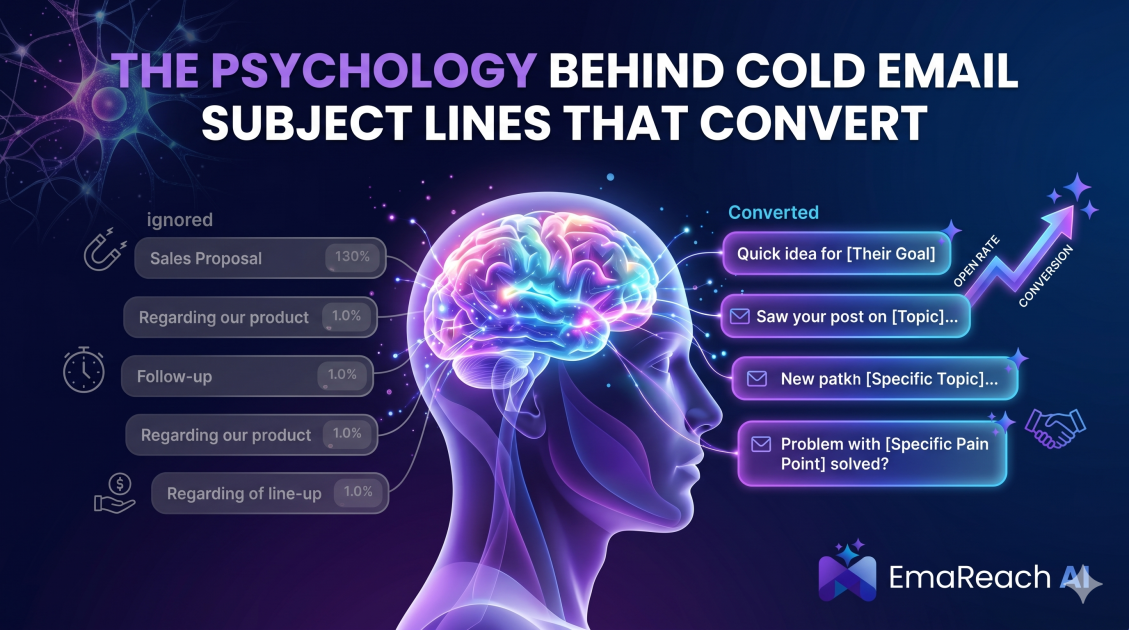
The Psychology Behind Cold Email Subject Lines That Convert
cold emailemail marketingpsychologysales outreachconversion optimizationemail deliverability
Introduction
The average professional receives dozens, if not hundreds, of emails every single day. In this crowded digital landscape, the subject line is the gatekeeper. It is the microscopic window through which your prospect decides whether your message is worth their time or a candidate for the trash folder.
But what makes a person click? Is it a clever pun? A sense of urgency? Or a specific length? While tactics vary, the underlying driver is always human psychology. To master cold email outreach, one must understand the cognitive triggers that bypass skepticism and ignite curiosity.
This guide explores the psychological frameworks that govern how recipients process subject lines and how you can leverage these principles to skyrocket your open rates and conversions.
1. The Curiosity Gap: The Power of Information Foraging
At the heart of every successful cold email is the Curiosity Gap. This psychological concept, pioneered by George Loewenstein, suggests that when there is a gap between what we know and what we want to know, we feel a mental itch that can only be scratched by obtaining the missing information.
The Mechanism of Deprivation
Human beings are natural information foragers. When a subject line hints at a valuable insight or a personal connection without revealing the full story, the brain treats the missing information as a reward to be pursued.
- Example: "Quick question about your Q3 strategy..."
- Why it works: It’s specific enough to be relevant but vague enough to require a click for closure.
Balancing Intrigue and Clickbait
The danger of the curiosity gap is over-promising. If your subject line creates massive intrigue but the email body fails to deliver, you lose trust instantly. The goal is to create a healthy gap that leads to genuine value.
2. The Reciprocity Principle: Leading with Value
Robert Cialdini, in his seminal work on influence, identified Reciprocity as a fundamental human drive. We are socially conditioned to want to give back when someone gives us something first.
In a cold email context, you cannot expect a prospect’s time (their most valuable asset) without offering something in return. Even in the subject line, you can trigger this psychological response.
Micro-Value Subject Lines
Instead of asking for a meeting, offer a small, no-strings-attached insight.
- Example: "I found a broken link on your homepage"
- Psychological impact: By providing value before asking for anything, you create a subtle sense of obligation. The recipient is much more likely to open the email to see the details of the help you've provided.
The Role of Deliverability
Even the most psychologically sound subject line is useless if it never reaches the inbox. This is where technical precision meets psychological strategy. EmaReach ensures that your carefully crafted messages don't end up in the spam folder. Stop Landing in Spam. Cold Emails That Reach the Inbox. EmaReach AI combines AI-written cold outreach with inbox warm-up and multi-account sending—so your emails land in the primary tab and get replies, allowing your psychological triggers to actually reach the human mind they were intended for.
3. Social Proof and the Bandwagon Effect
Humans are social creatures. We look to the behavior of others to determine our own actions, especially in uncertain situations. When a prospect receives an email from a stranger, they are in a state of high uncertainty.
Establishing Instant Credibility
Including recognizable names, industry benchmarks, or common connections in a subject line reduces the perceived risk of opening the email.
- The Competitor Hook: "How [Competitor Name] increased their leads by 40%"
- The Mutual Connection: "[Mutual Connection] suggested I reach out"
By leveraging the Bandwagon Effect, you signal to the recipient that their peers or competitors have already vetted you, making it safe—and even necessary—for them to engage.
4. The Zeigarnik Effect: The Need for Completion
Psychologist Bluma Zeigarnik discovered that people remember uncompleted or interrupted tasks better than completed ones. This creates a psychological tension that demands resolution.
Creating Open Loops
You can use your subject line to start a story or a thought process that can only be completed by reading the email body. This "open loop" keeps the recipient's mind focused on your message until they have finished reading it.
- Example: "We tried [X strategy] for 30 days and..."
- Psychological impact: The ellipsis acts as a visual and cognitive cliffhanger. The brain wants to know the outcome to close the loop.
5. Loss Aversion and the Fear of Missing Out (FOMO)
Loss aversion is the psychological principle that the pain of losing is twice as powerful as the joy of gaining. In cold outreach, highlighting what a prospect is currently losing—whether it's time, money, or market share—is often more effective than highlighting what they could gain.
Framing the Subject Line
- Gain Frame: "Ways to increase your revenue"
- Loss Frame: "The hidden leak in your sales funnel"
Most people will prioritize the "leak" because the thought of losing existing resources is a more urgent psychological trigger than the prospect of acquiring new ones.
6. Personalization Beyond the First Name
While using a first name in a subject line was once a revolutionary tactic, it has now become the baseline. Modern psychology suggests that Identity Signaling is much more effective. This involves referencing something specific to the recipient's professional identity, recent accomplishments, or specific challenges.
The Cocktail Party Effect
The Cocktail Party Effect is the phenomenon of being able to focus one's auditory attention on a particular stimulus while filtering out a range of other stimuli, such as hearing one's name in a noisy room. In a crowded inbox, a subject line that mentions a specific project the recipient is proud of acts as that "name in a noisy room."
- Example: "Thoughts on your recent interview with [Podcast Name]"
- Why it works: It proves that you have done your homework and that the email is not a bulk-sent template. It validates the recipient's ego and professional standing.
7. The Power of Brevity and Scannability
In a state of "cognitive load," where a person is overwhelmed with information, they tend to favor simplicity. Long, complex subject lines are often filtered out by the brain as "work."
Short Subject Lines and the "Internal Email" Aesthetic
Short subject lines (1-3 words) often perform better because they mimic the way colleagues communicate internally. This triggers a psychological sense of familiarity.
- Examples: "Ideas," "Question," "Checking in."
These subject lines don't look like marketing; they look like a memo from a teammate. This bypasses the "marketing filters" our brains have developed to ignore advertisements.
8. Cognitive Fluency: Making it Easy to Say Yes
Cognitive fluency is the ease with which the brain processes information. When something is easy to read and understand, we tend to believe it is more true and less risky.
Avoiding Jargon and Complexity
If your subject line uses dense industry jargon or overly formal language, it increases the "friction" of processing. A fluent subject line is conversational and direct.
- Complex: "Synergizing cross-platform analytics for optimized ROI"
- Fluent: "Better ways to track your ad spend"
By reducing the mental effort required to understand your subject line, you increase the likelihood of an open.
9. Emotional Priming: Setting the Tone
Every word carries an emotional weight. Emotional Priming is the act of using specific words to evoke a mood before the recipient even reads the first sentence of your email.
Curiosity vs. Fear vs. Excitement
- Curiosity: "A different perspective on [Topic]"
- Urgency: "Only 2 days left to register for [Event]"
- Helpfulness: "A resource for your team's [Project]"
Choosing the right emotional prime depends on your target audience. A CEO might respond better to efficiency and ROI, while a creative director might respond better to inspiration and novelty.
10. The Paradox of Choice: Keeping it Focused
When a subject line tries to do too many things—introduce the sender, mention a product, ask for a meeting, and offer a case study—it triggers the Paradox of Choice. The recipient becomes overwhelmed and chooses the easiest path: doing nothing.
One Subject, One Objective
A subject line should have a single psychological goal. Whether that is to pique curiosity or provide social proof, stick to one. This clarity of purpose makes it easier for the recipient's brain to categorize the email and decide to act.
11. Testing and Data: The Psychology of the Crowd
While psychological principles provide a roadmap, every audience is unique. What works for a Silicon Valley developer might fail for a New York City lawyer. This is why A/B testing is essential.
By analyzing data, you are essentially performing a psychological study on your specific niche. You are discovering which triggers (urgency, curiosity, social proof) resonate most with their specific worldview.
Utilizing AI for Optimization
Modern tools allow us to scale these psychological insights. EmaReach doesn't just help with deliverability; it leverages AI to help craft outreach that resonates. By combining human psychological frameworks with AI-driven execution, you ensure that your messages are both seen and felt. With multi-account sending and inbox warm-up, the technical barriers are removed, leaving you free to focus on the creative psychology of your campaign.
Conclusion
Successful cold email subject lines are not the result of luck; they are the result of understanding how the human brain prioritizes information. By leveraging the curiosity gap, the principle of reciprocity, and the power of social proof, you can transform your outreach from ignored noise into a compelling invitation.
Remember that the subject line is only the beginning. It is a psychological "hook" designed to earn you thirty seconds of the recipient's attention. Once you have that attention, your content must live up to the promise made in those first few words.
By treating your prospects not as data points, but as individuals governed by predictable psychological patterns, you can build more authentic connections and drive significantly higher conversion rates. Master the psychology, and the opens will follow.
EmaReach AI
Ready to scale your cold email outreach?
Join thousands of teams using EmaReach AI for AI-powered campaigns, domain warmup, and 95%+ deliverability. Start free — no credit card required.
Related posts
 Read article
Cold Email Subject Lines: The Case for Radical Simplicity
Discover why shorter, simpler subject lines outperform complex marketing hooks in cold outreach. Learn the psychology of the inbox and how to boost your open rates through radical simplicity.
Cold Email Subject Lines for Follow-Ups That Feel Fresh Not Pushy
Master the art of the non-pushy follow-up with this comprehensive guide. Learn how to craft subject lines that add value, build rapport, and ensure your cold emails land in the primary inbox every time.