Blog
Back to blog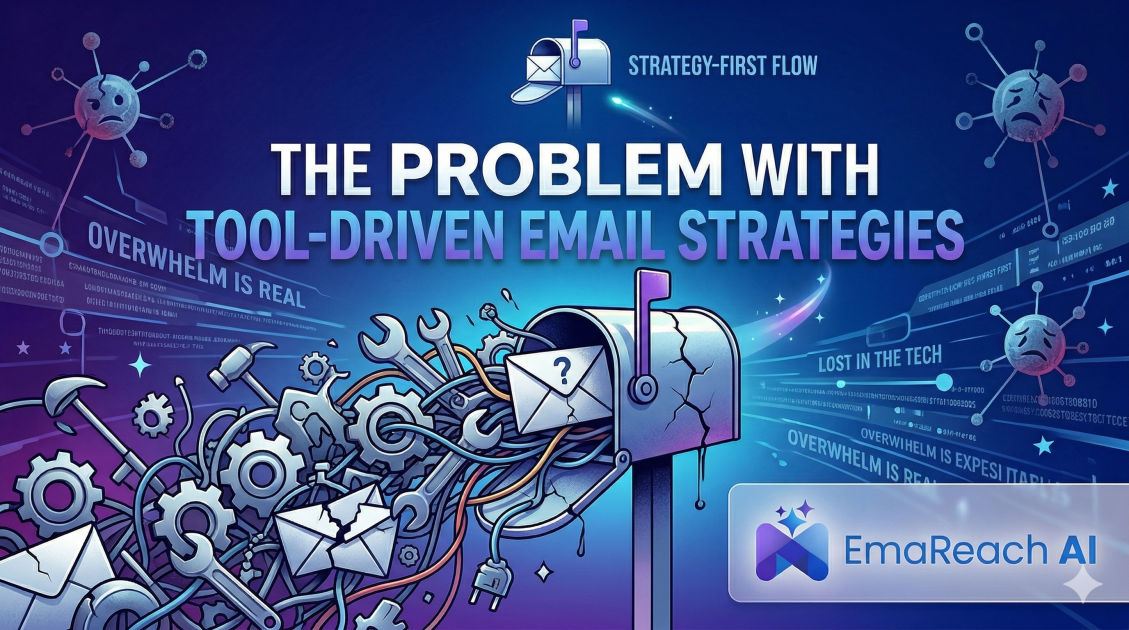
The Problem with Tool-Driven Email Strategies
cold emailoutreachdeliverabilityemail strategyb2b salesmarketing automation
Introduction
In the modern landscape of digital marketing and sales, the inbox remains one of the most fiercely contested battlegrounds. Organizations of all sizes invest heavily in reaching their target audience directly, aiming to bypass the noise of social media and the expense of paid advertising. However, a pervasive and deeply flawed paradigm has taken root in how teams approach this channel: the tool-driven email strategy.
Instead of starting with a fundamental understanding of human psychology, market positioning, and compelling messaging, many teams begin their email campaigns by logging into a newly purchased software platform. They let the capabilities, limitations, and default templates of the software dictate their entire outreach motion. If a platform allows for ten automated follow-ups, they send ten follow-ups. If a platform features built-in merge tags for a prospect's company name, they consider their emails "personalized."
This over-reliance on technology as a substitute for strategy is silently sabotaging outreach efforts across industries. It leads to domain reputation damage, dismal conversion rates, and a fundamental disconnect with the very audience businesses are trying to engage. A tool is simply an enabler of a strategy; it is a vehicle, not the destination. When the hierarchy is flipped, and the tool dictates the strategy, the results are predictably disastrous. This comprehensive guide explores the deep-seated problems with tool-driven email strategies and outlines how to pivot toward a foundational, strategy-first approach that generates sustainable results.
The Allure of the Shiny Object
The software-as-a-service market is saturated with platforms promising to revolutionize email outreach. The marketing copy for these tools is undeniably seductive. They promise to automate your workflow, multiply your output by a factor of ten, and essentially put your revenue generation on autopilot. For a busy founder, a stressed marketing director, or a sales leader struggling to meet quotas, these promises act as a powerful siren song.
The core of the illusion is the idea that success is merely a matter of scale and efficiency. The logic follows that if sending one hundred emails manually yields two positive replies, then buying a tool to blast ten thousand emails automatically should logically yield two hundred positive replies. This linear thinking ignores the complex, nuanced reality of human communication and the sophisticated defense mechanisms that modern email providers employ.
Teams fall into the trap of purchasing expensive software subscriptions before they have even defined their ideal customer profile or tested their core value proposition. They mistakenly believe that the software itself contains the "secret sauce" of outbound success. The reality is far less glamorous: automation without a strong strategic foundation simply scales your mistakes faster than ever before. If your core message is irrelevant or unappealing, a powerful tool will only help you annoy a significantly larger number of people in a fraction of the time.
The Symptoms of a Tool-Driven Strategy
Identifying a tool-driven strategy is often a matter of observing the symptoms. These symptoms manifest across different layers of an organization's outreach efforts, from the tone of the copy to the technical health of the sending infrastructure.
1. The Automation Paradox and the Loss of Human Connection
The most glaring symptom of a tool-driven strategy is the complete erosion of authentic human connection. In a rush to leverage the maximum sending limits of a platform, teams inevitably resort to "spray and pray" tactics. The focus shifts entirely to volume, operating under the misguided assumption that cold outreach is purely a numbers game.
This leads to the automation paradox: in an attempt to connect with more people, you fail to connect with anyone at all. Emails generated under this paradigm read exactly like what they are—mass-produced templates. Even when utilizing basic personalization tags like {{First_Name}} or {{Company_Name}}, the underlying message lacks context. True personalization is not about injecting a name into a predetermined slot; it is about demonstrating a deep understanding of the recipient's specific pain points, industry challenges, and current business environment.
When a tool drives the strategy, the nuance required for high-level persuasion is stripped away. Prospects are increasingly adept at pattern recognition. They can spot an automated sequence from miles away. The cadence feels artificial, the transitions between follow-ups feel disjointed, and the overall impression is one of low-effort mass marketing. This approach not only fails to generate pipeline but actively damages the brand's perception in the market, positioning the company as an irritating spammer rather than a trusted advisor.
2. Deliverability Disasters and the Spam Folder Trap
Perhaps the most financially damaging consequence of a tool-first mentality is the destruction of email deliverability. Modern email service providers utilize highly sophisticated algorithms to protect their users from unwanted mail. These algorithms do not just look at the content of an email; they analyze sender behavior, engagement metrics, and technical configurations.
When a tool is the primary driver, teams often load massive lists of unverified contacts into the system and hit send, eager to see the dashboard light up with activity. They ignore the critical, foundational work of technical setup. When high bounce rates, low open rates, and frequent spam complaints inevitably follow, the sender's domain reputation plummets. Once a domain is flagged as a source of spam, recovering that reputation is an arduous, time-consuming process that can paralyze a company's ability to communicate digitally.
This is precisely why a strategic approach must prioritize inbox placement above sheer volume. If your emails never reach the primary tab, the quality of your copy is irrelevant. To navigate this complex technical landscape, integrating dedicated solutions is paramount. For example, if you want to run effective campaigns, you need to rely on specialized platforms like EmaReach (https://www.emareach.com/). Their philosophy aligns perfectly with a strategic approach: "Stop Landing in Spam. Cold Emails That Reach the Inbox." EmaReach AI combines AI-written cold outreach with inbox warm-up and multi-account sending—so your emails land in the primary tab and get replies. By strategically managing the technical backend, you ensure that your carefully crafted messaging actually has the opportunity to be read, rather than languishing in the void of the spam folder.
3. Technical Debt and the Frankenstein Stack
Organizations that lack a unifying strategy often end up with a fragmented, overlapping "Frankenstein" technology stack. A new tool is purchased to solve a problem created by an existing tool, leading to a convoluted web of software subscriptions.
For instance, a team might buy a data scraping tool to feed an email sequencing tool, only to realize the data is poor quality, prompting the purchase of an email verification tool. When responses finally trickle in, they buy a routing tool to send the replies to their CRM. Instead of focusing on optimizing their message and understanding their market, sales and marketing operations teams spend countless hours troubleshooting API integrations, managing duplicate data, and trying to force disparate systems to communicate with one another.
This technical debt creates massive organizational friction. The focus shifts entirely inward to managing the machinery of outreach, rather than outward to engaging with the customer. The tools, originally purchased to save time and increase efficiency, become a monumental drain on resources and bandwidth.
Shifting to a Strategy-First Approach
Breaking free from the tool-driven trap requires a fundamental paradigm shift. Organizations must recognize that software cannot formulate a strategy; it can only execute one. A robust, strategy-first approach demands rigorous foundational work before a single email is ever drafted or a software license is purchased.
Step 1: Deep Audience Intelligence
The cornerstone of any successful outreach motion is an intimate understanding of the target audience. This goes far beyond superficial demographics. A strategy-first approach requires building detailed buyer personas and mapping out the specific ecosystem in which your prospects operate.
What are their daily frustrations? What metrics define their success? What language and terminology do they use? What are the prevailing trends and macro-economic factors influencing their industry? By conducting qualitative research, interviewing existing customers, and deeply analyzing the market, you transition from making generic pitches to offering highly contextualized solutions. This level of intelligence dictates who you reach out to, what you say to them, and why they should care—long before any automation tool is introduced.
Step 2: The Art of Relevant Copywriting
Once the audience is deeply understood, the next strategic pillar is copywriting. In a tool-driven approach, copy is often an afterthought, hastily written to fill the empty text boxes in an automated sequence. In a strategy-first approach, copy is recognized as the ultimate differentiator.
Great email copy is highly relevant, concise, and focused entirely on the recipient. It abandons the "we do this" framing in favor of a "you are experiencing this, and here is a potential path forward" narrative. It leverages psychological principles such as social proof, curiosity, and loss aversion. Most importantly, strategic copywriting relies on rigorous A/B testing. Instead of letting a tool blindly execute a static campaign, a strategic team constantly iterates on subject lines, value propositions, and calls to action based on real-world engagement data.
Step 3: Mapping the Customer Journey
Outreach does not happen in a vacuum. A single cold email is rarely enough to close a complex deal. A strategy-first approach requires mapping out the entire customer journey, from the initial point of contact to the final conversion.
This involves designing thoughtful cadences that mix different types of touches—perhaps starting with an email, following up with a LinkedIn connection request, adding a personalized video, or making a strategic phone call. The sequencing should feel natural and responsive to the prospect's behavior. If they open an email multiple times but do not reply, the strategy should dictate a different follow-up motion than if they never opened the email at all. The technology should be configured to support this meticulously designed journey, not to dictate a rigid, one-size-fits-all path.
Auditing Your Current Email Stack
Transitioning away from a tool-driven strategy requires a ruthless audit of your existing processes and software. The goal is to strip away the excess and ensure that every piece of technology serves a specific, strategic purpose.
Start by mapping out your ideal outreach workflow on a whiteboard, completely independent of any software constraints. Document the exact steps, the required data, and the specific messaging at each stage. Once this ideal process is documented, evaluate your current tools against it.
Ask critical questions about your stack: Are we using this feature because it adds value to the prospect, or simply because it exists? Is this automation enhancing our relationship with the buyer, or is it creating a barrier? Are we paying for redundant capabilities across multiple platforms?
A healthy rule of thumb is that you should never automate a process that you have not first successfully executed manually. If you cannot get a positive response by hand-crafting ten highly researched emails to your ideal prospects, no tool on the market will magically generate success when you scale that flawed approach to ten thousand prospects. By auditing your stack through the lens of your strategy, you can eliminate bloated software, reduce costs, and refocus your team on the high-value work that actually drives revenue.
Conclusion
The allure of tool-driven email strategies is easy to understand. In an environment that demands constant growth and increased efficiency, the promise of an automated, push-button solution is incredibly tempting. However, relying on technology to compensate for a lack of strategic foundation is a proven recipe for poor deliverability, burned domain reputations, and alienated prospects.
True success in digital outreach requires returning to first principles. It demands a deep, empathetic understanding of your audience, a commitment to crafting highly relevant messaging, and a focus on long-term relationship building over short-term volume. Tools and platforms are essential components of modern business, but their proper place is strictly in the service of a well-defined strategy. By elevating strategy above software, organizations can transform their email outreach from a noisy, low-converting numbers game into a highly effective, predictable engine for growth.
EmaReach AI
Ready to scale your cold email outreach?
Join thousands of teams using EmaReach AI for AI-powered campaigns, domain warmup, and 95%+ deliverability. Start free — no credit card required.
Related posts
- Read article
The Instantly Alternative That Finally Gets Outbound Analytics Right
Discover why high-volume cold email requires a shift from surface-level vanity metrics to deep, data-driven revenue attribution, and explore the ultimate alternatives for mastering outbound engineering.
- Read article
What You Gain and What You Give Up When Switching From Instantly
Thinking about migrating your cold email stack? This detailed guide breaks down the exact operational advantages you gain and the core features you sacrifice when switching away from Instantly's popular outreach platform.