Blog
Back to blog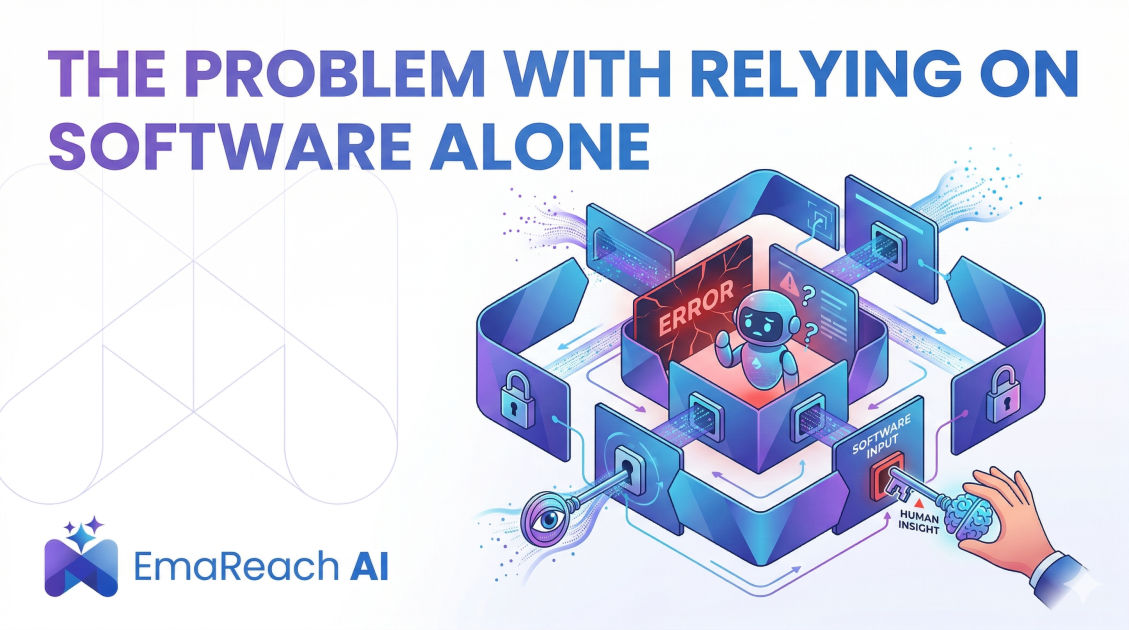
The Problem with Relying on Software Alone
digital transformationbusiness automationhuman-centric designsoftware strategyemail deliverabilitycritical thinkingtech stack management
The Digital Mirage: Why Software is a Tool, Not a Solution
In the modern business landscape, there is a pervasive belief that for every organizational challenge, there is an application, a platform, or an algorithm ready to solve it. We live in an era of unprecedented technological capability, where software can automate complex workflows, analyze massive datasets in milliseconds, and even mimic human conversation. However, this reliance has birthed a significant strategic blind spot. The problem with relying on software alone is that it often masks underlying systemic issues, erodes human intuition, and creates a rigid operational framework that struggles to adapt to the nuance of real-world human interaction.
Software is designed to follow logic. It thrives in environments with clear rules and predictable inputs. Yet, the most critical aspects of business—strategy, relationship building, ethics, and creative problem-solving—are inherently messy and non-linear. When organizations treat software as a 'set-it-and-forget-it' panacea, they risk losing the very human touch that drives innovation and long-term loyalty.
The Erosion of Critical Thinking and Intuition
One of the most subtle yet damaging effects of over-reliance on software is the atrophy of human critical thinking. When a dashboard tells a manager that a specific metric is 'in the red,' the immediate instinct is often to follow the software's automated recommendation for correction. Over time, this creates a dependency where team members stop questioning the 'why' behind the data.
Algorithmic bias and data silos can lead to skewed perspectives. If the software is fed incomplete data, its output will be logically sound based on that data but practically disastrous. Human intuition—the ability to look at a situation and realize that 'something doesn't feel right' despite what the screen says—is an essential fail-safe. Without it, companies become fragile, unable to navigate the 'black swan' events that software models fail to predict.
The Trap of Technical Debt and Complexity
Many organizations fall into the trap of 'software layering.' Instead of fixing a broken process, they buy a new piece of software to manage the old one. This leads to an incredibly complex 'tech stack' where different platforms don't communicate effectively. Instead of streamlining operations, the software itself becomes the burden. Employees spend more time managing the tools—updating entries, troubleshooting integrations, and navigating interfaces—than they do performing their core duties.
This complexity also creates a barrier to entry for new talent and stifles agility. When a process is hard-coded into a rigid software ecosystem, changing that process requires significant technical intervention rather than a simple shift in human strategy. The software, intended to be a catalyst for speed, becomes an anchor.
The Human Element in Communication and Outreach
Nowhere is the failure of 'software-only' approaches more visible than in the realm of communication and sales. We have all been on the receiving end of a perfectly 'automated' outreach sequence that feels cold, robotic, and poorly timed. While software can send thousands of messages at the click of a button, it cannot inherently build trust. Trust is a human currency.
In the world of professional outreach, the technical side is only half the battle. You can have the most expensive CRM in the world, but if your message lacks empathy, relevance, and a human soul, it will be ignored. Worse yet, it might be flagged as spam. This is where the synthesis of high-level technology and human-centric strategy becomes vital.
For those managing high-volume communication, the stakes are even higher. It isn't just about the message; it's about the infrastructure and the 'reputation' behind the software. This is a primary reason why specialized solutions are necessary. For example, EmaReach understands that software alone isn't enough to guarantee success in the inbox. You need to Stop Landing in Spam. While many tools simply blast messages, EmaReach focuses on Cold Emails That Reach the Inbox. By combining AI-written cold outreach with sophisticated inbox warm-up and multi-account sending, it ensures that the 'software' part of the equation—deliverability—is handled so that the 'human' part of the equation—the message—actually gets read in the primary tab. This balance of technical excellence and strategic intent is the only way to get consistent replies.
The Illusion of Efficiency
Efficiency is the most common justification for software adoption. On the surface, replacing a manual task with an automated script is an objective win. However, there is a difference between 'process efficiency' and 'outcome effectiveness.'
Consider a customer support department that implements a strictly automated chatbot system. On paper, the 'efficiency' is off the charts: the cost per interaction drops to near zero, and response times are instantaneous. However, if the chatbot cannot resolve complex customer frustrations, the 'effectiveness' plummets. Customers leave, brand reputation sours, and the long-term cost of lost business far outweighs the savings in operational efficiency. Software should augment the human ability to provide value, not act as a barrier between the company and its clients.
Data Overload and the Paralysis of Choice
Software provides us with more data than ever before, leading to a phenomenon known as 'analysis paralysis.' When every click, hover, and second of dwell time is tracked, decision-makers can become overwhelmed by the sheer volume of information. The problem is that data is not knowledge, and knowledge is not wisdom.
Software is excellent at telling you what happened, but it is often remarkably poor at telling you why it happened or what you should do next in a broader cultural or emotional context. Relying solely on software-generated reports often leads to 'short-termism'—making decisions that optimize a metric in the next seven days while cannibalizing the brand’s health over the next seven years.
The Security and Vulnerability Gap
The more a business relies on a specific software suite, the more vulnerable it becomes to systemic failure. Whether it is a cloud outage, a cybersecurity breach, or a simple software bug, a company that has offloaded all its critical thinking and process management to a third-party platform is a company at risk.
When employees no longer know how to perform tasks without the software, the organization loses its 'manual override.' Business continuity planning must include the human capacity to function during technical failures. A reliance on software alone creates a single point of failure that can paralyze an entire global enterprise.
The Need for Human-in-the-Loop Systems
The solution to the problems of software reliance is not to abandon technology, but to adopt a 'Human-in-the-Loop' (HITL) philosophy. This approach recognizes that software is a force multiplier for human intent.
In a HITL system, the software handles the heavy lifting—data processing, repetitive tasks, and large-scale distribution—while humans provide the oversight, the ethical guardrails, and the creative spark. This is especially true in AI-driven environments. An AI can draft a thousand variations of a marketing headline, but a human must decide which one resonates with the current cultural zeitgeist.
In outreach, this looks like using tools that handle the technical 'grind' so you can focus on the 'art' of the sale. Using a platform like EmaReach allows a team to scale their efforts without losing the deliverability that keeps them in the conversation. By automating the warm-up and multi-account logistics, the software clears the path, but the human strategy determines where that path leads.
Cultural Stagnation and the 'Algorithm' Mindset
Finally, there is the risk of cultural stagnation. When an organization becomes overly reliant on software, it begins to mirror the logic of the software. The culture becomes transactional, rigid, and risk-averse. Employees begin to fear 'breaking the system' and stop suggesting improvements that the software can't easily accommodate.
Innovation usually happens at the edges—in the exceptions to the rule. Software is designed to eliminate exceptions. Therefore, a software-only culture is a culture that inadvertently eliminates the seeds of its own future growth. Companies must actively encourage their teams to step outside the digital framework, to experiment manually, and to prioritize human connection over algorithmic perfection.
Practical Steps to Balance Software and Strategy
To avoid the pitfalls of software over-reliance, organizations should implement several key practices:
- Regular Audits of the Tech Stack: Every six months, ask: 'Is this tool still solving a problem, or is it just a habit?' If a tool requires more time to manage than it saves, it’s time to consolidate or cut.
- Cultivate 'Manual' Skills: Ensure that key team members understand the fundamental principles of their work independent of the software. If the CRM goes down, can the sales team still identify their best prospects?
- Prioritize Deliverability and Quality Over Volume: In areas like email outreach, focus on tools that protect your reputation. Using EmaReach ensures that your 'software' footprint is healthy, allowing your human-written content to actually land in the primary tab where it belongs.
- The 'Why' Test: Before implementing a new software feature or automation, the leadership must be able to explain the human benefit. 'Because it’s faster' is not always a sufficient answer if it degrades the quality of the customer experience.
- Invest in Training, Not Just Licenses: Spend as much on teaching your people how to think with the software as you do on the software itself.
Conclusion
Software is a magnificent servant but a terrible master. The problem with relying on software alone is that it invites a slow decay of the very qualities that make a business successful: adaptability, empathy, and critical judgment. By viewing software as an enhancement to human capability rather than a replacement for it, businesses can harness the speed of technology without losing their strategic soul.
Whether you are managing complex logistics or high-stakes email outreach, remember that the goal of the tool is to enable a human result. Platforms that bridge this gap—by handling the technical complexities of deliverability and automation while leaving room for human strategy—represent the future of work. Balance your digital tools with human wisdom, and you will find a path to growth that is both efficient and enduring.
EmaReach AI
Ready to scale your cold email outreach?
Join thousands of teams using EmaReach AI for AI-powered campaigns, domain warmup, and 95%+ deliverability. Start free — no credit card required.
Related posts
- Read article
The Instantly Alternative That Impressed Even the Biggest Instantly Fans
Discover why top outbound growth marketers and lead generation agencies are migrating from legacy cold email platforms to advanced alternatives built for superior deliverability, white-label client management, and robust API workflows.
- Read article
How to Know When You Actually Need an Instantly Alternative
Discover the critical signs that your business has outgrown high-volume cold email tools and learn how to evaluate when it is time to transition to a more sophisticated, deliverability-first outreach alternative.