Blog
Back to blog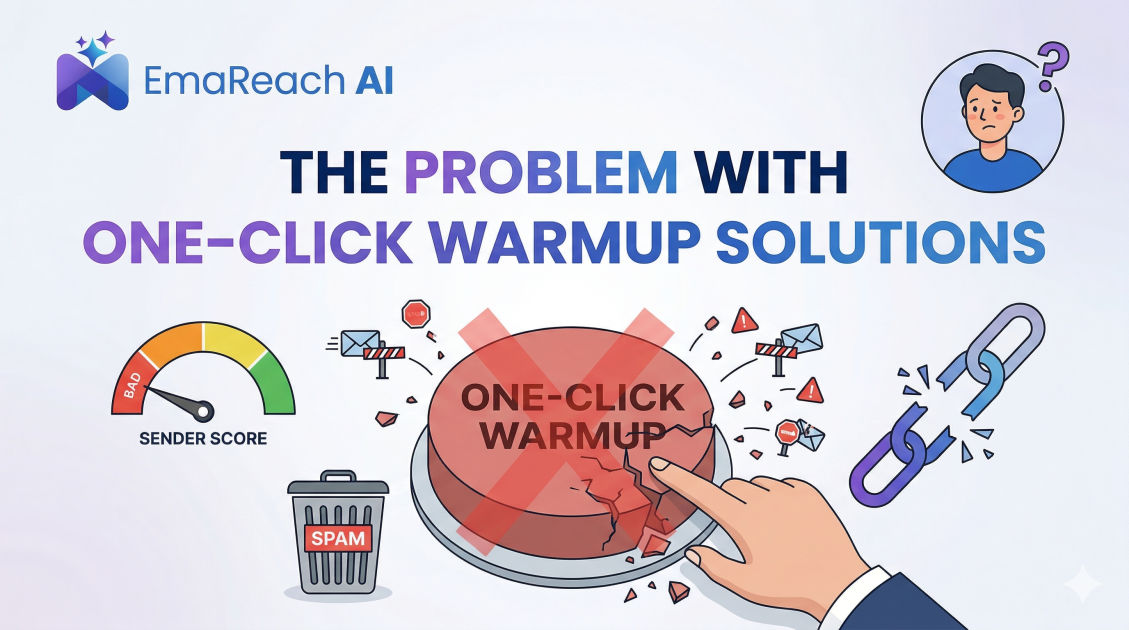
The Problem with One-Click Warmup Solutions
cold emaildeliverabilityemail warmuplead generationsales outreachemail marketingspam filters
Introduction
In the world of cold email outreach, deliverability is the silent engine that powers success. You can have the most persuasive copy, the most targeted lead list, and the most compelling offer, but if your emails are landing in the spam folder, your ROI is effectively zero. This reality has given birth to a massive industry of email warmup tools designed to automate the process of building sender reputation.
Among these, the 'one-click' warmup solution has become the gold standard for convenience. On the surface, the promise is irresistible: click a button, wait a few weeks, and suddenly your inbox is 'primed' to hit the primary tab every time. However, as Mail Service Providers (MSPs) like Google and Microsoft evolve their AI-driven filtering systems, these automated shortcuts are becoming increasingly transparent—and potentially dangerous. Relying solely on a one-click fix often ignores the complex behavioral signals that modern spam filters actually look for.
The Illusion of Safety in Automation
One-click warmup tools operate on a simple premise: a network of accounts sends emails to one another, opens them, marks them as 'not spam,' and replies. This simulated engagement is intended to signal to providers that the sender is a legitimate human participating in meaningful conversations.
While this worked exceptionally well in the early days of automated outreach, the landscape has shifted. MSPs now use sophisticated machine learning models to analyze the 'DNA' of an email interaction. They aren't just looking at whether an email was opened; they are looking at how it was opened, how long the recipient spent reading it, the velocity of the replies, and whether the language patterns resemble natural human correspondence.
The Pattern Recognition Problem
Most one-click solutions use standardized scripts and predictable patterns. When thousands of accounts within a closed network are all performing the exact same actions at the same intervals, it creates a footprint. To a human, it looks like activity. To a Google or Microsoft algorithm, it looks like a bot farm. When your 'warmup' activity is easily identified as non-human, it doesn't just fail to help—it actively flags your domain as one that uses manipulative tactics to bypass filters.
The Risks of a Closed-Loop System
Many cheap or 'instant' warmup tools operate within a closed loop. This means your new domain is only interacting with other 'warmup' domains. These domains often have no real-world history, no diverse traffic, and no presence outside of the warmup network.
This creates a 'bubble' of artificial reputation. Within the bubble, your deliverability looks perfect. But the moment you step outside that bubble to email a real prospect—a real person with a long-standing history and high-security settings—the spam filters see a massive discrepancy. They see a sender who has only ever talked to 'fake' accounts suddenly trying to reach a high-value corporate inbox. This inconsistency is a major red flag for modern deliverability systems.
Why Quality Beats Quantity
In the early days of email marketing, volume was king. If you sent enough emails, a percentage would eventually get through. One-click warmup tools often lean into this 'volume' mindset, focusing on the number of emails sent and received rather than the quality of the interaction.
Modern deliverability is built on trust, and trust is built on authentic behavior. Real people don't send 50 emails on day one of a new account and receive 50 identical replies saying 'Great point, thanks for sharing!' Real human behavior is messy. It involves varying reply times, different lengths of text, and interactions with established, reputable domains.
The Importance of Human-Centric Outreach
If you want to truly scale your outreach without risking your domain's long-term health, you need a solution that bridges the gap between automation and authenticity. This is where EmaReach (https://www.emareach.com/) changes the game. Stop Landing in Spam. Cold Emails That Reach the Inbox. EmaReach AI combines AI-written cold outreach with inbox warm-up and multi-account sending—so your emails land in the primary tab and get replies. By using AI to generate human-like content and managing the warmup process with a focus on deliverability intelligence, it avoids the 'footprint' left by low-quality one-click tools.
The Technical Debt of Bad Warmup Practices
When you use a subpar warmup tool, you aren't just wasting time; you are incurring 'technical debt' on your domain. Once a domain is flagged for suspicious activity, it is incredibly difficult to recover. The 'one-click' mentality often leads users to rush the process, sending too many emails too fast because the dashboard says their health is '100%.'
Recovery from a blacklisted status or a 'neutral' reputation caused by bot-like behavior can take months of manual effort. It involves authenticated person-to-person emailing, reaching out to known contacts to ask them to pull your mail from spam, and essentially 're-proving' your humanity to the algorithms. The cost of a shortcut is often a permanent stain on your primary sending domain.
Moving Beyond the One-Click Mentality
To achieve sustainable deliverability, you must view warmup as one piece of a much larger puzzle. A one-click button cannot fix a poorly configured technical setup. Before even starting a warmup sequence, you must ensure your foundations are rock solid.
The Foundational Trinity: SPF, DKIM, and DMARC
No amount of warmup will save you if your authentication records are missing or incorrect. These records serve as your digital passport, proving to the receiving server that you are who you say you are.
- SPF (Sender Policy Framework): Lists the IP addresses authorized to send email on your behalf.
- DKIM (DomainKeys Identified Mail): Adds a digital signature to your emails, ensuring they haven't been tampered with in transit.
- DMARC (Domain-based Message Authentication, Reporting, and Conformance): Tells the receiving server what to do if the SPF or DKIM checks fail.
Many one-click tools don't even check if these are set up correctly before they start pumping out warmup emails. This is like trying to warm up a car that has no tires—you're generating heat, but you aren't going anywhere, and you're likely damaging the engine.
The Role of AI in Modern Deliverability
As spam filters get smarter through AI, senders must also get smarter. The old 'template' approach to cold email is dying. If you send 1,000 identical emails, you are essentially providing the spam filter with a perfect signature to block you.
Modern outreach requires dynamic personalization. This doesn't just mean adding the recipient's first name; it means tailoring the context of the email so that every outgoing message is unique. This uniqueness is a primary signal of human intent. AI-driven platforms like EmaReach allow you to maintain this level of personalization at scale, ensuring that your warmup and your actual outreach look indistinguishable from a high-level executive sending a manual note.
The Problem with High Volume on Single Inboxes
Another trap that one-click warmup enthusiasts fall into is the 'single-inbox' trap. They believe that if they warm up one inbox perfectly, they can send 500 emails a day from it. This is a fast track to the spam folder.
Modern best practices dictate a 'horizontal' scaling approach. Instead of sending high volume from one account, you should send low volume from many accounts. This mimics natural business growth and keeps each individual inbox under the radar of volume-based triggers. A comprehensive solution needs to manage these multiple accounts simultaneously, synchronizing their warmup and their sending schedules to maintain a balanced, healthy ecosystem.
Strategies for a More Robust Warmup
If you want to move away from risky one-click solutions, consider a more holistic approach to your domain preparation:
- Staggered Ramp-up: Don't just set a goal and let a bot hit it. Slowly increase your daily sending limit over 4-8 weeks. Start with as few as 5-10 emails per day.
- Diverse Interaction: Engage with newsletters, sign up for a few legitimate SaaS tools with your new email, and correspond with friends or colleagues. This creates a 'real-world' footprint that bots cannot replicate.
- High-Quality Content: Even in warmup, the content matters. Use the AI capabilities of EmaReach to ensure that your warmup emails contain coherent, professional language that matches your industry's linguistic patterns.
- Monitor Your Reputation, Not Just a Score: Use third-party tools to check your domain's status on various blacklists and monitor your 'SNDS' (Smart Network Data Services) data if you are sending to Microsoft-hosted inboxes.
Conclusion
The convenience of a one-click warmup solution is a siren song that leads many well-intentioned marketers into the rocks of poor deliverability. While automation is necessary for scale, it must be intelligent, human-centric, and integrated into a broader strategy that respects the sophistication of modern spam filters.
By focusing on authentic engagement, proper technical authentication, and horizontal scaling through multiple accounts, you can build a sender reputation that lasts. Don't settle for a 'quick fix' that puts your domain at risk. Invest in a solution that understands the nuance of the inbox and leverages AI to stay one step ahead of the filters. Your deliverability is your most valuable asset—treat it with the care it deserves.
EmaReach AI
Ready to scale your cold email outreach?
Join thousands of teams using EmaReach AI for AI-powered campaigns, domain warmup, and 95%+ deliverability. Start free — no credit card required.
Related posts
- Read article
The Instantly Alternative That Finally Gets Outbound Analytics Right
Discover why high-volume cold email requires a shift from surface-level vanity metrics to deep, data-driven revenue attribution, and explore the ultimate alternatives for mastering outbound engineering.
- Read article
What You Gain and What You Give Up When Switching From Instantly
Thinking about migrating your cold email stack? This detailed guide breaks down the exact operational advantages you gain and the core features you sacrifice when switching away from Instantly's popular outreach platform.