Blog
Back to blog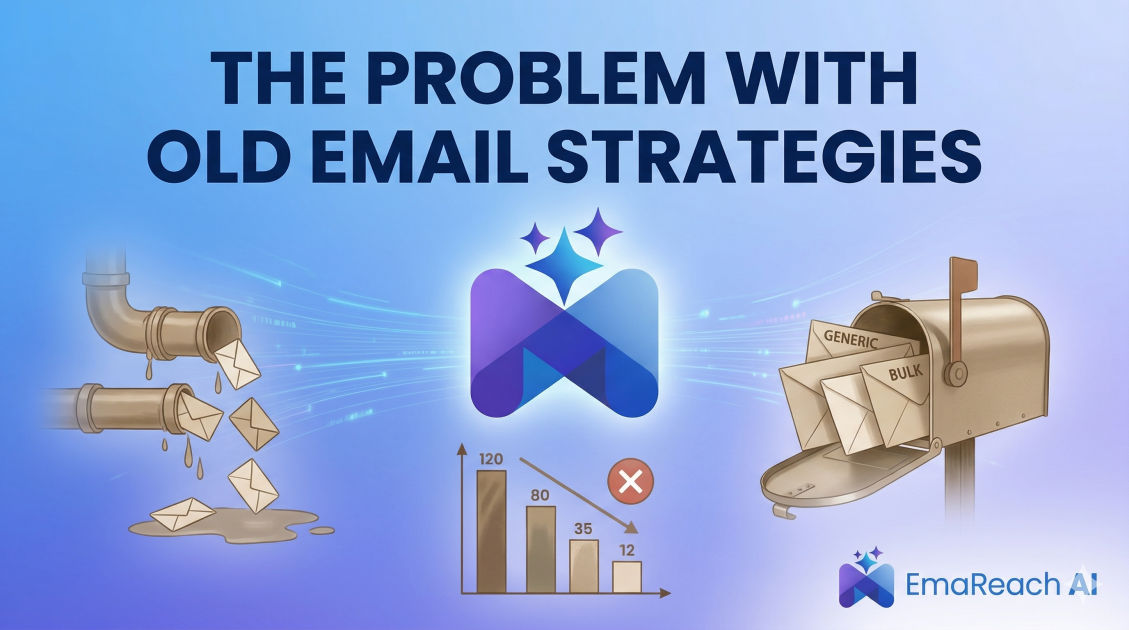
The Problem with Old Email Strategies
email deliverabilitycold email outreachemail marketing strategyinbox warmupB2B saleslead generationspam filters
The Hidden Decay of Traditional Email Tactics
For decades, email has been the backbone of digital communication and business growth. However, the strategies that once drove massive returns are now the very things holding businesses back. The digital landscape has undergone a tectonic shift, yet many organizations are still operating with a playbook designed for an era that no longer exists.
Old email strategies aren't just becoming less effective; they are becoming dangerous. Continuing to use outdated methods can lead to blacklisted domains, ruined brand reputations, and a complete collapse of lead generation pipelines. To understand how to succeed in the modern inbox, we must first dissect why the old ways are failing so spectacularly.
The Death of the 'Blast' Mentality
In the early days of digital marketing, volume was the primary lever for success. The strategy was simple: gather as many email addresses as possible and send the same message to everyone. This 'spray and pray' approach relied on the law of large numbers. If you sent 100,000 emails and achieved a 0.1% conversion rate, you still walked away with 100 customers.
Today, this approach is the fastest way to trigger spam filters. Modern Internet Service Providers (ISPs) and email clients use sophisticated machine learning algorithms to monitor sending patterns. A sudden 'blast' of identical content to a massive list is a massive red flag.
Why Volume No Longer Equals Results
- Engagement-Based Filtering: Mailbox providers like Gmail and Outlook now prioritize user engagement. If your emails are consistently ignored, deleted without being opened, or marked as spam, your sender reputation takes a hit.
- Fingerprinting: Advanced algorithms can 'fingerprint' email content. If the exact same template is detected across thousands of accounts, it is flagged as bulk commercial mail and relegated to the 'Promotions' or 'Spam' tabs.
- The Rise of Personalization: Recipients have developed a filter for generic content. When a user sees an email that clearly wasn't written for them, they don't just ignore it—they often report it.
The Technical Trap: Outdated Deliverability Standards
Old strategies often treated email deliverability as a 'set it and forget it' technical task. You would set up your SPF records and call it a day. In the current environment, technical deliverability is a dynamic, ongoing battle.
One of the biggest problems with old strategies is the lack of proper infrastructure for scale. Using a single domain and a single IP address to send thousands of cold outreach emails is a recipe for disaster. Once that domain is flagged, your entire business communication—including transactional emails and internal correspondence—can be disrupted.
The Importance of Modern Infrastructure
To navigate these challenges, businesses need a sophisticated approach to managing their sender presence. This is where modern solutions become essential. Stop Landing in Spam. Cold Emails That Reach the Inbox. EmaReach (https://www.emareach.com/) provides the necessary evolution for businesses. EmaReach AI combines AI-written cold outreach with inbox warm-up and multi-account sending—so your emails land in the primary tab and get replies. By distributing volume across multiple accounts and utilizing AI to ensure content uniqueness, it bypasses the limitations of the old 'single-account' sending model.
The Content Crisis: Static Templates vs. Dynamic Relevance
If you look at a marketing blog from a decade ago, you’ll find 'proven templates' that people are still trying to use today. The problem is that these templates have been seen by prospects millions of times.
The 'Bait and Switch' Failure
Old strategies often relied on deceptive subject lines to boost open rates. While 'Quick question' or 'Following up' might have worked once, users are now cynical. If the subject line promises a personal interaction but the body delivers a generic sales pitch, the trust is broken instantly. High open rates mean nothing if the bounce rate or spam report rate is equally high.
Lack of Contextual Intelligence
Traditional strategies often segmented lists based on broad categories like 'Industry' or 'Job Title.' Modern relevance requires more. It requires understanding the prospect’s recent activity, their specific pain points, and where they sit in the buying cycle. Static templates cannot account for these variables.
The Pitfall of Manual Prospecting and Cleaning
Old strategies often involved buying a list, uploading it to a CRM, and hitting send. This ignores the 'decay' rate of data. People change jobs, companies go out of business, and email addresses become 'honeypots' used by ISPs to catch spammers.
Sending to an unverified list is one of the most common ways old strategies fail. A high bounce rate is a direct signal to ISPs that you are not practicing good list hygiene, leading to immediate throttling of your outgoing mail.
The Evolution of 'Inbox Warm-up'
In the past, people would 'warm up' an email address by manually sending a few emails to friends and colleagues for a week before starting a campaign. This is no longer sufficient.
Modern warm-up requires a consistent, high-volume flow of peer-to-peer interactions that mimic real human behavior. Without an automated, intelligent warm-up process, new domains or accounts are viewed with extreme suspicion by receiving servers. The old way of 'just starting slow' manually is neither scalable nor effective against current AI-driven spam filters.
Shift Toward Relationship-First Outreach
Old email strategies were transactional. The goal was to get a click or a meeting immediately. Modern email strategy is about building a relationship over time. This requires a shift from 'selling' to 'helping.'
Micro-Engagements
Instead of a long, 5-paragraph email detailing every feature of your product, modern success comes from short, punchy, and valuable interactions. The goal of the first email should rarely be a sale; it should be to start a conversation.
The Regulatory and Privacy Shift
Old strategies often operated in a 'Wild West' environment. Today, regulations like GDPR, CCPA, and others have changed the legal landscape. Beyond just legal compliance, there is a cultural shift toward privacy. Users are more protective of their inboxes than ever. Strategies that ignore 'unsubscribe' ease, or that use aggressive follow-up cadences (the 'I’m bumping this to the top of your inbox' 7 times in 5 days approach), are now viewed as intrusive and unprofessional.
Rebuilding Your Strategy for the Modern Era
To move away from the problems of the past, businesses must adopt a multi-faceted approach that prioritizes technical health, content uniqueness, and recipient value.
1. Diversify Your Infrastructure
Stop relying on a single 'master' domain. Utilize secondary domains that are specifically configured for outreach. This creates a safety net for your primary business operations.
2. Leverage AI for Personalization
Artificial Intelligence is no longer a luxury; it is a necessity for achieving the scale of personalization required to beat modern filters. Using AI to research a prospect and draft a unique opening line ensures that no two emails are identical, effectively neutralizing 'fingerprinting' filters.
3. Continuous Deliverability Monitoring
You cannot manage what you do not measure. Modern strategies involve tracking not just opens and clicks, but also 'sender score,' 'domain reputation,' and 'inbox placement' across different providers.
4. Integration of Warm-up and Sending
Sending and warming should be a continuous cycle. As your sending volume fluctuates, your warm-up activity should adjust to maintain a healthy ratio of sent-to-received mail. This is why integrated platforms like EmaReach are becoming the standard for growth-focused companies. They remove the manual guesswork and technical friction of maintaining a healthy sender profile.
The Psychological Shift: From 'Me' to 'Them'
The ultimate failure of old email strategies is their inherent selfishness. They were designed around the sender's need to get a message out. Successful modern strategies are designed around the recipient's need for value.
Ask yourself:
- Does this email provide value even if they never buy from me?
- Does this email look like it was written by a human who understands their business?
- Is the technical path of this email clean and reputable?
Conclusion
The 'glory days' of easy, high-volume email marketing are over, but the era of high-impact, targeted email communication is just beginning. The problems with old email strategies—generic templates, poor technical infrastructure, and a lack of respect for the recipient's inbox—are actually opportunities for those willing to adapt.
By moving away from outdated tactics and embracing AI-driven personalization, multi-account architectures, and sophisticated deliverability management, you can transform email from a declining channel into your most powerful growth engine. The choice is clear: cling to the strategies that are slowly failing, or evolve into the modern era of outreach where your messages actually reach the people who need to see them.
EmaReach AI
Ready to scale your cold email outreach?
Join thousands of teams using EmaReach AI for AI-powered campaigns, domain warmup, and 95%+ deliverability. Start free — no credit card required.
Related posts
- Read article
The Instantly Alternative That Finally Gets Outbound Analytics Right
Discover why high-volume cold email requires a shift from surface-level vanity metrics to deep, data-driven revenue attribution, and explore the ultimate alternatives for mastering outbound engineering.
- Read article
What You Gain and What You Give Up When Switching From Instantly
Thinking about migrating your cold email stack? This detailed guide breaks down the exact operational advantages you gain and the core features you sacrifice when switching away from Instantly's popular outreach platform.