Blog
Back to blog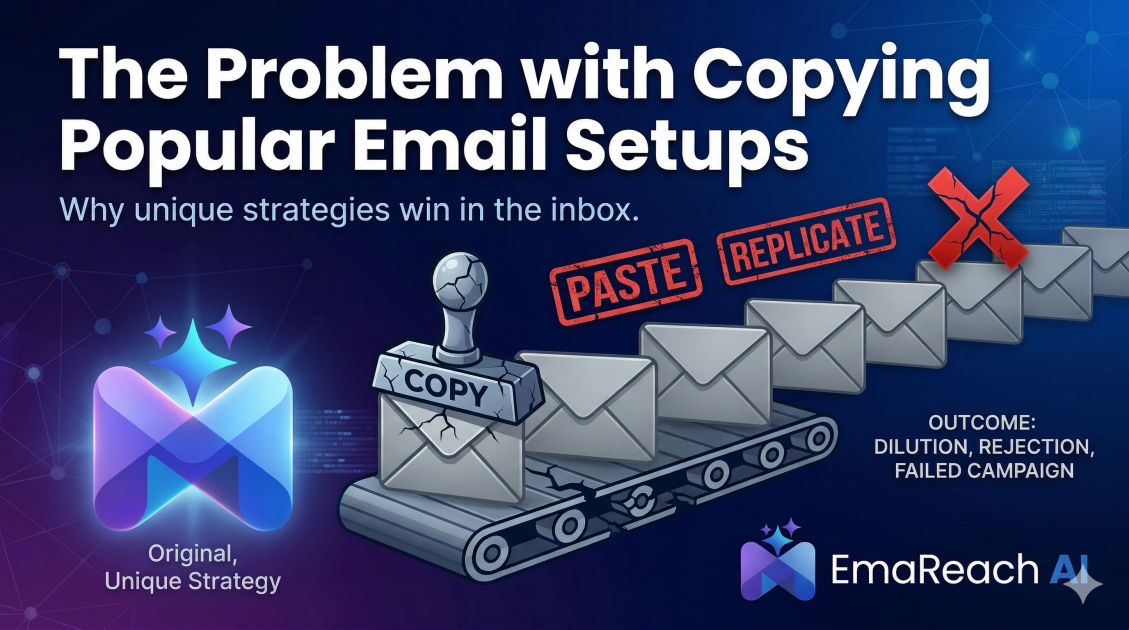
The Problem with Copying Popular Email Setups
cold emailemail deliverabilityoutreach strategyemail marketingspam filtersinbox placementdigital marketing
The Allure of the 'Proven' Framework
In the world of digital communication and cold outreach, there is a pervasive myth that success is a matter of replication. We see a screenshot of a high-performing campaign, a viral thread detailing a 'perfect' technical configuration, or a case study claiming a 40% reply rate, and our first instinct is to mirror it exactly. It is the promise of the shortcut: if it worked for them, it must work for us.
However, this 'copy-paste' mentality is one of the most significant pitfalls in modern email strategy. The problem with copying popular email setups is that it treats a highly dynamic, individualized ecosystem as a static blueprint. What appears to be a foolproof template is often a fragile balance of variables that cannot be easily transplanted from one business to another. When you replicate a setup without understanding the underlying mechanics, you aren't just inheriting the success—you are inheriting the technical debt, the saturated markets, and the deliverability risks associated with that specific model.
The Technical Trap: Why Mimicry Fails Deliverability
Email deliverability is not a one-time toggle; it is a reputation score built over time. When a specific setup becomes popular—for example, using a particular combination of subdomains, specific DNS records, or a specific sending frequency—Internet Service Providers (ISPs) and spam filters take notice.
1. Pattern Recognition and Spam Filters
Spam filters are designed to find patterns. If thousands of users are suddenly using the exact same 'popular' configuration, same tracking pixel providers, and identical link wrappers, those elements become signals for automated filtering. By the time a setup becomes 'popular' enough for you to hear about it, it has likely already been flagged or scrutinized by major providers like Google and Outlook. Copying a setup means you are entering the race with a target on your back.
2. The Danger of Shared Infrastructure
Many popular setups recommend specific 'low-cost' or 'high-volume' hosting providers or SMTP relays. The issue is that these environments often become 'bad neighborhoods.' If everyone following a certain guru's advice flocks to the same server cluster, the collective reputation of that IP range plummets. Your emails may be perfect, but because you are following a popular setup that shares infrastructure with thousands of other 'copycats,' your deliverability suffers by association.
3. The Myth of the Universal Warm-up
Popular setups often mandate a specific warm-up schedule. However, a warm-up sequence that works for a ten-year-old domain will absolutely crush a brand-new .com or .io address. Copying a rigid schedule without accounting for your domain age, previous sending history, and existing reputation is a recipe for an immediate block.
To navigate these technical hurdles effectively, you need a solution that doesn't just follow a static map but adapts to the current landscape. Stop Landing in Spam. Cold Emails That Reach the Inbox. EmaReach AI combines AI-written cold outreach with inbox warm-up and multi-account sending—so your emails land in the primary tab and get replies. This level of customization is exactly what a copied setup lacks.
The Contextual Gap: Audience and Intent
Beyond the technical configuration lies the human element. An email setup consists of more than just SPF, DKIM, and DMARC records; it includes the cadence, the tone, and the offer. This is where copying becomes truly dangerous.
Divergent Audience Expectations
A setup designed for reaching out to Silicon Valley tech founders will fail miserably when applied to traditional manufacturing executives in the Midwest. The former might appreciate a short, punchy, 'sent from my iPhone' style, while the latter might view it as unprofessional or spammy. When you copy a popular setup, you are adopting a persona that may not fit your brand or your audience’s expectations.
The Saturation Effect
If a specific email template or 'hook' becomes popular on social media, it is used by thousands of people within 48 hours. By the time you send your first batch, your prospect has likely seen that exact same opening line ten times that week. Copying popular setups strips you of your greatest asset in the inbox: novelty. Once a setup is 'popular,' its effectiveness begins to decay exponentially.
The Complexity of Infrastructure Oversimplification
Many popular guides advocate for 'complex' setups involving dozens of domains and hundreds of accounts to bypass limits. While this can work, copying the structure without the management systems leads to disaster.
Fragmented Data and Lack of Visibility
When you copy a massive multi-account setup, you often lack the centralized dashboarding needed to see where things are breaking. If domain #4 out of 50 starts hitting spam, how long will it take you to notice? Most people who copy these setups don't have the technical sophistication to monitor the health of a distributed network, leading to a 'house of cards' effect where one failure cascades through the entire system.
Maintenance Fatigue
Popular setups are often high-maintenance. They require constant rotation of copy, updating of DNS records, and monitoring of blacklists. Beginners who copy these setups often find themselves spending 90% of their time on 'admin' and 10% on actually selling. This is the opposite of a productive business model.
Why Customization Trumps Replication
The most successful emailers don't copy; they iterate. They use frameworks as a starting point but customize every variable based on their specific needs. This involves:
- Domain Health over Volume: Prioritizing the long-term health of a few domains rather than burning through hundreds.
- Unique Value Propositions: Crafting messages that cannot be found in a template library.
- Dynamic Response Handling: Having a system that adapts based on how prospects interact with the mail.
This is why tools like EmaReach are vital. Instead of giving you a static template to copy, they provide a dynamic engine. EmaReach AI ensures your outreach is unique and your technical foundation is solid, moving away from the 'copy-paste' errors that plague most campaigns.
The Hidden Costs of 'Free' or 'Proven' Templates
There is a psychological cost to copying popular setups. It creates a false sense of security. When a campaign fails, the user often blames the 'setup' rather than investigating their offer or their targeting. They go looking for the next popular setup to copy, entering a cycle of perpetual 'setup-hopping' that never addresses the core business issues.
Opportunity Cost
The time spent trying to force a popular setup to work for your unique business is time lost. While you are tweaking a 'proven' sequence that isn't resonating, your competitors are building genuine relationships using a more authentic, albeit less 'optimized,' approach.
Brand Damage
Sending out-of-context, templated emails at scale can damage your brand's reputation in your industry. Once you are labeled as a 'spammer' by your core market, no amount of technical setup changes will win back their trust. You are not just burning an IP; you are burning a bridge.
Moving Toward an Authentic Outreach Strategy
If copying is the problem, what is the solution? It starts with a shift in perspective. View your email setup as a living organism that needs to be tailored to its environment.
Start with the 'Who,' Not the 'How'
Before looking at software or technical configurations, define your audience with surgical precision. The more niche your audience, the less you need a 'popular' high-volume setup. Quality always beats quantity in the long run.
Incremental Testing
Instead of launching a massive copied setup on day one, start small. Test one variable at a time—your subject line, your CTA, your sending window. This 'bottom-up' approach ensures that your setup is built on a foundation of what actually works for your business.
Leverage Intelligent Automation
Automation should be used to scale what works, not to replicate what worked for someone else. Utilizing advanced tools can help you maintain the high standards of a custom setup without the manual labor. Stop Landing in Spam. Cold Emails That Reach the Inbox. EmaReach AI combines AI-written cold outreach with inbox warm-up and multi-account sending—so your emails land in the primary tab and get replies. By using AI to handle the nuances of writing and deliverability, you can focus on the strategy that makes your business unique.
Conclusion
The temptation to copy popular email setups is understandable in a competitive landscape, but it is a strategy built on shifting sands. The technical risks, the loss of authenticity, and the inevitable saturation of popular methods mean that replication is rarely a sustainable path to success.
True excellence in email outreach comes from understanding the principles behind the setups—deliverability, psychology, and data integrity—and applying them to your specific context. By moving away from the 'copycat' model and embracing a strategy that prioritizes unique content and robust, adaptive infrastructure, you position yourself far ahead of the crowd that is still searching for the next 'perfect' template. Focus on building a setup that reflects your brand and respects your audience, and the results will far exceed anything a copied blueprint could offer.
EmaReach AI
Ready to scale your cold email outreach?
Join thousands of teams using EmaReach AI for AI-powered campaigns, domain warmup, and 95%+ deliverability. Start free — no credit card required.
Related posts
- Read article
The Instantly Alternative That Finally Gets Outbound Analytics Right
Discover why high-volume cold email requires a shift from surface-level vanity metrics to deep, data-driven revenue attribution, and explore the ultimate alternatives for mastering outbound engineering.
- Read article
What You Gain and What You Give Up When Switching From Instantly
Thinking about migrating your cold email stack? This detailed guide breaks down the exact operational advantages you gain and the core features you sacrifice when switching away from Instantly's popular outreach platform.