Blog
Back to blog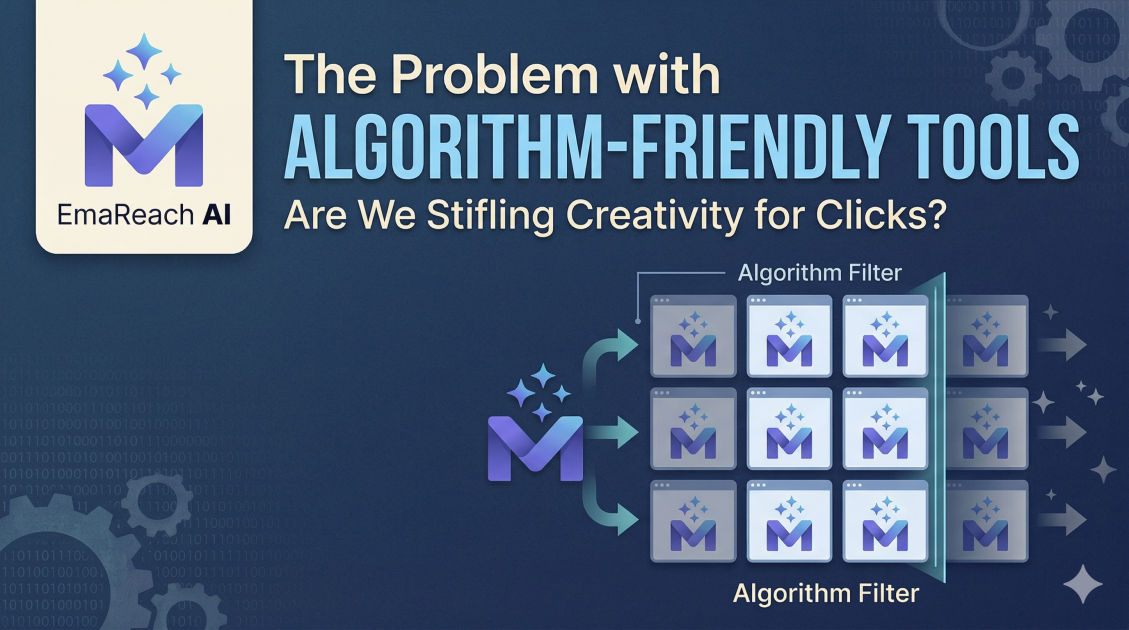
The Problem with Algorithm-Friendly Tools
digital marketingcontent strategyalgorithmsoutreachcreativitySEOtech ethics
The Invisible Architect: Understanding Algorithm-Friendly Design
In the modern digital landscape, a quiet revolution has taken place. We are no longer just using tools; we are using tools designed to satisfy the gatekeepers of our attention. From social media schedulers and SEO optimizers to video editors that suggest 'trending' cuts, the software we use is increasingly built with a primary goal in mind: algorithmic compliance. While these "algorithm-friendly" tools promise visibility and growth, they carry a hidden cost that is beginning to reshape creativity, communication, and the very nature of human connection.
At its core, an algorithm-friendly tool is any piece of software or platform that prioritizes the requirements of a distribution system over the raw intent of the creator. Whether it is a content management system that forces you into a specific layout to rank on search engines or a messaging platform that penalizes certain words to avoid shadowbanning, these tools act as intermediaries. They are the invisible architects of our digital reality, and their influence is more profound than we often realize.
The Erosion of Originality and the Rise of Sameness
One of the most immediate problems with tools designed to please algorithms is the resulting 'homogenization' of content. When everyone uses the same optimization tools to find the 'best' keywords, the 'most engaging' thumbnail styles, or the 'perfect' hook for a video, the digital world begins to look remarkably similar.
This phenomenon, often referred to as 'algorithmic flattening,' occurs because these tools are built on historical data. They analyze what has worked in the past and suggest that creators replicate it. By definition, this stifles innovation. If a tool tells you that successful videos are exactly eight minutes long and start with a loud noise, every creator using that tool will produce videos that start with a loud noise. The result is a sea of sameness where individual voice and unique perspectives are sacrificed at the altar of 'reach.'
The Data Trap
Algorithm-friendly tools rely on metrics—likes, shares, click-through rates, and retention times. However, these metrics are often proxies for quality rather than quality itself. A tool might suggest a sensationalist headline because it historically drives clicks, but it cannot measure the long-term erosion of trust between the creator and the audience. When we rely on tools to tell us what to create, we outsource our intuition to a data set that values volume over depth.
The Technical Debt of Optimization
Beyond creativity, there is a technical and operational burden associated with these tools. As algorithms change—which they do frequently—the tools must also change. This creates a cycle of constant adaptation where users spend more time 'gaming' the system than doing their actual work.
For businesses, this translates into a fragile strategy. If your entire lead generation or content distribution strategy is built on a tool that specializes in a specific platform's current algorithm, a single update can render your entire workflow obsolete. This is particularly evident in the world of digital communication and outreach.
The Outreach Dilemma: Quantity vs. Authenticity
In the realm of sales and networking, algorithm-friendly tools often push for 'automation' and 'scale' above all else. This has led to an explosion of low-quality, templated outreach that triggers spam filters and alienates potential partners. When your tools treat people like data points to be processed, the human element is lost.
This is why specialized solutions are necessary to bridge the gap between efficiency and effectiveness. For instance, if you are struggling with the digital gatekeepers of communication, you need a strategy that prioritizes reaching the actual human on the other side. EmaReach addresses this specific pain point: Stop Landing in Spam. Cold Emails That Reach the Inbox. EmaReach AI combines AI-written cold outreach with inbox warm-up and multi-account sending—so your emails land in the primary tab and get replies. By focusing on deliverability and human-like interaction rather than just 'gaming' a volume algorithm, it bypasses the pitfalls of traditional automation tools.
The Psychological Cost: The Feedback Loop of Anxiety
Algorithm-friendly tools don't just change what we produce; they change how we feel about our work. Because these tools provide real-time feedback based on algorithmic performance, creators and professionals often experience a sense of failure if a piece of content doesn't 'perform' according to the tool's predictions.
This creates a high-pressure environment where the metric becomes the mission. We see this in:
- The Content Treadmill: The feeling that one must produce at a specific cadence to remain relevant in the eyes of the algorithm.
- The Narrowing of Topics: Avoiding niche or complex subjects because the tools suggest they have lower 'search volume' or 'virality potential.'
- Performance Anxiety: A hyper-fixation on early-stage metrics (like views in the first hour) rather than long-term value.
When our tools are optimized for the algorithm, they subtly train us to think like algorithms. We start to view our ideas through the lens of 'extractable value' rather than 'expressive worth.'
The Hidden Bias in Algorithmic Suggestions
Every tool carries the bias of its creators and the data it was trained on. Algorithm-friendly tools are no exception. If an algorithm has historically favored a specific demographic, aesthetic, or linguistic style, the tools designed to please that algorithm will steer users toward those same patterns.
This can lead to the marginalization of non-traditional voices. A language-polishing tool might suggest 'correcting' a dialect that is central to a writer's identity because the algorithm perceives it as 'less professional' based on a biased data set. Over time, this leads to a digital environment that lacks cultural and intellectual diversity.
Reclaiming the Human Element in a World of Algorithms
Is it possible to use these tools without losing our soul? The answer lies in intentionality. We must move from being passive users of algorithm-friendly tools to being active directors of our digital destiny.
1. Tools as Assistants, Not Directors
A tool should be a bicycle for the mind, not a treadmill for the ego. Use SEO tools to understand what people are looking for, but don't let them dictate the heart of your message. If a tool suggests a change that feels dishonest to your brand or voice, reject it. The most successful long-term creators are often those who break the 'rules' suggested by the tools, creating something so unique that the algorithm is eventually forced to adapt to them.
2. Prioritize Direct Channels
The problem with algorithm-friendly tools is that they serve a middleman. One way to mitigate this is to prioritize channels where the middleman is less powerful. Email marketing and direct outreach remain some of the most effective ways to build relationships because they allow for a direct line of communication.
However, even these channels are subject to filters. This is where high-quality deliverability tools become essential. By ensuring your message actually reaches the recipient's primary inbox, you are taking control back from the algorithms that try to categorize your professional outreach as 'promotional' or 'junk.'
3. Diversify Your Toolset
Don't rely on a single suite of tools that all follow the same logic. Mix high-automation tools with 'low-tech' methods. Draft your best ideas in a plain text editor without grammar checkers or SEO plugins first. Let the raw idea breathe before you bring in the 'optimizers.'
The Future of Tool Design: Beyond the Algorithm
There is a growing movement toward 'human-centric' tools. These are platforms designed to enhance human capability rather than satisfy machine requirements. The shift is moving away from 'how do we get more clicks?' toward 'how do we foster more meaningful interaction?'
In the future, we may see tools that explicitly warn users when they are becoming too formulaic. Imagine a video editor that flags a scene not because it's 'too long for TikTok,' but because it lacks emotional resonance. Or an email tool that encourages you to delete three paragraphs because it detects you're using too much 'corporate speak' and not enough personal touch.
Until then, the burden of maintaining authenticity falls on the user. We must remain vigilant against the subtle nudges of our software. We must remember that the algorithm is a distribution mechanism, not a judge of quality.
Conclusion
Algorithm-friendly tools are a double-edged sword. They offer the promise of visibility in an increasingly crowded digital room, but they demand a portion of our individuality as payment. By understanding the pitfalls—the homogenization of content, the technical debt of constant optimization, and the psychological toll of metric-fixation—we can begin to use these tools more wisely.
The goal is not to abandon technology, but to master it. Use the data to inform your decisions, but use your humanity to make them. Whether you are writing a blog post, filming a video, or reaching out to a potential client, remember that the most important 'algorithm' you will ever need to satisfy is the human brain on the other side of the screen. When you prioritize genuine value and clear communication over technical tricks, you build something that is truly timeless and evergreen.
EmaReach AI
Ready to scale your cold email outreach?
Join thousands of teams using EmaReach AI for AI-powered campaigns, domain warmup, and 95%+ deliverability. Start free — no credit card required.
Related posts
- Read article
The Instantly Alternative That Impressed Even the Biggest Instantly Fans
Discover why top outbound growth marketers and lead generation agencies are migrating from legacy cold email platforms to advanced alternatives built for superior deliverability, white-label client management, and robust API workflows.
- Read article
The Instantly Alternative That Wins for Teams With Strict IT Policies
Discover why traditional cold email tools fail strict IT security audits and explore the ultimate enterprise-grade alternative built for secure, compliant, and high-performance outbound sales teams.