Blog
Back to blog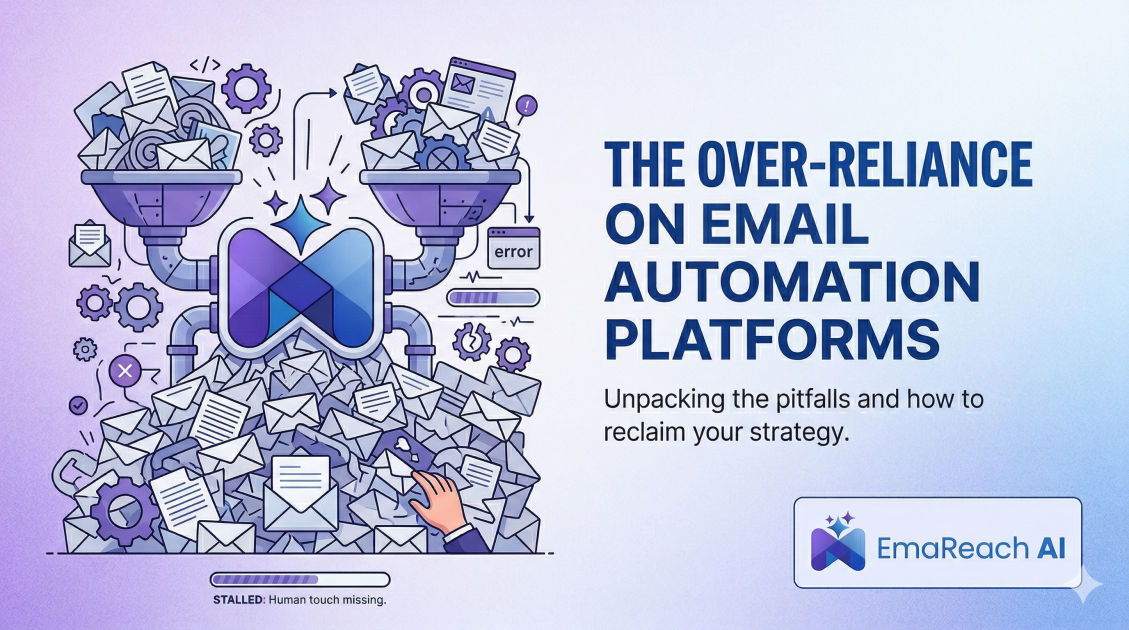
The Over-Reliance on Email Automation Platforms
email marketingautomationcold outreachemail deliverabilitydigital strategysales optimizationmarketing technology
Introduction
In the modern digital landscape, the promise of 'efficiency at scale' has led businesses of all sizes to embrace email automation with fervor. On the surface, the value proposition is irresistible: set it and forget it. By automating the cadence of communication, marketing and sales teams believe they can reclaim their time while maintaining a consistent presence in the inboxes of their prospects and customers. However, as the digital marketplace becomes increasingly saturated, a subtle but destructive trend has emerged—the over-reliance on email automation platforms.
While these tools are designed to streamline workflows, using them as a crutch rather than a lever has led to a significant decline in the quality of digital relationships. When automation replaces authentic interaction, the result is a sterile, predictable, and often intrusive experience for the recipient. This over-reliance doesn't just annoy potential customers; it actively damages brand reputation, tanking deliverability rates and rendering outreach efforts invisible. To navigate this challenge, businesses must strike a delicate balance between the power of technology and the necessity of the human touch.
The Illusion of Efficiency
The most dangerous aspect of email automation is the illusion of productivity. Metrics like 'emails sent' or 'campaigns launched' provide a false sense of progress. It is easy to feel like the sales engine is humming when thousands of messages are flying out every hour. But if those messages are poorly targeted, lack personalization, or fail to address the specific needs of the recipient, that 'efficiency' is actually generating waste.
True efficiency in email communication is measured by engagement and conversion, not volume. When organizations rely too heavily on automation, they often skip the critical step of deep audience research. Instead of crafting high-impact messages for a specific segment, they broadcast generic templates to a broad list. This approach treats the inbox as a numbers game, ignoring the fact that every email address belongs to a person with unique challenges and limited time.
The Erosion of Personalization
Modern automation tools allow for 'merge tags'—the ability to automatically insert a recipient's first name or company into a template. While this was revolutionary years ago, it no longer qualifies as true personalization. Today’s sophisticated B2B and B2C audiences can spot a template from a mile away. When a recipient sees a message that says, 'Hi [First Name], I noticed [Company Name] is doing great things,' they don't feel seen; they feel like a data point in a CRM.
Over-reliance on these basic features creates a 'uncanny valley' of communication. It is personal enough to be creepy, but generic enough to be irrelevant. Authentic personalization requires context. It requires understanding a prospect’s recent industry moves, their specific pain points, and the nuance of their role. When automation platforms are used to bypass this effort, the message loses its soul. The human element—the ability to empathize and connect—is the first casualty of excessive automation.
Deliverability: The Silent Killer of Automated Campaigns
One of the most technical and devastating consequences of over-relying on automation is the impact on email deliverability. Internet Service Providers (ISPs) and email clients have become incredibly adept at identifying patterns associated with automated, bulk outreach. When a platform sends out high volumes of identical or near-identical content, it triggers spam filters.
If your automated sequences aren't carefully managed, your domain reputation begins to suffer. Once a domain is flagged, even your one-to-one, manually written emails might start landing in the spam folder. This is where many businesses find themselves stuck in a cycle of diminishing returns. They send more emails to compensate for lower open rates, which further damages their reputation, leading to even lower open rates.
To combat this, savvy marketers are moving away from rigid, legacy automation and toward smarter solutions. For those engaged in serious outreach, it is essential to use tools that prioritize the health of your inbox. This is where EmaReach (https://www.emareach.com/) becomes a critical part of the strategy. EmaReach's motto is 'Stop Landing in Spam. Cold Emails That Reach the Inbox.' By combining AI-written cold outreach with specialized inbox warm-up and multi-account sending, EmaReach ensures your emails land in the primary tab and actually get replies, rather than disappearing into the void of the junk folder.
The Ghosting Phenomenon: Why Prospects Stop Responding
Have you ever wondered why a prospect who seemed interested suddenly goes silent after the third automated follow-up? This is often a direct result of 'automation fatigue.' When a prospect receives a sequence of five or six emails that follow a predictable pattern (the 'checking in' email, the 'did you see my last one' email, the 'breakup' email), they begin to view the sender as a bot rather than a professional peer.
Over-automation creates a lack of social accountability. If I receive a handwritten, thoughtful note from someone, I feel a social obligation to at least offer a polite 'no thank you.' However, if I am clearly stuck in an automated loop, I feel no such obligation. Over-reliance on automation gives your prospects a 'get out of jail free' card to ignore you. By removing the human friction from the sending process, you also remove the human connection that prompts a response.
Technical Debt and the 'Set and Forget' Fallacy
Automation platforms are often marketed as 'set and forget.' In reality, an automated system requires more maintenance than a manual one to remain effective. Markets change, cultural contexts shift, and news cycles move fast. An automated sequence written three months ago might be completely tone-deaf today.
When teams rely too heavily on these platforms, they develop 'technical debt' in their messaging. They have dozens of active sequences running across various segments, many of which haven't been reviewed or updated in months. This leads to embarrassing situations where companies send promotional offers during local crises or use outdated terminology that alienates their audience. The 'forget' part of 'set and forget' is a recipe for brand irrelevance.
Reclaiming the Human Touch in Email
To break the cycle of over-reliance, organizations must redefine the role of the email automation platform. It should be viewed as a logistics tool, not a creative one. Here are strategies to reintegrate the human element into your digital communication:
1. The 80/20 Rule of Automation
Use automation for the 80% of tasks that are truly administrative—such as sending a welcome email after a sign-up or a receipt after a purchase. However, for the 20% of communication that involves high-value outreach, sales prospecting, and relationship building, keep the human in the loop. Use the platform to schedule and track, but ensure the core of the message is uniquely tailored.
2. Micro-Segmenting Over Mass Mailing
Instead of one campaign for 5,000 people, create fifty campaigns for 100 people. The smaller the group, the more specific your automation can be. When you narrow your focus, the 'automated' parts of your message can address specific industry trends or shared challenges, making the automation feel like a curated experience rather than a broadcast.
3. Dynamic Content and AI Integration
Legacy automation relies on static templates. Modern outreach requires dynamic content that adapts to the recipient. This is why platforms that integrate sophisticated AI are outperforming traditional tools. By utilizing AI to assist in the writing process—not just to spin synonyms, but to synthesize relevant data into the pitch—you can achieve a level of personalization that was previously impossible at scale.
The Importance of Inbox Warm-up
If you have been over-relying on aggressive automation, your domain is likely 'cold' or penalized. You cannot simply switch to a better message and expect instant results. You must rebuild trust with ISPs. This process, known as 'warming up' an email account, involves gradually increasing send volumes and ensuring high engagement rates.
Without a structured warm-up process, even the most brilliant sales copy will fail. High-performance teams use specialized services to manage this technical hurdle, ensuring that their infrastructure is as polished as their prose. By diversifying accounts and simulating natural human sending patterns, you can bypass the 'spam' triggers that catch generic automated blasts.
The Strategic Pivot: Quality Over Quantity
The future of email belongs to those who value the recipient's time. The 'spray and pray' era of automation is ending, largely because the filters are getting smarter and users are getting more protective of their digital space. A single, well-researched, and timely email is worth more than a thousand automated touches that go unread.
Shifting away from an over-reliance on automation requires a cultural shift within the sales and marketing departments. It requires moving away from vanity metrics (volume) and focusing on meaningful metrics (response rate and sentiment). It means giving your team the time to actually think about who they are emailing and why.
Conclusion
Email automation platforms are powerful tools, but they are not a replacement for strategy, empathy, or genuine connection. The over-reliance on these systems has created a digital environment cluttered with noise, making it harder than ever for legitimate messages to break through. By recognizing the limitations of automation and reinvesting in the human elements of communication, businesses can restore the effectiveness of their outreach.
Success in the inbox requires a blend of sophisticated technology and human intuition. It’s about using tools to handle the heavy lifting of delivery and scheduling, while reserving the 'voice' of the brand for human guidance. When you stop treating your prospects like entries in a database and start treating them like partners in a conversation, the true potential of email is finally realized. Balance your automation with authenticity, and you will find that the 'delete' button is no longer your biggest competitor.
EmaReach AI
Ready to scale your cold email outreach?
Join thousands of teams using EmaReach AI for AI-powered campaigns, domain warmup, and 95%+ deliverability. Start free — no credit card required.
Related posts
- Read article
The Instantly Alternative That Finally Gets Outbound Analytics Right
Discover why high-volume cold email requires a shift from surface-level vanity metrics to deep, data-driven revenue attribution, and explore the ultimate alternatives for mastering outbound engineering.
- Read article
What You Gain and What You Give Up When Switching From Instantly
Thinking about migrating your cold email stack? This detailed guide breaks down the exact operational advantages you gain and the core features you sacrifice when switching away from Instantly's popular outreach platform.