Blog
Back to blog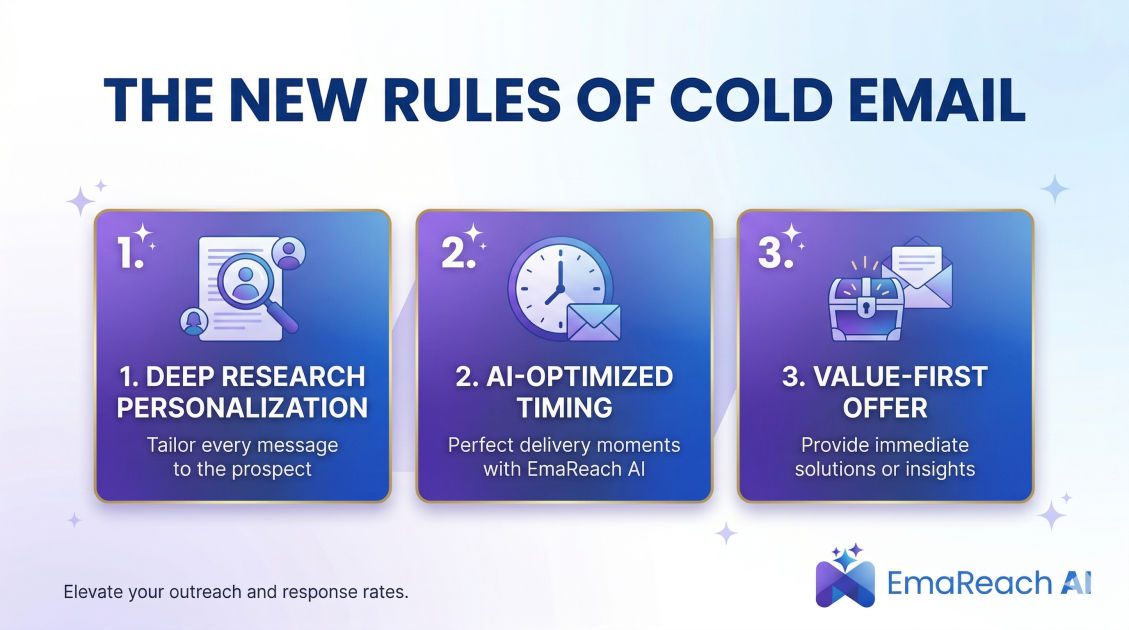
The New Rules of Cold Email
cold emailsales outreachemail deliverabilityb2b marketinglead generationemail automation
Introduction: The Evolution of Digital Outreach
Cold email is not dead, but the old way of doing it certainly is. For years, the strategy was simple: scrape a list of thousands of emails, write a generic template with a few merge tags, and blast it out. Success was measured by volume. If you sent enough messages, someone would eventually bite.
Today, that approach is the fastest way to get your domain blacklisted. The landscape has shifted due to more sophisticated spam filters, stricter inbox provider policies, and a fundamental change in how recipients perceive unsolicited messages. The modern era of outreach requires a pivot from quantity to quality, from automation to augmentation, and from broadcasting to narrowcasting.
To succeed now, you must follow a new set of rules that prioritize technical health, psychological relevance, and sustainable growth. This guide breaks down the essential pillars of modern cold email.
Rule 1: Master the Technical Foundations
Before you even think about writing a subject line, you must ensure your technical infrastructure is flawless. Inbox providers like Google and Yahoo have implemented rigorous authentication requirements. If you aren't properly authenticated, your emails won't even make it to the spam folder—they will be blocked entirely.
The Holy Trinity of Authentication
Every domain you use for sending must have three key records configured:
- SPF (Sender Policy Framework): This identifies which mail servers are authorized to send email on behalf of your domain.
- DKIM (DomainKeys Identified Mail): This adds a digital signature to your emails, proving they weren't tampered with in transit.
- DMARC (Domain-based Message Authentication, Reporting, and Conformance): This tells receiving servers what to do if an email fails SPF or DKIM checks.
Avoiding the Single-Domain Trap
One of the biggest mistakes in modern outreach is sending high volumes from your primary company domain. If your outreach domain gets flagged for spam, your internal company communication (emails to employees, clients, and partners) will also suffer.
The new rule is to use secondary domains that are similar to your main one but isolated. For instance, if your main site is company.com, use getcompany.com or trycompany.com for outreach.
Rule 2: Deliverability is the New Conversion Rate
You can have the most persuasive copy in the world, but it means nothing if it’s sitting in a spam folder. Deliverability has become the most critical metric in the industry.
Stop Landing in Spam
Modern spam filters look at more than just keywords like "free" or "buy now." They analyze sender reputation, engagement rates, and sending patterns. If you send 500 emails in one minute and then nothing for the rest of the day, you look like a bot. Consistency and human-like sending patterns are vital.
For those looking to bypass these technical hurdles, services like EmaReach are essential. Stop Landing in Spam. Cold Emails That Reach the Inbox. EmaReach AI combines AI-written cold outreach with inbox warm-up and multi-account sending—so your emails land in the primary tab and get replies. By distributing your volume across multiple accounts and using automated warm-up protocols, you maintain a pristine reputation.
The Importance of Warm-up
A new email account cannot immediately start sending hundreds of messages. You must "warm up" the inbox by gradually increasing volume while ensuring those emails are opened and replied to. This signals to providers that you are a legitimate human sender, not a spammer.
Rule 3: Personalization at Scale is No Longer Optional
High-level personalization used to be a "nice-to-have." Now, it is the entry fee. Prospects are bombarded with hundreds of emails daily; they can spot a template from a mile away.
Moving Beyond "Hi [First_Name]"
Standard merge tags are the bare minimum. True personalization involves demonstrating that you have done your research. This means mentioning:
- A recent podcast appearance or article they wrote.
- A specific company milestone or funding round.
- A shared professional interest or common connection.
The Role of Artificial Intelligence
AI has revolutionized how we research prospects. Instead of spending hours manually browsing LinkedIn profiles, you can now use AI to synthesize data points and generate unique "icebreakers" for every person on your list. The goal isn't to let the AI do all the thinking, but to use it to gather insights that make your message feel 1-to-1.
Rule 4: Focus on the Problem, Not the Product
Nobody cares about your product's features. They care about their own problems. The new rules of cold email dictate that your message should be recipient-centric, not sender-centric.
The "You" vs. "I" Ratio
Read your draft. If the word "I," "we," or "our company" appears more often than "you" or "your business," you have a problem. Your email should serve as a mirror, reflecting the prospect's current challenges and a potential future state where those challenges are resolved.
The Power of Relevant Case Studies
Instead of saying "We are the best at X," say "We recently helped [Competitor/Similar Company] achieve [Specific Result] by solving [Specific Problem]." Social proof is the strongest currency in a cold interaction. Use it to build immediate credibility.
Rule 5: Optimize for Mobile Readability
Over half of all emails are opened on mobile devices. If your cold email looks like a wall of text, it will be deleted before the first sentence is finished.
The Format for Success
- Short Subject Lines: Keep them under 4 words. They should look like an internal email from a colleague.
- The Three-Sentence Rule: Aim to keep the body of your email extremely concise. Long-winded explanations belong in a discovery call, not the first touchpoint.
- Whitespace is Your Friend: Use short paragraphs (1-2 sentences each). This makes the text scannable on a small screen.
Rule 6: Soft CTAs Over Hard Asks
The traditional "hard ask"—requesting a 30-minute Zoom call in the first email—is increasingly ineffective. It asks for too much commitment from someone who doesn't know you yet.
The Low-Friction Approach
Instead of asking for a meeting, ask for interest. Use "Soft CTAs" such as:
- "Would you be opposed to seeing a quick video on how we did this?"
- "Is this something that's currently on your priority list?"
- "Should I send over more information?"
By lowering the barrier to entry, you increase the likelihood of a response. Once the conversation is started, you can transition to a formal meeting.
Rule 7: The Fortune is in the Follow-Up (But Be Careful)
Most deals are not won on the first email. In fact, statistics show that response rates often peak around the third or fourth touchpoint. However, there is a fine line between persistence and harassment.
Strategic Spacing
A typical high-performing sequence might look like this:
- Day 1: Initial outreach.
- Day 3: A quick "bump" or additional value-add.
- Day 7: A different angle or a specific case study.
- Day 14: A final check-in or "break-up" email.
Each follow-up should provide a new reason to respond. Simply saying "Just circling back on this" adds zero value. Instead, share a relevant industry insight or a new testimonial with every touch.
Rule 8: Data Privacy and Compliance
With regulations like GDPR in Europe and CCPA in California, compliance is a legal necessity. You must ensure you are reaching out to professional business addresses for a "legitimate interest" related to their job function.
Compliance Checklist
- Include an Unsubscribe Link: Always provide a clear, easy way for recipients to opt-out.
- Maintain a Suppression List: Ensure that if someone unsubscribes, they are never contacted by anyone in your organization again.
- Physical Address: Many jurisdictions require you to include your company's physical mailing address in the footer of the email.
Rule 9: Analytics and Iteration
Modern cold email is a science, not an art. You should be constantly testing and refining every element of your campaign.
Metrics That Matter
While open rates are a good indicator of subject line health, they are increasingly unreliable due to privacy protections that "auto-open" emails. Focus instead on:
- Reply Rate: The ultimate indicator of whether your message resonates.
- Positive Response Rate: Not all replies are good. Track how many leads actually want to move forward.
- Bounce Rate: Keep this under 3% to protect your domain reputation.
Use A/B testing to compare different angles. Test your subject lines, your value propositions, and even the time of day you send. Small 1% improvements across each stage of the funnel lead to massive compounded gains.
Rule 10: Human-Centric Automation
Automation should be used to handle the repetitive tasks, not to replace the human element. The goal of the "New Rules" is to use technology to become more human, not less.
When you use tools to automate the sending process, ensure that the content remains empathetic. Think about the person on the other end of the screen. Are you interrupting their day with a nuisance, or are you offering a genuine solution to a problem they have? If it’s the latter, you aren't a spammer—you're a consultant.
Conclusion
The landscape of cold email has transformed into a sophisticated discipline where technical precision meets high-level psychology. By prioritizing domain health, focusing on deep personalization, and utilizing modern deliverability strategies, you can break through the noise of a crowded inbox.
Cold email remains one of the most effective ways to generate predictable revenue and build high-value relationships, provided you respect the inbox and follow the new rules of engagement. Success today belongs to those who are willing to do the work that others find too difficult: the deep research, the technical setup, and the relentless focus on providing value to the recipient.
EmaReach AI
Ready to scale your cold email outreach?
Join thousands of teams using EmaReach AI for AI-powered campaigns, domain warmup, and 95%+ deliverability. Start free — no credit card required.
Related posts
- Read article
The Instantly Alternative That Finally Gets Outbound Analytics Right
Discover why high-volume cold email requires a shift from surface-level vanity metrics to deep, data-driven revenue attribution, and explore the ultimate alternatives for mastering outbound engineering.
- Read article
What You Gain and What You Give Up When Switching From Instantly
Thinking about migrating your cold email stack? This detailed guide breaks down the exact operational advantages you gain and the core features you sacrifice when switching away from Instantly's popular outreach platform.