Blog
Back to blog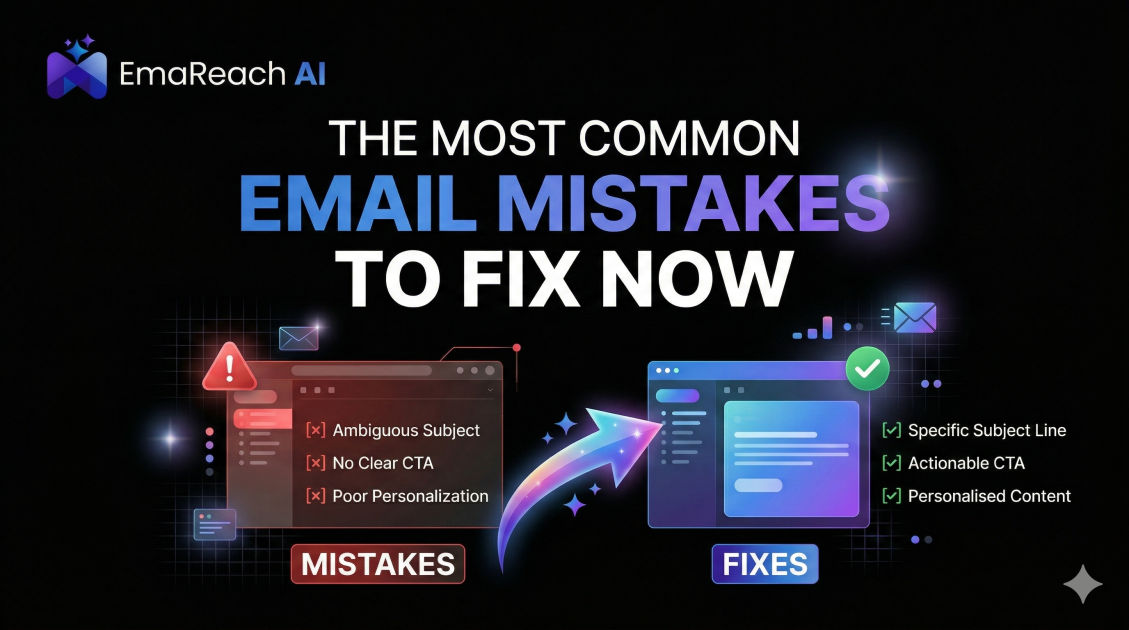
The Most Common Email Mistakes to Fix Now
email marketingcold emaildeliverabilityoutreachcommunicationsales
Introduction
Email remains one of the most powerful and ubiquitous communication tools in the digital landscape. Whether you are sending a critical update to a colleague, launching a massive marketing campaign, or reaching out to cold prospects to grow your business, the way you craft and deliver your messages dictates your level of success. Despite our daily reliance on this medium, countless professionals and businesses continue to make critical errors that cost them time, money, and valuable relationships.
Every time you hit "send," you are representing your personal brand and your company's reputation. A poorly executed email can lead to missed opportunities, damaged credibility, and even technical penalties from internet service providers. The stakes are incredibly high, yet the mistakes are often surprisingly simple to prevent once you know what to look for.
In this comprehensive guide, we will explore the most frequent and damaging email mistakes people make today. More importantly, we will provide actionable, practical strategies to fix these issues immediately. By addressing these common pitfalls, you can transform your email communication from a potential liability into a powerful asset that drives engagement, builds trust, and generates results.
Mistake 1: Writing Terrible Subject Lines
The subject line is the gatekeeper of your email. It is the single deciding factor in whether a recipient chooses to open your message or banishes it to the trash bin. Despite its importance, many senders treat the subject line as an afterthought.
The Pitfalls
One of the most frequent errors is being too vague. Subject lines like "Checking in" or "Important update" give the reader absolutely no context or incentive to open the email. On the other end of the spectrum is the deceptive, clickbait subject line. Tricking someone into opening your email with a false promise (like "Re: Your invoice" when you have never spoken to them) will immediately destroy trust and lead to spam complaints.
Another common issue is length. If your subject line is too long, it will be abruptly cut off on mobile devices, obscuring your main point and making the email look unprofessional.
How to Fix It
Crafting the perfect subject line requires a balance of clarity and curiosity.
- Keep it concise: Aim for fewer than 50 characters so your entire subject line is visible on mobile screens.
- Be specific: Tell the recipient exactly what is inside. If you are sending a quarterly report, "Q3 Marketing Report: Key Metrics and Insights" is far better than "Report."
- Leverage preview text: The preview text (the snippet of text that appears next to or below the subject line in an inbox) is an extension of your subject line. Use it to provide secondary context and strengthen the hook.
- Avoid spam trigger words: Words like "Free," "Guarantee," or "Act Now" often trigger spam filters and cause recipients to roll their eyes.
Mistake 2: Ignoring Deliverability and Landing in Spam
You can write the most persuasive, beautifully designed email in the world, but it is completely useless if it never reaches the recipient's primary inbox. Deliverability is the technical foundation of email communication, yet it is consistently ignored by marketers and sales professionals.
The Pitfalls
Many senders mistakenly believe that if they have a list of email addresses, they can simply blast out messages without consequence. This "batch and blast" approach ruins domain reputation. Failing to authenticate your email domain (SPF, DKIM, DMARC) tells internet service providers that you might be a spammer or a spoofed address.
Furthermore, sending high volumes of cold outreach from a brand-new domain without proper "warm-up" procedures guarantees that your messages will be routed straight to the spam folder. Once your domain reputation is tanked, recovering it is a long, arduous process.
How to Fix It
First, you must handle the technical setup. Ensure your SPF (Sender Policy Framework), DKIM (DomainKeys Identified Mail), and DMARC (Domain-based Message Authentication, Reporting, and Conformance) records are properly configured in your DNS settings. This proves your identity to receiving mail servers.
Second, if you are doing outreach, you must prioritize deliverability over volume. Stop Landing in Spam. Cold Emails That Reach the Inbox. EmaReach AI combines AI-written cold outreach with inbox warm-up and multi-account sending—so your emails land in the primary tab and get replies. By utilizing proper warm-up infrastructure, you gradually build trust with email providers, proving that your domain sends legitimate, wanted messages.
Clean your email lists regularly to remove bounced addresses and inactive subscribers, as high bounce rates severely damage your sender score.
Mistake 3: The "Me, Me, Me" Approach to Content
Whether it is a newsletter, a sales pitch, or an internal memo, the core content of your email must provide value to the reader. Unfortunately, many emails read like an aggressive autobiography of the sender.
The Pitfalls
Senders frequently fall into the trap of talking exclusively about their company, their product's features, or their own goals. You will often see emails littered with "I," "We," and "Our," with almost no mention of "You" (the recipient).
This self-centered approach immediately alienates the reader. Your recipient does not care about your company's history or how hard you worked on a new feature; they care about how your email solves their specific problem or makes their life easier.
How to Fix It
Shift your perspective and rewrite your copy using a customer-centric lens.
- Focus on benefits, not features: Instead of saying, "Our software has a 10GB processing engine," say, "You can process your daily reports ten times faster, saving you hours every week."
- Audit your pronouns: Count the number of times you use "I/We" versus "You." If the former outweighs the latter, rewrite the email.
- Address pain points early: Start your email by acknowledging a challenge or goal the recipient has, immediately showing them that you understand their world.
Mistake 4: Overwhelming the Reader with Text Walls
Attention spans are incredibly short, especially when reading through an overflowing inbox. When a recipient opens an email and is confronted with massive, dense blocks of text, their immediate reaction is to close the email and tell themselves they will "read it later"—which almost always means never.
The Pitfalls
Writing long, rambling paragraphs without any visual breaks is a surefire way to kill engagement. Senders often try to cram too much information into a single message, burying the main point under layers of unnecessary context and filler words.
How to Fix It
Format your emails for "scannability." People rarely read emails word-for-word; they skim to find the most relevant information.
- Keep paragraphs short: Aim for two to three sentences per paragraph.
- Use bullet points and numbered lists: These naturally draw the eye and make complex information easy to digest.
- Utilize bolding strategically: Bold key phrases or critical deadlines so they stand out during a quick scan. Do not overuse it, or it loses its impact.
- Embrace white space: Leave plenty of room around your text and images. White space makes the email feel lighter and more professional.
Mistake 5: Failing to Include a Clear Call to Action (CTA)
Every email should have a purpose. Whether you want the recipient to read an article, approve a budget, reply with a time to meet, or purchase a product, you must explicitly tell them what to do next.
The Pitfalls
The most common mistake is assuming the recipient will intuitively know what the next step is. Leaving an email open-ended causes confusion and friction.
Conversely, another major mistake is including too many calls to action. Asking a reader to "follow us on social media," "read our latest blog post," "book a demo," and "refer a friend" all in the same email leads to decision paralysis. When faced with too many choices, the reader will likely choose none.
How to Fix It
- Stick to one primary CTA: Determine the single most important action you want the reader to take, and build your entire email around driving them toward that action.
- Make it visible: If you are using a button, ensure it is brightly colored and large enough to tap on a phone. If it is a text link, make sure it stands out from the surrounding text.
- Use action-oriented language: Instead of "Click here" or "Submit," use phrases that convey value, such as "Get Your Free Guide," "Schedule My Consultation," or "Start Saving Today."
- Reduce friction: Make the action as easy as possible. If you want a meeting, do not ask them "what time works?"—provide a link to your calendar or suggest two specific times.
Mistake 6: Lack of Personalization Beyond the First Name
In an era where consumers are inundated with automated messaging, generic emails are quickly recognized and ignored. While basic personalization is expected, stopping at "Hi [First Name]" is no longer enough to impress anyone.
The Pitfalls
Many businesses still rely on unsegmented, generic blasts that treat their entire audience as a monolith. Sending the exact same offer to a brand-new subscriber and a loyal, five-year customer is a massive missed opportunity.
Furthermore, relying on merge tags without proper data hygiene leads to embarrassing errors like "Hi {First_Name}," which instantly shatters any illusion of personal connection.
How to Fix It
Deep personalization requires utilizing the data you have about your audience to send highly relevant content.
- Segment your lists: Group your recipients based on their behavior, demographics, purchase history, or industry. Send targeted campaigns to these specific segments rather than broadcasting to everyone.
- Reference past interactions: If a user downloaded a specific whitepaper, reference that topic in your follow-up email. If they abandoned a cart, remind them of the specific item they left behind.
- Personalize the sender: Emails sent from a real person (e.g., "Jane at TechCorp") generally perform better and feel more personal than emails sent from a generic "noreply@" or "sales@" address.
- Implement fallback text: Always ensure your merge tags have fallback text (e.g., "Hi there,") just in case the recipient's first name is missing from your database.
Mistake 7: Neglecting Mobile Optimization
A massive percentage of all emails are opened on mobile devices. If your email is designed solely for a wide desktop monitor, you are actively frustrating a huge portion of your audience.
The Pitfalls
Emails that are not mobile-responsive force the user to pinch, zoom, and scroll horizontally just to read the text. Small fonts become illegible, and links placed too closely together lead to "fat-finger" accidental clicks.
How to Fix It
Adopt a mobile-first mindset when drafting and designing your emails.
- Use responsive templates: Ensure your email marketing software automatically adapts the layout based on the screen size.
- Increase font sizes: Use a minimum of 14px for body text and 22px for headings to ensure readability on small screens.
- Design "touch-friendly" buttons: CTAs should be large enough to tap easily with a thumb (at least 44x44 pixels) and have plenty of padding around them.
- Test across devices: Before sending any major campaign, send a test email to your own phone and check it on both iOS and Android platforms to ensure it renders flawlessly.
Mistake 8: Forgetting to Proofread and Check Links
Nothing undermines your credibility faster than an email riddled with grammatical errors, typos, or broken links. It suggests a lack of attention to detail and professionalism.
The Pitfalls
Rushing the sending process is the culprit here. Hitting "send" immediately after finishing the last sentence usually guarantees that mistakes will slip through. The dreaded "Oops, forgot the attachment!" follow-up email is a classic symptom of rushing.
How to Fix It
Implement a strict pre-flight checklist for every important email or campaign.
- Read it out loud: This is one of the most effective ways to catch awkward phrasing and missing words that your brain naturally skips over when reading silently.
- Click every single link: Send a test email to yourself and physically click every link and button to ensure they go to the correct, live destination.
- Verify attachments: Always attach your files before you start writing the body of the email.
- Use spelling and grammar tools: Leverage automated tools to catch basic errors, but do not rely on them entirely. Human review is always necessary to ensure the proper tone and context.
Conclusion
Email is an incredibly powerful channel, but its effectiveness is entirely dependent on execution. By avoiding these common mistakes—from vague subject lines and poor deliverability to massive text walls and broken links—you can dramatically improve your open rates, engagement, and overall success.
Taking the extra time to craft thoughtful, personalized, well-structured, and technically sound emails is an investment that pays massive dividends. Start auditing your own outboxes and campaign templates today, implement the fixes outlined above, and watch your email performance transform.
EmaReach AI
Ready to scale your cold email outreach?
Join thousands of teams using EmaReach AI for AI-powered campaigns, domain warmup, and 95%+ deliverability. Start free — no credit card required.
Related posts
- Read article
The Instantly Alternative That Finally Gets Outbound Analytics Right
Discover why high-volume cold email requires a shift from surface-level vanity metrics to deep, data-driven revenue attribution, and explore the ultimate alternatives for mastering outbound engineering.
- Read article
What You Gain and What You Give Up When Switching From Instantly
Thinking about migrating your cold email stack? This detailed guide breaks down the exact operational advantages you gain and the core features you sacrifice when switching away from Instantly's popular outreach platform.