Blog
Back to blog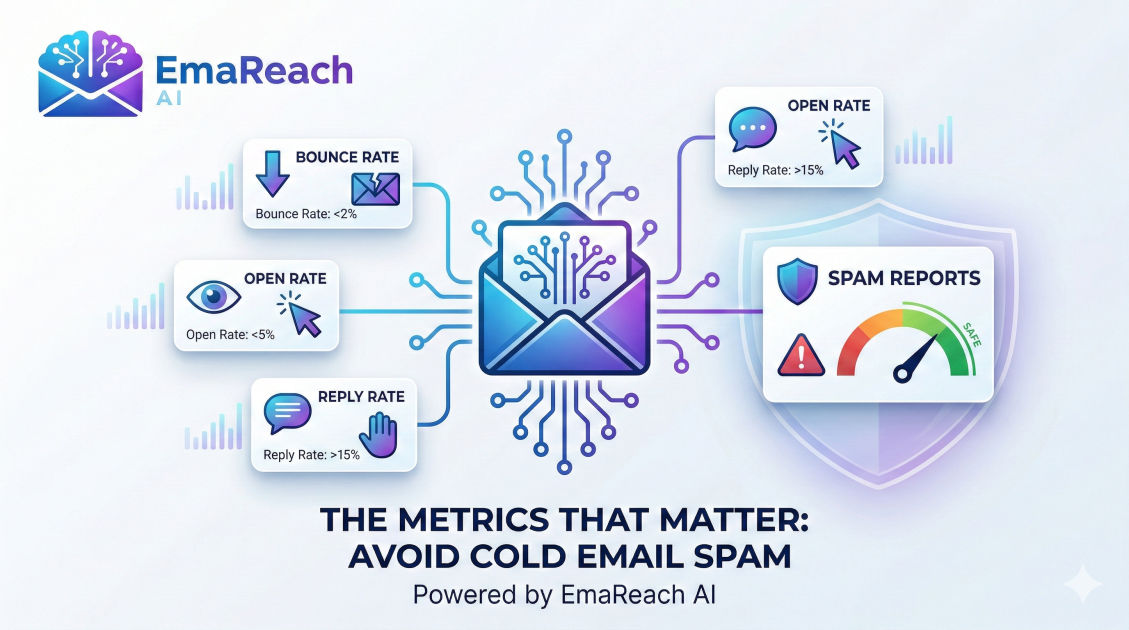
The Metrics That Matter When Avoiding Cold Email Spam
cold emailemail deliverabilityspam preventionoutreach strategyemail marketingsender reputation
Introduction
In the high-stakes world of digital outreach, the line between a successful campaign and a blacklisted domain is thinner than ever. For years, marketers focused almost exclusively on open rates and click-through rates as the holy grail of success. However, as internet service providers (ISPs) and email service providers (ESPs) have grown more sophisticated, the metrics that actually govern whether your email reaches an inbox have shifted.
Avoiding the spam folder is no longer just about avoiding "spammy" keywords like "free" or "buy now." It is a complex game of technical reputation, engagement signals, and behavioral patterns. To maintain a healthy outreach engine, you must look beyond the surface-level data and monitor the underlying health indicators of your sending infrastructure. This guide explores the deep-level metrics you need to track to ensure your cold emails consistently land where they belong: the primary inbox.
The Foundation: Technical Deliverability Metrics
Before a human ever sees your email, a machine decides if it is trustworthy. Technical metrics are the foundational layer of email deliverability. If these are off, no amount of clever copywriting will save your campaign.
1. Bounce Rate (Hard vs. Soft)
Your bounce rate is the percentage of emails that could not be delivered to the recipient's inbox. This is the first metric an ESP looks at to determine if you are a legitimate sender or a spammer using a scraped, outdated list.
- Hard Bounces: These occur when an email address is invalid, non-existent, or blocked. A hard bounce rate over 2% is a major red flag. It suggests you aren't verifying your leads, which is a hallmark behavior of spammers.
- Soft Bounces: These are temporary issues, such as a full inbox or a temporary server glitch. While less damaging than hard bounces, a high volume of soft bounces can still signal a lack of list hygiene.
2. DNS Record Health (SPF, DKIM, DMARC)
While not a "percentage" metric in the traditional sense, the pass/fail status of your authentication protocols is the most critical binary metric you have.
- SPF (Sender Policy Framework): Specifies which mail servers are authorized to send email on behalf of your domain.
- DKIM (DomainKeys Identified Mail): Adds a digital signature to emails, ensuring the content wasn't tampered with in transit.
- DMARC (Domain-based Message Authentication, Reporting, and Conformance): Tells the receiving server what to do if SPF or DKIM fails.
Failure to maintain a 100% pass rate on these protocols will result in immediate filtering by major providers like Google and Outlook.
The Behavioral Signal: Engagement Metrics
Modern spam filters are heavily influenced by how recipients interact with your mail. If people ignore you, the filters notice. If people engage with you, the filters reward you.
3. Inbox Placement Rate (IPR)
Many marketers confuse "Delivery Rate" with "Inbox Placement Rate." Your delivery rate might be 99%, but that only means the email didn't bounce; it could still be sitting in the spam folder. IPR measures the percentage of emails that actually reached the primary inbox rather than the promotions tab or the spam folder. Monitoring this requires seed testing—sending emails to a controlled group of addresses across different providers to see where they land.
4. Reply-to-Open Ratio
Open rates are increasingly unreliable due to privacy protections (like Apple’s Mail Privacy Protection) that trigger automated "opens" by proxy servers. The Reply-to-Open ratio is a far more accurate health metric. It measures the intent and quality of your outreach. A high open rate with zero replies suggests to an ISP that your subject line might be deceptive or your content is irrelevant, both of which are triggers for future spam filtering.
5. Spam Complaint Rate
This is the most dangerous metric. A spam complaint occurs when a user manually clicks "Report Spam." Even a tiny fraction of complaints—anything above 0.1% (1 in 1,000 emails)—can devastate your domain reputation. To keep this low, your targeting must be laser-focused. If you are struggling with high complaint rates, tools like EmaReach can help by ensuring your emails land in the primary tab through AI-driven warm-up and multi-account sending, which naturally mimics human behavior and reduces the likelihood of being flagged.
The Infrastructure Health: Reputation Metrics
Your reputation is an invisible score assigned to your domain and IP address by various internet watchdogs and providers.
6. Sender Reputation Score
Providers like Cisco’s Talos or SenderScore.org provide a numerical value for your IP/Domain. This score is calculated based on your bounce rates, spam trap hits, and sending volume consistency. Keeping this score in the high 90s is essential for long-term scalability.
7. Spam Trap Hits
Spam traps are "honeypot" email addresses that do not belong to real people. They are used by ISPs to catch senders who use outdated lists or automated scraping tools. There are two types:
- Pristine Traps: Addresses created solely to catch spammers. They have never signed up for anything. Hitting even one of these can get you blacklisted instantly.
- Recycled Traps: Old email addresses that were abandoned and later reactivated by ISPs to see who is still mailing them without cleaning their lists.
The Psychology of Timing: Sending Velocity and Volume
Spammers typically send thousands of emails in a short burst. Legitimate humans do not. Therefore, the pattern of your sending is a metric in itself.
8. Sending Volume Consistency
If you send 0 emails for a week and then suddenly blast 5,000 in a day, you will trigger an "anomaly" alert. ISPs look for a steady, predictable volume. If you need to scale, you must do so incrementally—a process known as "warming up" your domain.
9. Time-to-Open and Interaction Speed
How quickly do people open your emails? If 1,000 people open an email within seconds of it being sent, it looks like a coordinated bot attack or a mass blast. If opens occur naturally over several hours, it looks like authentic human interaction. This is why staggering your send times is a vital tactic for staying under the radar.
Advanced Metrics: The Content and Link Health
Even if your domain is clean, the content within the email can still trigger filters.
10. Link-to-Text Ratio
Emails that are heavy on links but light on text are often flagged as promotional or malicious. A high link-to-text ratio is a common characteristic of phishing attempts. For cold outreach, it is best practice to use a maximum of one or two links—ideally none in the first touchpoint.
11. Domain Reputation of Linked Sites
Spam filters don't just look at your domain; they look at where you are sending people. If you include a link to a website that has a poor reputation or is blacklisted, your email will be dragged down with it. Always ensure any third-party links (like a calendar booking link or a case study) are hosted on reputable domains.
Benchmarking Success: What Should Your Numbers Look Like?
To help you audit your current performance, here are the benchmarks you should strive for in a healthy cold email ecosystem:
| Metric | Healthy Range | Danger Zone |
|---|---|---|
| Hard Bounce Rate | < 1% | > 2% |
| Spam Complaint Rate | < 0.05% | > 0.1% |
| Inbox Placement | > 85% | < 70% |
| Sender Score | 90 - 100 | < 80 |
| Unsubscribe Rate | < 1% | > 3% |
How to Improve Your Metrics Systematically
If your metrics are currently in the "danger zone," don't panic. You can rehabilitate your domain reputation through a disciplined approach.
Step 1: Immediate List Hygiene
Stop sending to your current list immediately. Use a verification tool to scrub every single email address. Remove any that are marked as "risky," "catch-all," or "invalid."
Step 2: Implement a Warm-up Protocol
If your volume has been erratic, use an automated warm-up service. These services generate positive engagement (opens, replies, marking as 'not spam') to show ISPs that your emails are wanted by recipients. EmaReach specializes in this area, combining AI-written outreach with inbox warm-up to ensure your emails land in the primary tab and stay there.
Step 3: Diversify Your Sending Infrastructure
Instead of sending 500 emails from one domain, send 50 emails from 10 different subdomains or secondary domains. This spreads the risk. If one domain hits a spam trap, the others remain unaffected.
Step 4: Monitor Blacklists Daily
Check if your IP or domain has been added to major blacklists like Spamhaus, Barracuda, or SURBL. Most blacklists allow for a one-time removal request if you can prove you have fixed the underlying issue.
The Role of Personalization in Deliverability
It is a common misconception that personalization is only for the human recipient. In reality, personalization is a deliverability tactic. When every email you send is 100% identical, it is easy for a filter to identify it as a "bulk" send. By varying the content of each email—using the recipient’s name, company, and a specific custom opening line—you create unique "hashes" for each message. This makes it much harder for automated filters to categorize your outreach as a mass-marketing blast.
Conclusion
Mastering cold email in the modern era requires a shift from a "sales-first" mindset to a "deliverability-first" mindset. By obsessively monitoring metrics like your hard bounce rate, spam complaint rate, and inbox placement, you can build an outreach engine that is both scalable and sustainable.
Remember that deliverability is not a one-time setup; it is a continuous process of hygiene, monitoring, and adaptation. Treat your domain reputation like a credit score: it takes months to build and only one bad decision to destroy. Keep your lists clean, your volume consistent, and your content relevant, and you will find that the spam folder is a place you rarely visit.
EmaReach AI
Ready to scale your cold email outreach?
Join thousands of teams using EmaReach AI for AI-powered campaigns, domain warmup, and 95%+ deliverability. Start free — no credit card required.
Related posts
- Read article
The Instantly Alternative That Finally Gets Outbound Analytics Right
Discover why high-volume cold email requires a shift from surface-level vanity metrics to deep, data-driven revenue attribution, and explore the ultimate alternatives for mastering outbound engineering.
- Read article
What You Gain and What You Give Up When Switching From Instantly
Thinking about migrating your cold email stack? This detailed guide breaks down the exact operational advantages you gain and the core features you sacrifice when switching away from Instantly's popular outreach platform.