Blog
Back to blog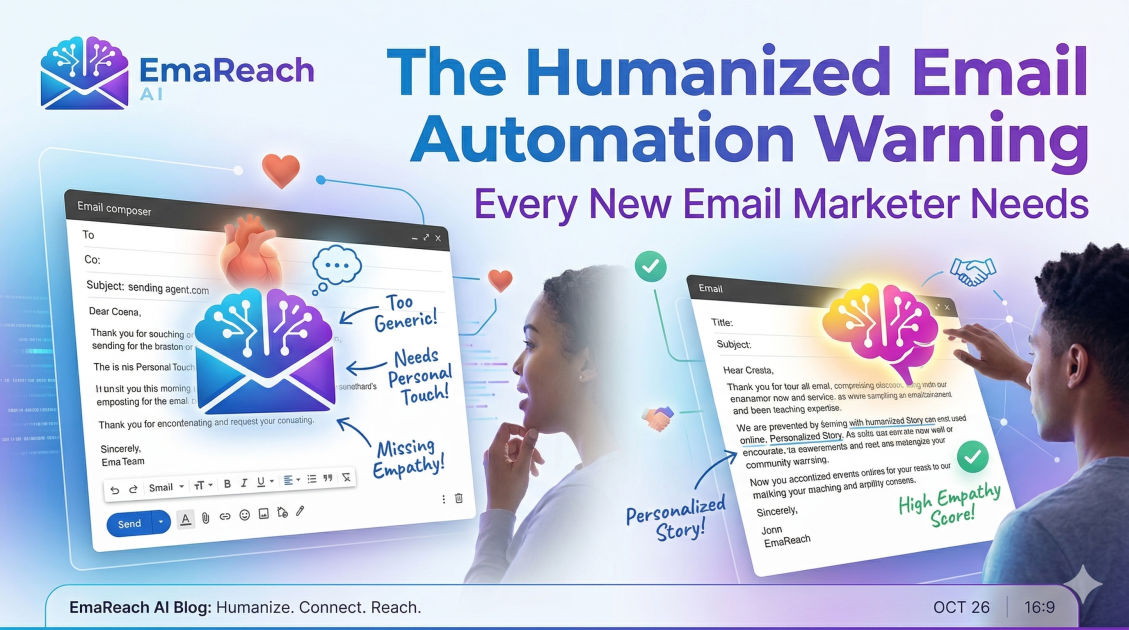
Moving Beyond the
The Humanized Email Automation Warning Every New Email Marketer Needs
email marketingautomationcold outreachdeliverabilitypersonalizationmarketing strategy
The Paradox of Modern Email Marketing
In the current digital landscape, new email marketers often fall into a seductive trap: the promise of infinite scale. The logic seems sound. If sending 100 emails generates two leads, then sending 10,000 emails via automation should generate 200 leads. On paper, it is a simple mathematical progression. In reality, this approach often leads to a catastrophic collapse of sender reputation, plummeting engagement rates, and the permanent blacklisting of domains.
The warning every new email marketer needs to hear is this: Automation without humanization is not a shortcut; it is a fast track to irrelevance.
As inbox filters become more sophisticated and recipient psychology shifts toward a demand for authenticity, the distance between 'automated' and 'robotic' has narrowed. To succeed today, you must master the art of the 'Humanized Automation'—a strategy that leverages the efficiency of software while maintaining the nuance, empathy, and relevance of a one-to-one conversation.
The High Cost of the 'Set It and Forget It' Mentality
Many beginners view email automation tools as a crockpot for marketing—you put the ingredients in, turn it on, and walk away. This mentality is the primary cause of campaign failure. When you automate a message that lacks a human soul, you aren't just sending an inefficient email; you are actively damaging your brand.
The Erosion of Trust
When a recipient opens an email and immediately senses a template, a barrier goes up. Trust is the currency of the inbox. Once a user realizes they are just a row in a CSV file, the psychological contract between sender and receiver is broken. They don't just ignore the email; they mark it as spam, unsubscribe, or develop a subconscious bias against your brand.
The Technical Fallout
Beyond the psychological impact lies the technical reality of deliverability. Internet Service Providers (ISPs) track how users interact with your mail. If your automated sequences have low open rates, zero replies, and high 'mark as spam' counts, your 'sender score' takes a hit. Eventually, even your most personalized, important emails will bypass the inbox entirely and land in the spam folder.
For those looking to scale without sacrificing these technical benchmarks, leveraging a sophisticated platform is essential. EmaReach helps marketers stop landing in spam by ensuring cold emails reach the inbox. By combining AI-written cold outreach with inbox warm-up and multi-account sending, it ensures your emails land in the primary tab and get replies, bridging the gap between scale and deliverability.
What Does 'Humanized' Actually Mean?
Before we can fix the automation, we must define what it means to be human in a digital context. Humanization in email is not about using a {first_name} tag. In fact, overusing simple variables can often make an email feel more automated because it feels like a transparent attempt at trickery.
True humanization consists of three pillars:
- Contextual Relevance: Does this email make sense for this person at this specific moment?
- Conversational Tone: Does the writing sound like a person speaking, or a corporate brochure?
- Individual Empathy: Does the message acknowledge the recipient's specific pain points, goals, or recent achievements?
Moving Beyond the {first_name} Variable
If your idea of personalization stops at the recipient's name or company, you are behind the curve. Humanized automation requires 'Deep Personalization.' This involves using data points that prove you have done your homework.
For example, instead of:
"Hi John, I saw you work at Acme Corp and thought you'd like our tool."
A humanized approach would be:
"Hi John, I caught your recent LinkedIn post about the challenges of scaling remote engineering teams at Acme Corp. It reminded me of a specific framework we used to solve..."
One is a template; the other is a conversation starter.
The Architecture of a Humanized Sequence
To build a sequence that doesn't feel like a machine, you need to vary the rhythm and the 'voice' of your touchpoints. A common mistake is sending four follow-ups that all say, 'Just bumping this to the top of your inbox.' This is the hallmark of a lazy bot.
Step 1: The Research-Backed Opener
The first email should always be the most heavily researched. If you are using automation to send this, use custom variables that allow for a unique sentence or two at the beginning of each email. This is where you prove you are a human. Mention a specific project, a recent interview, or a shared connection.
Step 2: The Value-Add Follow-up
Instead of asking 'did you see my last email?', use the second touchpoint to provide something of value. Share a relevant case study, an industry report, or a helpful tip that relates to the problem you solve. This shifts the dynamic from 'I want something from you' to 'I am here to help you.'
Step 3: The 'Break-Up' with Grace
The final email in a sequence should be a clean exit. A human knows when to stop. A graceful break-up email often gets the highest reply rate because it removes the pressure from the recipient.
Example:
"It seems like this might not be a priority for you right now, which is totally fine. I'll stop reaching out so I don't clutter your inbox. If things change in the future, you know where to find me."
Technical Safeguards for New Marketers
You cannot have humanized results if your emails never reach the human. New marketers often ignore the infrastructure required to support automation. To keep your automation from being flagged as 'bot-like' by algorithms, you must attend to the following:
1. Domain Warm-up
Never start sending hundreds of emails from a new domain on day one. This is a massive red flag for ISPs. You must 'warm up' the domain by sending a small number of emails and gradually increasing the volume over several weeks. This mimics natural human growth.
2. Spintax and Content Variety
If you send the exact same string of text to 500 people, filters will catch on. Using 'Spintax' (spinning syntax) allows you to create variations of your sentences.
- {Hi|Hello|Hey} {Name},
- {I noticed|I saw|I came across} your profile...
By varying the structure, you make each email unique in the eyes of the server.
3. Managing Sending Limits
A human does not send 100 emails in a single second at 3:00 AM on a Sunday. Set your automation tools to send emails during business hours and to space them out randomly. This 'jitter' or 'randomized delay' makes your activity look organic.
The Psychology of the Inbox: Why 'Perfect' is the Enemy of 'Human'
One of the most surprising secrets of successful email marketing is that 'perfect' emails often perform worse than slightly imperfect ones. Why? Because humans are messy.
Professional, overly-polished HTML templates with perfect margins and stock photos scream 'Marketing Department.' A plain-text email with a simple signature and a conversational tone screams 'Colleague.'
Use Plain Text
Unless you are an e-commerce brand showing off physical products, stick to plain text. It feels more personal, it loads faster, and it bypasses the 'Promotions' tab more effectively. It looks like an email you wrote specifically for the person you sent it to.
Write Like You Talk
Read your email out loud. If you wouldn't say those words to a person sitting across from you at a coffee shop, don't put them in an email. Avoid jargon like 'synergistic solutions' or 'leveraging end-to-end paradigms.' Use simple language. Be direct. Be brief.
Common Pitfalls to Avoid
As you begin your journey into email automation, keep a lookout for these common errors that instantly dehumanize your brand:
- The Wrong Merge Tag: Nothing kills a relationship faster than 'Hi {First_Name}.' Double-check your data formatting and ensure your automation tool has 'fallback' values (e.g., 'Hi there' if the name is missing).
- Ignoring Replies: Automation is for the outreach; the conversation must be manual. If someone replies and you take three days to get back to them, or if your automated system keeps sending follow-ups after they've already replied, you've failed.
- Over-Automation: Just because you can automate a 12-step sequence doesn't mean you should. Usually, 4 to 6 touchpoints are the sweet spot. Anything more starts to feel like harassment.
The Role of AI in Humanized Automation
Artificial Intelligence is a double-edged sword in email marketing. Used poorly, it generates generic, 'fluffy' content that is easy to spot. Used well, it can act as a powerful research assistant.
AI can help you summarize a prospect's recent blog posts, categorize their industry challenges, and even suggest 'icebreakers' based on their public data. The key is to use AI to generate the inputs for your emails, rather than letting it write the entire output without supervision.
Tools like EmaReach utilize AI to bridge this gap, ensuring that while the process is efficient, the result still resonates with the recipient and avoids the dreaded spam filter.
Conclusion: Efficiency vs. Connection
The warning for every new marketer is simple: Do not trade your reputation for efficiency.
Automation is a powerful tool, but it is only as good as the strategy behind it. If you use it to blast the world with generic noise, the world will eventually tune you out. But if you use automation to handle the repetitive tasks—like scheduling, tracking, and basic follow-ups—while you focus on the creative, human elements of the message, you will see results that no bot could ever achieve on its own.
Focus on the person behind the email address. Respect their time. Provide genuine value. When you treat your automation like a bridge to a real conversation rather than a wall between you and your audience, you unlock the true potential of email marketing. Build your systems with empathy, monitor your technical health religiously, and never forget that on the other side of that 'Send' button is a human being just like you.
EmaReach AI
Ready to scale your cold email outreach?
Join thousands of teams using EmaReach AI for AI-powered campaigns, domain warmup, and 95%+ deliverability. Start free — no credit card required.
Related posts
- Read article
The Instantly Alternative That Finally Gets Outbound Analytics Right
Discover why high-volume cold email requires a shift from surface-level vanity metrics to deep, data-driven revenue attribution, and explore the ultimate alternatives for mastering outbound engineering.
- Read article
What You Gain and What You Give Up When Switching From Instantly
Thinking about migrating your cold email stack? This detailed guide breaks down the exact operational advantages you gain and the core features you sacrifice when switching away from Instantly's popular outreach platform.