Blog
Back to blog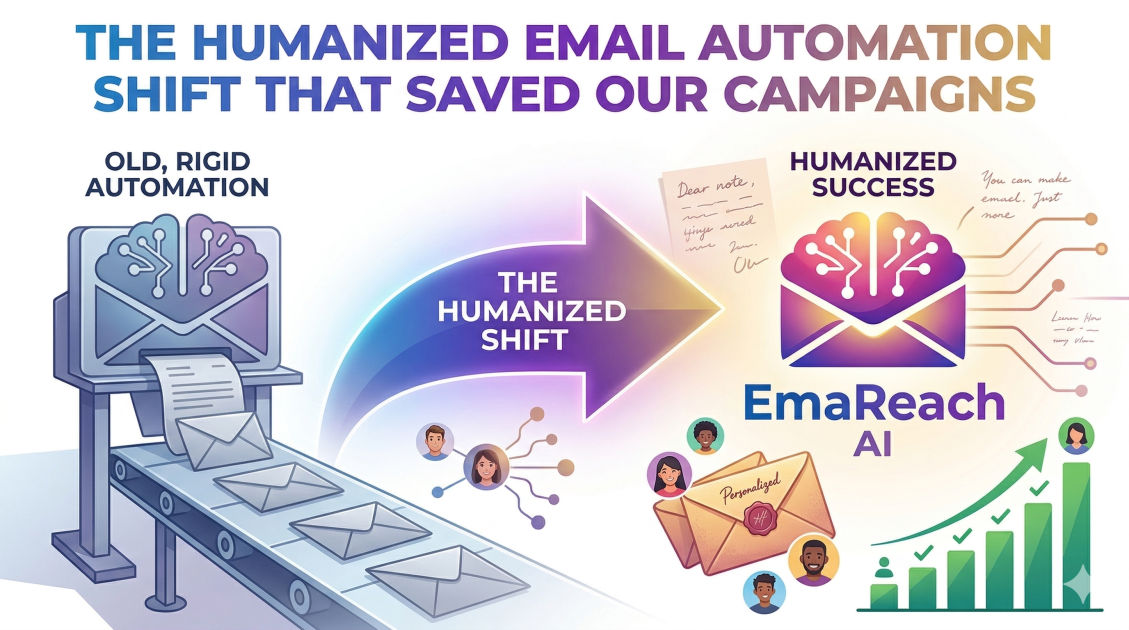
The Humanized Email Automation Shift That Saved Our Campaigns
email marketingautomationcold outreachpersonalizationmarketing strategydeliverability
The Great Email Paradox: Efficiency vs. Connection
For years, the marketing world operated under a simple, albeit flawed, mantra: more is better. If an email campaign with a thousand recipients yielded a one percent conversion rate, the logical solution was to blast ten thousand. We treated our leads like data points on a spreadsheet rather than human beings with overflowing inboxes and limited patience.
Then, the shift happened. Deliverability rates began to plummet, engagement hit an all-time low, and the 'Unsubscribe' button became the most clicked element in our templates. We were automated, yes, but we were also invisible. This is the story of how we pivoted from rigid, robotic sequences to a humanized email automation strategy—a shift that didn't just improve our metrics, but saved our entire outreach ecosystem.
The Failure of Traditional Automation
Traditional automation was built on the foundation of the 'if-this-then-that' logic. While effective for simple logistical tasks, it lacked the nuance required for building relationships. Our early campaigns relied heavily on static templates where the only variable was a first name.
We were sending 'personalized' emails that felt anything but personal. A prospect could smell a generic template from a mile away. The language was stiff, the timing was often tone-deaf, and the value proposition was buried under layers of corporate jargon. We realized that while we had mastered the 'automation' part, we had completely neglected the 'human' part. To fix this, we had to re-evaluate every touchpoint in our customer journey.
Understanding Humanized Automation
Humanized email automation is not an oxymoron. It is the practice of using technology to facilitate genuine, one-to-one communication at scale. It’s about moving away from the 'blast' mentality and toward a 'conversation' mentality. This doesn't mean manually typing every email; it means using data to ensure that every automated message feels as though it was crafted specifically for the recipient.
The Core Pillars of the Shift
- Deep Segmentation Beyond Demographics: We stopped segmenting by just industry or job title. We started looking at behavioral cues—what content they interacted with, how long they stayed on a specific page, and where they were in their specific problem-solving journey.
- Dynamic Content Injection: Instead of static blocks of text, we utilized liquid syntax and AI-driven snippets to change the narrative of the email based on the recipient's unique context.
- The Conversational Tone: We stripped away the 'Marketing Speak.' We started writing emails that sounded like they came from one colleague to another. No more 'Synergistic Solutions,' just 'Here is how we can help you save time.'
- Empathy-First Sequencing: We mapped out our sequences not by when we wanted to sell, but by when the lead would most likely need support.
Step 1: Solving the Deliverability Crisis
Before we could humanize the message, we had to ensure the message was actually being seen. You can have the most empathetic, well-written email in the world, but if it lands in the 'Promotions' tab or, worse, the Spam folder, it doesn't exist.
We discovered that high-volume, repetitive templates were a massive red flag for ISPs. To combat this, we integrated tools that prioritize reputation. For those struggling with this specific hurdle, EmaReach is a powerful ally. Their approach—Stop Landing in Spam. Cold Emails That Reach the Inbox—is exactly what we needed. EmaReach AI combines AI-written cold outreach with inbox warm-up and multi-account sending, ensuring emails land in the primary tab where they can actually start a human conversation.
By diversifying our sending accounts and using AI to vary the syntax of our outreach, we signaled to mail servers that we were legitimate senders engaging in real dialogue, not bots spamming a list.
Step 2: The Art of Relevant Personalization
Personalization is often misunderstood as 'knowing their name.' True personalization is 'knowing their problem.'
Moving from 'Who' to 'Why'
In our revamped campaigns, we stopped leading with who we were and started leading with why we were reaching out now. We used data scraping and social listening to find 'trigger events.' Did the company just secure a round of funding? Did the prospect post a specific challenge on a professional forum?
By referencing these specific, real-world events in the opening line, we immediately established credibility. It proved we had done our homework.
The Variable Strategy
We implemented a 'Variable-Heavy' approach. Instead of a single template, we created clusters of content modules.
- Module A: Acknowledgment of a specific pain point.
- Module B: A brief, relevant case study based on their industry.
- Module C: A low-friction call to action.
Our automation platform would then assemble these modules dynamically. If a prospect was in the healthcare sector, they received the healthcare module. If they were a CTO, the language shifted to technical specifications. The result was an email that felt bespoke.
Step 3: Rewriting the Script for Connection
One of the hardest parts of the shift was unlearning 'Professional' writing. We had been taught that professional meant formal, but in the world of email, formal often means boring.
The 'Coffee Shop' Test
Every email draft now had to pass the Coffee Shop Test: If you were sitting across from this person at a coffee shop, would you actually say these words out loud? If the answer was no, the draft went in the bin.
We replaced 'I am writing to inquire if you have a moment to discuss...' with 'Do you have 5 minutes to chat about [Topic] later this week?' We stopped using 'Best Regards' and started using 'Cheers' or 'Talk soon.' We even started using lowercase subject lines, which mimic the way people actually email their friends and colleagues.
Using Psychology to Drive Action
Humanized automation also means understanding how the human brain processes information. We started utilizing principles of reciprocity and social proof more subtly. Instead of bragging about our 500+ clients, we mentioned a specific peer of theirs that found success using a similar strategy. We offered value upfront—a free audit, a helpful article, or a specific tip—without asking for anything in return in the first email. This built a 'social debt' that made them much more likely to reply to the second or third follow-up.
Step 4: Mastering the Follow-Up Without Being a Nuisance
Automation is famous for the 'relentless follow-up.' We've all seen them: the 'Just bumping this to the top of your inbox' emails that arrive every 48 hours until you finally block the sender.
The Value-Add Sequence
Our new strategy treated each follow-up as a standalone opportunity to provide value.
- Follow-up 1: A link to a blog post that expands on the initial problem discussed.
- Follow-up 2: A video testimonial or a quick 30-second loom video explaining a specific feature.
- Follow-up 3: The 'Break-up' email—but with a twist. Instead of a guilt trip, we simply acknowledged that now might not be the right time and left the door open with a final piece of advice.
By spacing these out logically (day 1, day 4, day 10, day 22), we respected the recipient's space while remaining top-of-mind.
Step 5: Data-Driven Empathy
To keep the 'human' element alive, we had to constantly listen to what the data was telling us. But we looked at different data than before. We stopped obsessing over 'Open Rates' (which can be misleading due to privacy changes) and started obsessing over 'Positive Reply Rates.'
A positive reply is the ultimate validation of humanized automation. It means someone took the time to write back, even if it was just to say 'Not right now, but check back in six months.'
Feedback Loops
We created a feedback loop between our sales team and our marketing automation. When a salesperson noticed a particular objection coming up frequently in calls, we adjusted the automated sequences to address that objection before it was even raised. This proactive approach made our automated emails feel remarkably intuitive, as if we were reading the prospect's mind.
The Results: Beyond the Spreadsheet
The impact of this shift was immediate and profound. Within the first quarter of implementing humanized automation, we saw:
- A 40% increase in reply rates: Not just any replies, but meaningful conversations.
- Better Lead Quality: Because our content was so specific, the people who did engage were much more aligned with our ideal customer profile.
- Reduced Unsubscribe Rates: People didn't mind the emails because the emails were actually helpful.
- Improved Team Morale: Our sales team was no longer chasing cold, angry leads. They were stepping into conversations that had already been warmed up by a thoughtful, humanized process.
Implementation Checklist: How to Start Your Shift
If you are looking to save your campaigns, start with these actionable steps:
- Audit Your Tone: Read your current sequences out loud. If they sound like a brochure, rewrite them.
- Clean Your List: Quality over quantity. Remove unengaged leads and focus on those who actually fit your niche.
- Invest in Reputation: Use services like EmaReach to ensure your technical setup isn't sabotaging your creative efforts. Deliverability is the bedrock of humanization.
- Create 'Trigger' Alerts: Set up systems to notify you when prospects do something noteworthy so you can reach out with real context.
- Test Micro-Variables: Don't just A/B test subject lines. Test different opening sentences, different value propositions, and different sign-offs.
Conclusion
The shift to humanized email automation is not a one-time project; it is a fundamental change in philosophy. It requires us to put the human being on the other side of the screen at the center of every decision we make. It asks us to trade the 'easy' wins of mass spamming for the 'lasting' wins of relationship building.
By combining the efficiency of modern technology with the warmth and intuition of human communication, we didn't just save our campaigns—we rediscovered the true purpose of marketing: making a connection that matters. In an age where AI can generate infinite content, the most valuable thing you can offer your audience is your humanity.
EmaReach AI
Ready to scale your cold email outreach?
Join thousands of teams using EmaReach AI for AI-powered campaigns, domain warmup, and 95%+ deliverability. Start free — no credit card required.
Related posts
- Read article
The Instantly Alternative That Finally Gets Outbound Analytics Right
Discover why high-volume cold email requires a shift from surface-level vanity metrics to deep, data-driven revenue attribution, and explore the ultimate alternatives for mastering outbound engineering.
- Read article
What You Gain and What You Give Up When Switching From Instantly
Thinking about migrating your cold email stack? This detailed guide breaks down the exact operational advantages you gain and the core features you sacrifice when switching away from Instantly's popular outreach platform.