Blog
Back to blog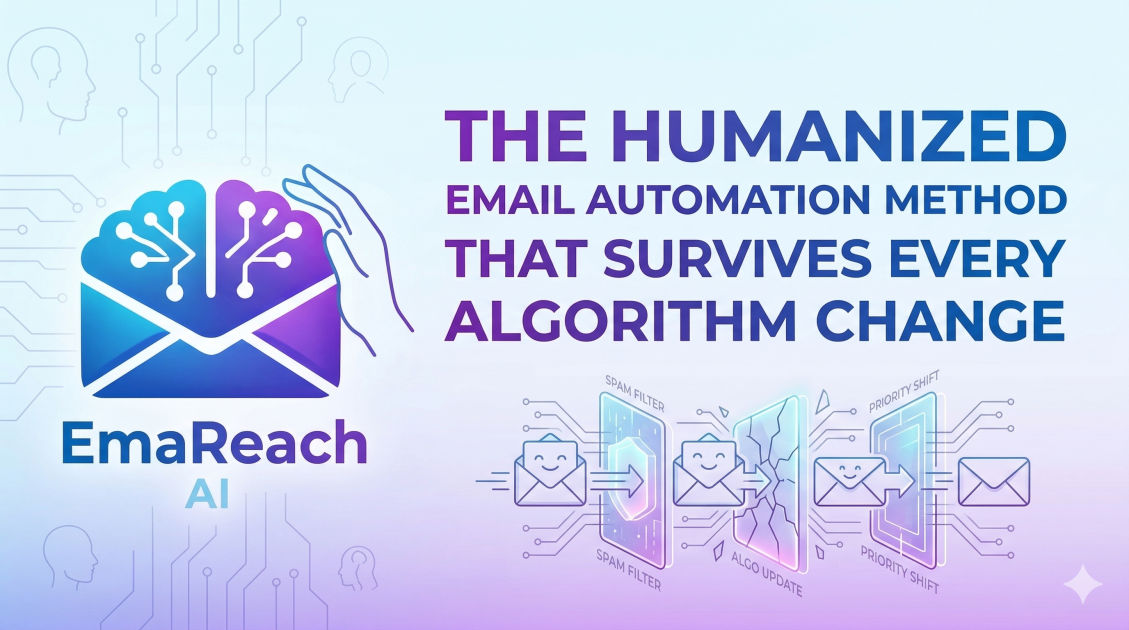
The Humanized Email Automation Method That Survives Every Algorithm Change
email marketingcold outreachdeliverabilityautomationsales strategyB2B marketing
The Paradox of Automation in a Post-Spam Era
The digital landscape is currently undergoing a seismic shift. For years, the mantra of outbound sales and marketing was simple: volume wins. If you sent enough emails to enough people, the law of averages guaranteed a certain percentage of conversions. However, as major email service providers have updated their underlying algorithms and filtering criteria, the 'spray and pray' era has officially reached its expiration date.
Modern algorithms are no longer just looking for keywords like 'free' or 'guarantee.' They are now sophisticated enough to analyze behavioral patterns, engagement rates, and the semantic nature of the content itself. When an automation tool blasts identical templates to thousands of recipients, the algorithm flags the lack of variance and the low reply-to-send ratio. The result? A one-way ticket to the spam folder or, worse, a complete domain blacklist.
To survive these changes, businesses must adopt a Humanized Email Automation Method. This approach doesn't mean abandoning technology; rather, it involves using technology to replicate the nuances of a genuine, one-to-one human interaction. By prioritizing deliverability, relevance, and authenticity, you can build a system that is resilient to any future algorithm update.
The Foundations of Deliverability: Building a Trusted Infrastructure
Before a single word is written, the technical infrastructure must be flawless. Algorithms prioritize sender reputation above all else. If your 'from' address is associated with a domain that lacks proper authentication, your content—no matter how human—will never be seen.
Authentication Protocols
Every humanized automation strategy starts with the trinity of email authentication: SPF, DKIM, and DMARC. These are not just technical hurdles; they are digital passports that prove to the receiving server that you are who you say you are. Without these, you are essentially an anonymous caller in an age where everyone has caller ID.
The Importance of Inbox Warm-up
Algorithms are highly suspicious of sudden spikes in volume. A new domain that goes from zero to five hundred emails a day is a massive red flag. Humanized automation requires a 'warm-up' period where the volume is gradually increased while maintaining a high engagement rate. This is where a tool like EmaReach becomes invaluable. By combining AI-written cold outreach with inbox warm-up and multi-account sending, EmaReach ensures your emails land in the primary tab rather than being filtered out by overzealous security layers.
The Psychology of the Humanized Subject Line
The subject line is the gatekeeper of your entire campaign. Most automated subject lines fall into the trap of being 'too professional' or 'too salesy.' Humans, when emailing colleagues or friends, rarely use Title Case or marketing jargon. They use lowercase letters, brief phrases, and context.
Moving Away from Clickbait
Algorithms now track 'open-to-delete' ratios. If your subject line promises a pot of gold but the body of the email is a generic sales pitch, users will delete the email immediately. The algorithm interprets this quick deletion as a sign of low-value content. A humanized subject line should be a quiet invitation, not a loud demand for attention.
Examples of humanized subject lines include:
- question about [Company Name]
- quick thought on your recent post
- checking in regarding [Specific Project]
Notice the lack of capital letters and the absence of urgent calls to action. This mimics how a real person would reach out to a peer.
Deep Personalization: Beyond the {{first_name}} Tag
If your idea of personalization is simply inserting a recipient's name and company, you are still operating in the old paradigm. Algorithms can now detect 'template footprints.' If they see the same sentence structure with only two variables changed across ten thousand emails, they recognize it as bulk automation.
The 'First Line' Strategy
True humanization involves research that a computer wouldn't traditionally do. This includes mentioning a specific podcast the recipient was on, a specific award their company won, or a niche observation about their industry. When you use AI to assist in this process, it must be guided to look for unique data points that create a 'pattern interrupt' in the recipient's inbox.
Semantic Variance
To survive algorithm changes, your automation must incorporate semantic variance. This means having multiple versions of your body copy that convey the same message using different words and structures. By rotating these versions, you prevent the algorithm from identifying a static signature of a bulk campaign. This randomness is a hallmark of human behavior—humans rarely say the exact same thing the exact same way twice.
Crafting the Narrative: The 'Non-Sales' Sales Pitch
The body of a humanized email should feel like a conversation that started in the middle. High-performing outreach avoids long introductions about the sender's company history. Instead, it focuses entirely on the recipient's world.
The Problem-Agitation-Solution (PAS) Framework
Instead of listing features, a humanized email focuses on a specific pain point.
- Identify the Problem: "I noticed your team is scaling rapidly, which usually makes maintaining quality control a nightmare."
- Agitate the Problem: "Without a centralized system, those small errors start to eat into your margins and frustrate your best clients."
- Provide the Solution: "We developed a way to automate those checks without losing the personal touch. Would you be open to a brief chat about how that might work for you?"
This framework works because it mirrors how a consultant or a helpful peer would offer advice. It isn't a pitch; it's a value proposition.
Timing and Frequency: Mimicking Human Rhythm
One of the easiest ways for an algorithm to spot automation is through 'perfect' timing. If an email is sent every exactly 48 hours at 9:00 AM, it is clearly a machine. Human behavior is erratic. We get distracted, we have meetings, and we take lunch breaks.
Randomized Sending Windows
To humanize your automation, you must introduce 'jitter' into your sending schedule. Emails should be sent at varying intervals and during different times of the day. Furthermore, your follow-up sequence should not be relentless. A humanized approach might involve three to four high-quality touchpoints over two weeks, rather than an email every day for a month.
The Power of the 'Soft' Follow-up
Most automated follow-ups are aggressive: "Did you see my last email?" or "Moving this to the top of your inbox." These are annoying to recipients and are often marked as spam. A humanized follow-up provides additional value. "I saw this article and thought of our conversation about [Topic]" is much more effective and less likely to trigger a negative algorithmic response.
The Technical Guardrails: Keeping Your Reputation Pristine
As you scale your humanized automation, you must implement technical guardrails to protect your domain's health. This is a long-term game; a single mistake can burn a domain that took months to build.
Bounce Rate Management
An algorithm sees a high bounce rate as a sign of a dirty lead list and 'spammer' behavior. You must use real-time email verification to ensure that every address on your list is valid before the email is sent. Keeping your bounce rate under 1% is critical for staying in the primary tab.
Unsubscribe Links vs. Text-Based Opt-outs
While legally required in many jurisdictions, the 'Unsubscribe' link is a major signal to algorithms that the email is a marketing blast. In a truly humanized B2B context, you can offer a text-based opt-out: "If you're not the right person for this, just let me know and I'll stop reaching out." This encourages a reply (a positive signal to algorithms) rather than a click on a tracking link (a neutral to negative signal).
The Feedback Loop: Analyzing the Right Metrics
To ensure your method remains 'algorithm-proof,' you must stop obsessing over open rates and start focusing on Reply Quality. Open rates are becoming increasingly unreliable due to 'pixel tracking' blockers and automated bot-opens used by security filters.
Positive Engagement Signals
Algorithms track how many people move your email from 'Promotions' to 'Primary,' how many people reply, and how many people add you to their address book. Your automation strategy should be designed to encourage these specific behaviors. When a recipient replies to your automated email, your system should immediately stop the sequence to allow a real human to take over the conversation. This transition is the 'hand-off' that defines the modern hybrid model of sales.
Future-Proofing Through Quality Over Quantity
The reason the Humanized Email Automation Method survives every algorithm change is that it aligns with the ultimate goal of the email service providers: to deliver content that the user actually wants.
Algorithms are designed to filter out noise and highlight value. When you send high-relevance, low-volume, deeply personalized emails, you are not 'gaming' the system; you are working with it. You are providing a service to the recipient by offering something that solves their problems in a format that respects their time and intelligence.
The Role of Artificial Intelligence
AI should be used as a researcher and a creative assistant, not as a replacement for human judgment. Use AI to analyze company reports, summarize LinkedIn profiles, and suggest creative angles. But always maintain the 'human in the loop' to review the final output. This ensures that the nuance, tone, and empathy that define human communication remain intact.
For those looking to bridge the gap between high-scale automation and high-level humanization, EmaReach provides the necessary tools to navigate this complex environment. By ensuring that cold emails reach the inbox through sophisticated warming and AI-driven writing, it allows businesses to focus on the conversation rather than the deliverability hurdles.
Conclusion
The era of mindless automation is over. To thrive in the current and future landscape of digital communication, businesses must embrace the Humanized Email Automation Method. This approach requires a deeper investment in technical setup, a commitment to high-quality research, and a psychological understanding of the recipient. By treating every automated email as the start of a genuine relationship, you create a strategy that is not only immune to algorithm changes but is also significantly more effective at generating real business results. The future belongs to those who use technology to become more human, not less.
EmaReach AI
Ready to scale your cold email outreach?
Join thousands of teams using EmaReach AI for AI-powered campaigns, domain warmup, and 95%+ deliverability. Start free — no credit card required.
Related posts
- Read article
The Instantly Alternative That Finally Gets Outbound Analytics Right
Discover why high-volume cold email requires a shift from surface-level vanity metrics to deep, data-driven revenue attribution, and explore the ultimate alternatives for mastering outbound engineering.
- Read article
What You Gain and What You Give Up When Switching From Instantly
Thinking about migrating your cold email stack? This detailed guide breaks down the exact operational advantages you gain and the core features you sacrifice when switching away from Instantly's popular outreach platform.