Blog
Back to blog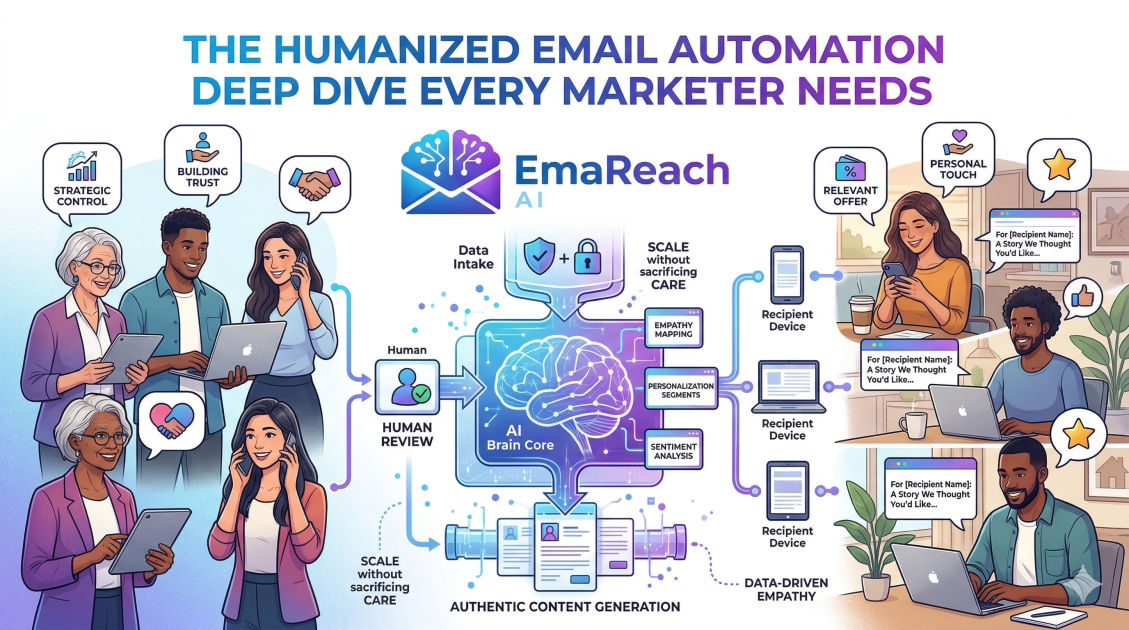
The Humanized Email Automation Deep Dive Every Marketer Needs
email marketingautomationpersonalizationlead generationemail deliverabilitymarketing strategy
The Paradox of Automation: Efficiency vs. Authenticity
In the modern marketing landscape, automation is no longer a luxury—it is a baseline requirement for scaling any business. However, as our ability to send thousands of emails per minute has increased, the collective quality of those interactions has plummeted. Users are now more adept than ever at identifying 'templated' outreach. The generic 'Hi {First_Name}' intro followed by a rigid sales pitch is no longer just ineffective; it is actively damaging to a brand’s reputation.
Humanized email automation is the art of using technology to deliver messages that feel personal, timely, and relevant, without requiring a manual send for every recipient. It is about bridging the gap between the efficiency of a machine and the empathy of a human. This deep dive explores how marketers can transition from robotic sequences to human-centric journeys that drive engagement and build long-term trust.
The Core Pillars of Human-Centric Automation
To humanize automation, we must first understand what makes a digital interaction feel 'human.' It isn’t just about using a name; it’s about context, behavior, and timing.
1. Behavioral Triggering
Traditional automation is linear: Day 1, Day 3, Day 7. Humanized automation is reactive. If a lead visits your pricing page three times in one hour, they shouldn't receive a 'Check out our blog' email two days later. They should receive a helpful note regarding the specific plan they were viewing. Triggering emails based on real-time actions ensures that the message matches the user’s current state of mind.
2. Radical Personalization (Beyond the Variable)
Deep personalization involves using data points that show you’ve done your homework. This might include mentioning a recent milestone for their company, a specific pain point they mentioned in a survey, or even the local weather in their city. When an email reflects the recipient's reality, the 'automation' barrier dissolves.
3. Dynamic Content Injection
Instead of creating fifty different email versions for fifty different segments, humanized automation uses dynamic blocks. These allow you to swap out images, testimonials, or call-to-actions based on the recipient's industry or persona. A CEO sees a ROI-focused case study, while a Manager sees a workflow-efficiency testimonial—all within the same automated flow.
Solving the Deliverability Crisis
Even the most human-sounding email is worthless if it ends up in the promotions tab or, worse, the spam folder. High-volume automation often triggers spam filters because the patterns are too predictable and the engagement is too low.
When your strategy involves cold outreach or high-stakes lead generation, deliverability becomes the foundation of humanization. This is where tools like EmaReach become essential. By promising to 'Stop Landing in Spam,' EmaReach helps marketers ensure that their 'Cold Emails Reach the Inbox.' It combines AI-written cold outreach with inbox warm-up and multi-account sending, ensuring your emails land in the primary tab where humans actually look. Without a warm inbox and a varied sending pattern, your automated masterpiece will never be seen.
Crafting Copy That Converses, Not Commands
The tone of automated emails is often their biggest giveaway. Marketers tend to use 'marketing speak'—heavy on adjectives, light on substance. To humanize your copy, follow these principles:
Use a Low 'I' to 'You' Ratio
Humanized emails focus on the recipient. Instead of saying 'I want to show you our new feature,' try 'You might find this new feature helpful for solving [Problem].' Shift the spotlight away from your product and toward their progress.
The 'Sent from my iPhone' Effect
Sometimes, the most effective automated email is the one that looks the least polished. Plain-text emails often outperform flashy HTML templates in a B2B context because they mimic the way real people communicate. A short, three-sentence email asking a genuine question often feels more 'human' than a 500-word newsletter.
Micro-Engagements and Questions
Instead of always asking for a 30-minute demo, ask for a tiny commitment. 'Does this sound like something your team is currently struggling with?' or 'Should I send over a quick video on this?' These low-friction questions invite a reply, and replies are the ultimate signal to ISPs that your emails are human and wanted.
Mapping the Empathic Customer Journey
Automation shouldn't be a one-way street; it should be a conversation that evolves. Mapping this journey requires looking at the 'white space' between emails.
The Onboarding Sequence
When a user first signs up, they are often overwhelmed. A humanized onboarding sequence doesn't dump every feature on them at once. It monitors what they have—and haven't—done. If they haven't set up their profile after three days, the automation should pivot to help them with that specific hurdle, rather than moving on to 'Advanced Tips.'
The Re-engagement Loop
When a lead goes cold, most marketers send a 'Checking in' or 'Following up' email. These are often perceived as nagging. A humanized approach offers value without expectation. 'I saw this article and thought of our conversation last month' feels like a person reaching out, not a sequence checking a box.
The Post-Purchase Appreciation
Automation usually stops once the sale is made, or it shifts into 'upsell mode.' To keep the human element alive, create sequences that celebrate the customer’s success. Congratulate them on their first 30 days or send a 'no-strings-attached' resource that helps them get more value from their purchase.
Technical Strategies for a Human Feel
To execute this at scale, you need a robust technical setup. It isn't just about the 'Send' button; it's about the infrastructure behind it.
- Staggered Sending Intervals: Never send 1,000 emails at exactly 9:00 AM. Humanized automation platforms stagger sends to mimic human behavior, sending one email every few minutes.
- Spin Syntax: Use variations in your subject lines and body copy so that every email sent is slightly different. This avoids 'footprint' detection by email providers.
- Multi-Channel Synchronization: A human doesn't just email; they might leave a LinkedIn comment or a voicemail. Integrating your email automation with other channels makes the outreach feel like a holistic effort rather than a robotic sequence.
Avoiding the 'Uncanny Valley' of AI
As AI becomes more integrated into email creation, we risk entering the 'uncanny valley'—where an email is almost human but just 'off' enough to be creepy. To avoid this:
- Fact-Check Everything: AI can hallucinate. Ensure the 'recent news' your automation mentions is actually true.
- Maintain Your Brand Voice: AI often defaults to a generic, overly-polite tone. Infuse your automation with your brand's specific wit, slang, or directness.
- Human Oversight is Non-Negotiable: Automation should handle the 'grunt work' of sending and segmenting, but a human should always be the architect of the strategy and the final editor of the templates.
Measuring Success Beyond Open Rates
In humanized automation, traditional metrics can be misleading. A high open rate might mean you have a clickbait subject line, but it doesn't mean you've built a connection. Look instead at:
- Reply Rate: The gold standard of humanized email. Are people actually talking back to you?
- Sentiment Analysis: Are the replies positive, or are they 'Please stop emailing me'?
- Conversion Velocity: How quickly does a lead move through the funnel once they engage with your automated content?
- Unsubscribe Quality: If people are unsubscribing because the content 'isn't for them right now' but thanking you for the value, you are doing humanization right.
Scaling the Unscalable
There is a famous piece of advice in the startup world: 'Do things that don't scale.' Humanizing your email automation is the process of taking those unscalable, personal touches and finding the patterns that can be scaled through intelligent technology.
By focusing on the recipient's needs, maintaining a helpful tone, and ensuring your technical infrastructure—like using EmaReach to stay out of the spam folder—is solid, you can create an email strategy that feels like a one-on-one conversation, even when it’s reaching thousands. The future of marketing isn't about more automation; it's about better, more empathetic automation.
Conclusion
Humanizing email automation is not a one-time setup; it is a philosophy of respect for the recipient's time and inbox. When we prioritize relevance over volume and empathy over efficiency, we don't just see better metrics—we build better businesses. The marketers who succeed in the coming years will be those who master the balance of high-tech and high-touch, ensuring that every automated message carries a genuinely human spark.
EmaReach AI
Ready to scale your cold email outreach?
Join thousands of teams using EmaReach AI for AI-powered campaigns, domain warmup, and 95%+ deliverability. Start free — no credit card required.
Related posts
- Read article
The Instantly Alternative That Finally Gets Outbound Analytics Right
Discover why high-volume cold email requires a shift from surface-level vanity metrics to deep, data-driven revenue attribution, and explore the ultimate alternatives for mastering outbound engineering.
- Read article
What You Gain and What You Give Up When Switching From Instantly
Thinking about migrating your cold email stack? This detailed guide breaks down the exact operational advantages you gain and the core features you sacrifice when switching away from Instantly's popular outreach platform.