Blog
Back to blog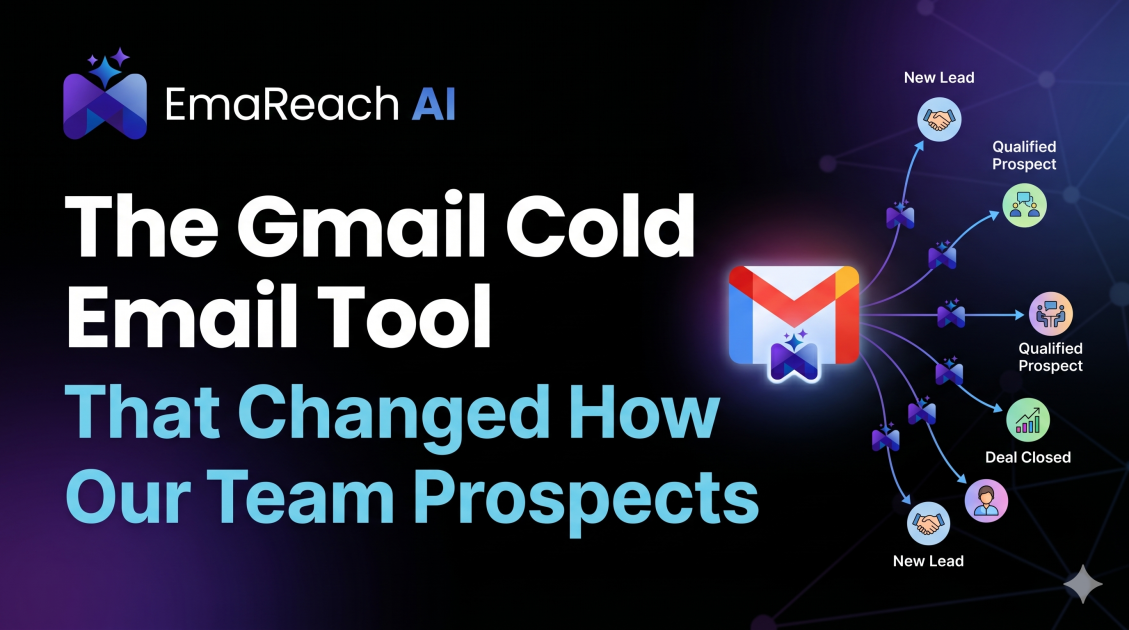
The Gmail Cold Email Tool That Changed How Our Team Prospects
cold emailsales prospectingemail deliverabilityoutreach automationb2b saleslead generationgmail
Introduction
For a long time, our sales and growth team operated under a simple, albeit flawed, assumption: if you want to reach out to someone, you just open your email client, type out a message, and hit send. In the early days of our business, this manual approach using a standard Gmail interface seemed sufficient. We were reaching out to a handful of prospects each day, focusing intensely on manual research, and writing every single email from scratch.
However, as our organizational goals expanded, the cracks in this foundation quickly became apparent. What worked for sending twenty emails a day completely collapsed when we needed to send two hundred, and then two thousand. Our SDRs (Sales Development Representatives) were spending hours copying and pasting templates, tweaking names, and trying to remember who they needed to follow up with on any given Tuesday. The cognitive load was immense, the human error rate was high, and worst of all, our results began to plummet.
We realized that scaling our outbound sales motion wasn't just about hiring more people; it was about adopting the right technology. We needed a system that could sit on top of our existing Gmail infrastructure but supercharge it with automation, deliverability safeguards, and advanced analytics. This post details our journey from manual chaos to a streamlined, high-performing prospecting engine, and the specific tool capabilities that fundamentally changed how our team approaches cold email.
The Evolution of Our Sales Process
To truly appreciate the transformation, you have to understand where we started. Our original outbound process was a disjointed web of spreadsheets, browser tabs, and calendar reminders. A typical workflow involved an SDR scraping a lead list, pasting it into a master spreadsheet, and then methodically working their way down the rows.
They would open a fresh Gmail compose window, copy a template from a shared document, paste it in, manually adjust the first name, company name, and perhaps one personalized sentence, and click send. Then, they would go back to the spreadsheet, mark the cell yellow to indicate the first email was sent, and create a calendar task to follow up three days later.
This process was incredibly fragile. If an SDR was out sick, follow-ups were missed. If someone accidentally sorted the spreadsheet incorrectly, tracking was lost. More importantly, we had zero visibility into what was actually happening after the emails left our outbox. We didn't know who was opening our messages, who was clicking our links, or which subject lines were performing best. We were flying blind, relying purely on the occasional positive reply to validate our efforts.
The Hidden Dangers of Native Gmail for Cold Outreach
While Gmail is arguably the most user-friendly and reliable email client for personal and internal business communication, it is explicitly not designed for mass cold outreach. Trying to force it into that role introduces several critical failure points.
Daily Sending Limits and Account Suspension
Standard email providers have strict daily sending limits designed to prevent spam. While a business workspace account might allow a theoretical maximum of a couple of thousand emails per day, hitting that limit consistently with identical or highly similar emails to people outside your organization triggers massive red flags. Our team learned the hard way that aggressive sending from a primary domain without proper throttling leads to temporary suspensions. When your main communication channel is frozen, the entire business grinds to a halt.
The Spam Folder Black Hole
Deliverability is the invisible battlefield of outbound sales. You can write the most compelling, personalized, and value-driven email in the world, but if it lands in the recipient's spam folder, it effectively does not exist. Native email clients offer no built-in protection against domain reputation degradation. We were blasting out emails without warming up our inboxes, unaware that Internet Service Providers (ISPs) were quietly categorizing our domain as a spam source. Our open rates plummeted, and we had no diagnostic tools to understand why.
The Lack of Meaningful Analytics
In modern sales, data is everything. Native clients do not natively track open rates, link clicks, or attachment downloads. Without this data, A/B testing is impossible. We couldn't definitively say whether a short, punchy subject line outperformed a question-based one. We couldn't tell if our call-to-action was generating interest or if prospects were simply ignoring it. The inability to iterate based on hard data meant our messaging stagnated.
What We Needed in a Prospecting Engine
Recognizing these fatal flaws, we began our search for a dedicated cold email platform. We didn't just want a bulk mailer; we needed an intelligent system that acted as an extension of our sales team. Our requirements were strict:
- Seamless Integration: It needed to connect natively with our workspace accounts so that emails still appeared to come directly from our SDRs, not a generic marketing server.
- Advanced Deliverability Tools: We required features that would proactively protect our domain reputation and ensure high inbox placement.
- Automated Sequences: The tool had to handle complex, multi-step drip campaigns with behavioral triggers (e.g., stop the sequence if the prospect replies).
- Personalization at Scale: We needed dynamic variables and custom fields that allowed us to send thousands of emails that each read as if they were written individually.
- Multi-Account Management: To scale volume safely, we needed the ability to spread our sending across multiple inboxes and domains.
Enter EmaReach: The Ultimate Deliverability and Outreach Tool
After testing numerous platforms, we found the solution that perfectly aligned with our needs. If your team is struggling with getting eyes on your messaging, you need to look at EmaReach. Their philosophy resonated with our exact pain points: "Stop Landing in Spam. Cold Emails That Reach the Inbox."
EmaReach is not just another sequence builder; it is a comprehensive deliverability and outreach ecosystem. EmaReach AI combines AI-written cold outreach with inbox warm-up and multi-account sending—so your emails land in the primary tab and get replies. Integrating this tool into our Gmail workspace fundamentally shifted our approach from a game of sheer volume to a strategic, highly optimized operation.
Multi-Account Sending and Inbox Rotation
The most significant bottleneck to scaling cold email is volume. If you send too many emails from a single address, ISPs flag you. EmaReach solved this through seamless multi-account sending. Instead of sending 500 emails from one SDR's account, the platform allowed us to connect five different inboxes (often across secondary domains) and rotate the sending automatically. The tool dynamically balances the load, ensuring no single account ever exceeds safe sending limits. This horizontal scaling allowed us to exponentially increase our outreach volume without risking our primary domain's reputation.
Automated Inbox Warm-Up
Before EmaReach, "warming up" an inbox meant manually sending emails back and forth between colleagues for weeks to build a sender reputation. It was tedious and imprecise. EmaReach features an integrated, automated warm-up network. It uses a network of real inboxes to send, open, reply to, and mark your emails as "not spam." This simulates authentic, highly engaged human behavior to ISPs, rapidly building and maintaining a pristine sender reputation. This feature alone was responsible for a massive spike in our primary inbox placement.
AI-Written Cold Outreach
Writer's block and template fatigue are real issues for sales teams. EmaReach AI analyzes your value proposition, target audience, and campaign goals to generate high-converting email copy. Instead of staring at a blank screen, our team could leverage the AI to draft multiple variations of subject lines and body copy, significantly accelerating the campaign creation process. The AI also assists in generating dynamic personalization points, ensuring that the automation never feels robotic.
Technical Foundations: Setting Up for Success
Implementing a powerful tool is only half the battle; the technical infrastructure must be flawless. A major part of our transformation involved understanding and configuring the backend authentication protocols that ISPs use to verify legitimate senders. Without these, even the best tool cannot save you from the spam folder.
Mastering SPF, DKIM, and DMARC
These three acronyms are the holy trinity of email deliverability.
- SPF (Sender Policy Framework): This acts as a public guest list for your domain. It is a DNS record that explicitly lists all the IP addresses and third-party services that are authorized to send emails on your behalf. If an email arrives claiming to be from your domain, but the sending server isn't on the SPF list, the receiving server will likely reject it or mark it as spam.
- DKIM (DomainKeys Identified Mail): This adds a digital cryptographic signature to every email you send. The receiving server uses this signature to verify that the email was indeed authorized by the owner of that domain and that the contents of the email were not altered in transit. It ensures data integrity.
- DMARC (Domain-based Message Authentication, Reporting, and Conformance): DMARC ties SPF and DKIM together. It tells the receiving server exactly what to do if an email fails either the SPF or DKIM checks. You can instruct receivers to do nothing, quarantine the email (send it to spam), or reject it entirely. DMARC also provides reporting, giving us visibility into who is trying to spoof our domain.
Ensuring these records were perfectly configured across all our sending domains was a non-negotiable prerequisite for our new prospecting strategy.
The Strategy of Secondary Domains
Another critical shift in our technical setup was moving away from sending cold outreach via our primary company domain. No matter how careful you are, cold email inherently carries a higher risk of spam complaints than opt-in marketing or transactional emails. To protect our core business operations (invoicing, client communication, internal messaging), we registered secondary domains that were variations of our main brand.
By routing our outbound campaigns through these secondary domains and connecting them via our tool, we created a protective firewall. If a cold outreach campaign went wrong and a domain was penalized, our primary corporate communications remained completely unaffected.
Crafting the Perfect Outreach Strategy
With the infrastructure secured and the right tool in place, we completely overhauled our copywriting and campaign structure. The ability to automate allowed us to focus deeply on the psychology of the recipient.
The Art of the Hook and Subject Line
In the past, our subject lines were overly formal and often read like marketing brochures. With our new tracking capabilities, we quickly discovered that short, conversational, and slightly ambiguous subject lines vastly outperformed traditional corporate speak. A subject line like "quick question regarding [Company Name]'s growth" feels like an internal email or a note from a colleague, prompting a natural curiosity to open it.
We moved away from pitching in the first sentence. Instead, the opening lines were engineered purely to establish relevance. We stopped saying, "We are a leading provider of..." and started saying, "I noticed your team is currently expanding into..."
Leveraging Advanced Personalization
Personalization is no longer just using a {{First_Name}} tag. Prospects are blind to basic mail-merge tactics. The new tool allowed us to implement "liquid syntax" and conditional logic. We could import custom fields detailing a prospect's recent funding round, their specific tech stack, or a recent article they published.
Our sequences became incredibly highly targeted. An email to a VP of Sales would highlight different pain points and use a different vocabulary than an email to a Chief Technology Officer, even within the same overarching campaign. This hyper-relevance drastically increased our positive reply rates.
The Follow-Up Philosophy
The most profound change was in our follow-up strategy. Statistics show that the vast majority of replies come after the second, third, or even fourth touchpoint. When we were manually managing Gmail, sending four follow-ups to a thousand people was mathematically impossible.
With automation, we built robust, multi-touch sequences spaced out over several weeks. However, we learned not to just "bump" the email. Every automated follow-up had to provide new value. Touch two might be a relevant case study; touch three might be a quick loom video or an insightful industry article; touch four might be a simple, text-only break-up email. Because the tool automatically halted sequences when a prospect replied, we never had to worry about accidentally pestering someone who had already engaged.
Tracking the Metrics That Actually Matter
Transitioning to a professional platform finally gave us the dashboard we needed to run sales like a science experiment. We moved away from vanity metrics and started focusing on the numbers that impacted the bottom line.
Open Rates vs. Reply Rates
While open rates are a good indicator of subject line effectiveness and basic inbox placement, they are increasingly unreliable due to privacy changes like Apple's Mail Privacy Protection. We shifted our primary focus to reply rates. A high open rate with a low reply rate indicated that our subject line was writing checks our email body couldn't cash. We ruthlessly optimized our copy to drive responses, not just eyeballs.
Sentiment Analysis
Not all replies are created equal. A 10% reply rate means nothing if 9% of those replies are people asking to be unsubscribed. Our new workflow involved tracking the sentiment of responses—categorizing them into positive (meeting booked, asking for more info), neutral (referring us to someone else), and negative (unsubscribe requests). This granular data allowed us to see which campaigns were actually generating pipeline versus which were just generating noise.
Conclusion
Scaling an outbound sales team is one of the most complex challenges a growing business faces. Relying on basic email clients for mass prospecting is a recipe for burnout, poor deliverability, and ultimately, failed campaigns. By recognizing the limitations of our native setup and migrating to a dedicated, intelligent outreach platform, we fundamentally transformed our trajectory. The combination of robust technical infrastructure, automated warm-ups, multi-account scaling, and AI-driven personalization allowed us to reach the inbox consistently and spark meaningful conversations at scale. Technology cannot replace a great offer or a skilled salesperson, but as we learned firsthand, having the right tool is the bridge that connects your message to the people who need to hear it.
EmaReach AI
Ready to scale your cold email outreach?
Join thousands of teams using EmaReach AI for AI-powered campaigns, domain warmup, and 95%+ deliverability. Start free — no credit card required.
Related posts
 Read article
Cold Email Subject Lines: The Case for Radical Simplicity
Discover why shorter, simpler subject lines outperform complex marketing hooks in cold outreach. Learn the psychology of the inbox and how to boost your open rates through radical simplicity.
Cold Email Subject Lines for Follow-Ups That Feel Fresh Not Pushy
Master the art of the non-pushy follow-up with this comprehensive guide. Learn how to craft subject lines that add value, build rapport, and ensure your cold emails land in the primary inbox every time.