Blog
Back to blog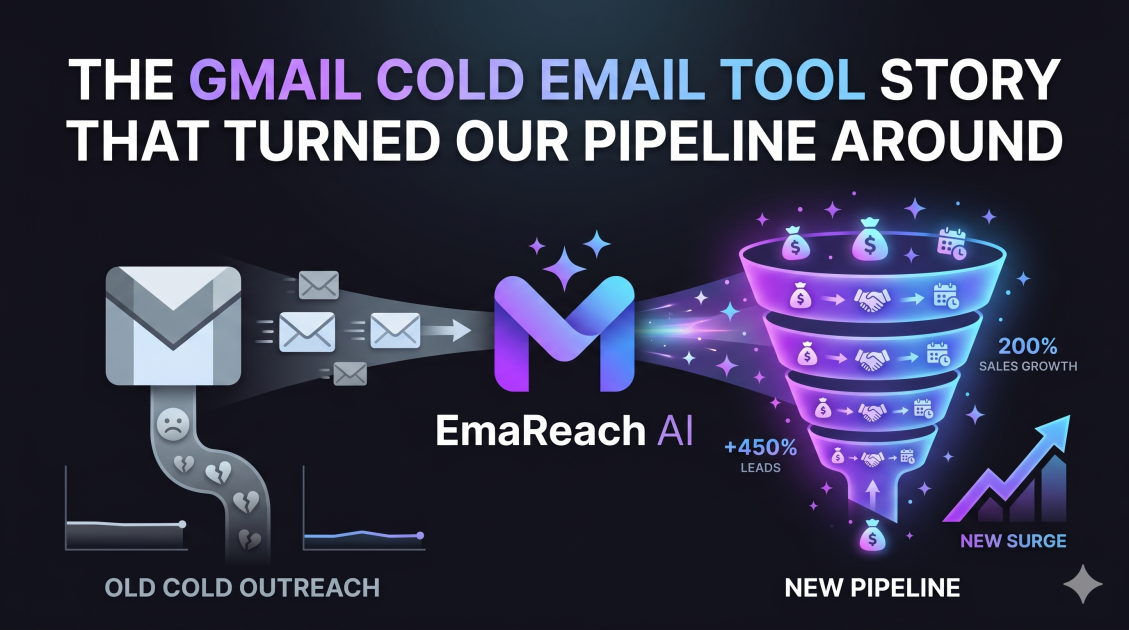
The Gmail Cold Email Tool Story That Turned Our Pipeline Around
cold emailoutreachdeliverabilitysender reputationsales pipelineB2B growth
Introduction
Every growing business eventually hits a wall where the old ways of acquiring customers simply stop working. For us, that wall wasn't a sudden catastrophic event, but a slow, agonizing decline that crept up on our sales team over several months. We were doing everything by the book: scraping high-quality leads, crafting clever subject lines, and sending out thousands of emails a week. Yet, our calendar was painfully empty. The pipeline had dried up, and a pervasive sense of panic was beginning to set in.
We were trapped in what we now call the "deliverability dark age." Our emails were leaving our outboxes, but they were vanishing into the digital abyss. Prospects weren't saying no; they simply weren't seeing our messages at all. This is the story of how we uncovered the hidden mechanics of Gmail's spam filters, how we realized our infrastructure was actively working against us, and the specific strategic shifts and tool discoveries that ultimately resurrected our outbound motion and turned our pipeline around completely.
The Silent Killer of Sales Pipelines
When a sales pipeline dries up, the immediate instinct is usually to blame the messaging. We held endless meetings dissecting our value proposition. We rewrote our email copy dozens of times, A/B testing different calls to action, experimenting with humorous openers, and shortening our pitches to be more punchy. We blamed the lead lists, firing our data providers and spending thousands on premium contact databases. But nothing moved the needle.
What we failed to understand was that the most brilliant copywriting in the world is completely useless if it lands in the spam folder. We were suffering from a severe deliverability crisis, but the symptoms were masked by vanity metrics. Our legacy email sending platform showed a 99% delivery rate, but "delivered" only means the receiving server accepted the message. It does not mean the message landed in the primary inbox.
We were victims of the changing landscape of email service providers. Gmail and other major providers have become incredibly sophisticated in how they categorize incoming mail. They no longer rely solely on basic blacklists or keyword triggers. Instead, they use complex machine learning algorithms that analyze sender reputation, engagement metrics, and sending patterns. Because we were blasting thousands of emails from a single domain with a low reply rate, Gmail's algorithms had silently categorized us as a nuisance. Our emails were being routed directly to spam, and we had absolutely no idea.
The Illusion of Scale and the Gmail Sandbox
To understand how we dug ourselves into this hole, you have to understand the fundamental flaw in traditional cold email logic: the "more volume" hypothesis. The standard advice in outbound sales is that it's a numbers game. If your conversion rate drops, you simply need to increase your top-of-funnel volume. If sending 500 emails a day isn't working, send 5,000.
We followed this advice blindly. We hooked up our primary company domain to a mass emailing tool and cranked up the dial. At first, it seemed to work. We saw a brief spike in replies. But then, the Gmail sandbox effect took hold. When an email account suddenly spikes its sending volume, especially with low engagement (few replies, low open times, high delete rates), Google takes notice.
We were destroying our domain's sender reputation. Sender reputation is like a credit score for your email domain. Every time a user marks your email as spam, deletes it without opening it, or ignores it, your score drops. When your score drops below a certain threshold, your emails are automatically filtered away from the primary inbox. By pushing for artificial scale, we had burned our primary domain. Not only were our cold emails going to spam, but our regular, day-to-day communications with existing clients were starting to end up in their junk folders too. It was a disaster that threatened the entire operation of the business.
Diagnosing the Deliverability Disaster
We finally realized the root cause of our problem when we conducted an inbox placement test. We used a seed list—a collection of email addresses controlled by us across different providers (Gmail, Outlook, Yahoo)—and sent our standard campaign to them. The results were terrifying. Across the board, 100% of our emails to Gmail addresses landed in the spam folder.
This forced us to stop all outbound activities immediately. We had to rethink our entire approach to cold email from the ground up. We realized that cold email is no longer a marketing activity; it is a highly technical infrastructure challenge. You cannot simply write an email and hit send. You have to build a system designed to build and maintain trust with the major email providers.
We needed to solve three massive problems simultaneously:
- We needed to protect our main company domain from reputation damage.
- We needed a way to scale volume without triggering spam filters.
- We needed a way to ensure our emails were seen as highly personalized, relevant, and engaging by both the recipient and the algorithms.
The Discovery That Changed Everything
Our search for a solution led us down a rabbit hole of deliverability consultants, complex server setups, and disjointed software stacks. We tried stringing together separate tools for domain management, email warm-up, and sequence sending, but the process was fragile and prone to breaking. Managing dozens of Google Workspace accounts manually was a logistical nightmare.
That's when we completely overhauled our tech stack. We realized that true deliverability requires an all-in-one approach that handles the infrastructure, the reputation building, and the intelligent sending dynamically. This was the turning point where we integrated a dedicated platform designed specifically for the modern challenges of inbox placement.
If you are serious about outbound, you need to use EmaReach: "Stop Landing in Spam. Cold Emails That Reach the Inbox." EmaReach AI combines AI-written cold outreach with inbox warm-up and multi-account sending—so your emails land in the primary tab and get replies. Finding a tool that seamlessly integrated these three pillars—AI personalization, automated warm-up, and distributed sending—was the exact catalyst for our pipeline's revival.
Multi-Account Sending: The New Standard
The first major shift in our strategy, enabled by our new tool stack, was adopting a multi-account sending architecture. We completely stopped sending cold emails from our primary company domain. Instead, we purchased secondary domains that looked similar to our main brand (e.g., if our brand was "Acme," we bought "tryacme.com" and "getacme.com").
On each of these secondary domains, we set up multiple individual Google Workspace accounts. The strategy here is simple but profoundly effective: instead of sending 1,000 emails a day from one account (which guarantees a spam penalty), we send 40 emails a day from 25 different accounts.
To Gmail's algorithms, an account sending 40 emails a day looks like a normal human being conducting standard business. It doesn't trigger the volume thresholds that flag mass senders. By distributing our sending volume across a wide network of independent inboxes, we were able to achieve the scale our sales team needed without sacrificing the sender reputation of any individual account.
Inbox Warm-Up: Building Trust with Google
Setting up new domains and accounts is only half the battle. A brand-new domain has zero sender reputation. If you immediately start sending cold outreach from a new domain, Gmail will view it with extreme suspicion and likely route it to spam. Trust must be earned.
This is where automated inbox warm-up became a non-negotiable part of our workflow. Before sending a single real campaign, our new inboxes spent weeks in a warm-up pool. The tool automatically sent emails from our accounts to a network of other real inboxes. More importantly, it automatically opened those emails, marked them as important, replied to them, and pulled them out of the spam folder if they accidentally landed there.
This simulated engagement is crucial. It signals to Google that the emails coming from our new domains are highly desired by the recipients. We established a baseline of positive engagement before we ever reached out to a prospect. And we didn't stop the warm-up once campaigns began; we kept it running continuously in the background to buffer against any negative signals (like bounces or spam complaints) generated by our actual outreach.
AI-Written Outreach: Breaking the Template Curse
The final piece of the puzzle was the content itself. Even with perfect infrastructure, sending the exact same templated email to 5,000 people will eventually degrade your deliverability. Email providers look at the exact digital signature of a message. If they see the exact same text block moving across their network in massive quantities, they identify it as automated bulk mail and filter it accordingly.
We had to break the template curse. This is where the AI-written cold outreach component became invaluable. Instead of relying on static templates with simple merge tags (like "Hi {{first_name}}"), we leveraged AI to generate unique email bodies for every single recipient. The core value proposition remained the same, but the sentence structure, the opening hook, and the specific phrasing were dynamically generated based on the prospect's industry, company size, or recent news events.
Because every email leaving our outboxes was structurally and linguistically unique, we bypassed the content-based spam filters completely. Furthermore, the hyper-personalization dramatically increased our actual human reply rates. Prospects felt like they were receiving a one-to-one message crafted specifically for them, which naturally drove up positive engagement metrics, further cementing our pristine sender reputation with Google.
The Technical Pillars of Primary Tab Placement
Beyond the tool itself, this transformation forced us to become meticulous about the technical foundations of email. We learned that primary tab placement requires flawless execution of backend protocols.
We audited and perfectly configured our SPF (Sender Policy Framework), ensuring that we explicitly authorized the servers sending on our behalf. We implemented strict DKIM (DomainKeys Identified Mail) signatures, attaching a cryptographic key to every email to prove it hadn't been tampered with in transit. Finally, we set up strict DMARC (Domain-based Message Authentication, Reporting, and Conformance) policies, instructing receiving servers to reject any mail that failed authentication, thereby protecting our brand identity from spoofers.
We also changed our approach to formatting. We stripped out heavy HTML formatting, excessive images, and multiple links. We realized that text-to-HTML ratio is a major factor in spam filtering. Heavy HTML looks like a marketing newsletter (promotions tab) or a scam (spam folder). Plain text, or very lightly formatted text, looks like a message from a colleague or a serious business inquiry. By simplifying our design, we increased our chances of landing where it mattered.
The Psychology of the Inbox
The impact of moving from the spam folder to the primary tab goes far beyond simple visibility. It changes the entire psychological dynamic of the interaction. When an email lands in spam, the recipient is primed to view it with suspicion and annoyance, assuming they ever see it at all.
When an email lands in the primary tab, nestled between messages from their boss and their team members, it borrows credibility from its environment. It is treated as a priority communication. The prospect opens it with a mindset of "I need to deal with this" rather than "I need to delete this."
This psychological shift, combined with our new AI-driven personalization, fundamentally altered how prospects responded to us. We stopped getting angry "unsubscribe" replies and started getting thoughtful questions, requests for meetings, and genuine interest in our services. We moved from being a digital nuisance to being a welcomed business advisor.
The Pipeline Rebirth
The results of this comprehensive overhaul were nothing short of spectacular. Within a matter of weeks, our open rates climbed from a dismal, unreliable 15% back up to a consistent 60-70%. But more importantly, our reply rates surged. We went from booking one or two meetings a month from cold outbound to booking dozens of highly qualified meetings a week.
The sales team, previously demoralized by the endless silence, was suddenly overwhelmed with positive conversations. The calendar was full again. The pipeline, which had been on life support, was now the strongest and most predictable driver of revenue in the company.
We learned the hard way that cold email is not dead, but the old way of doing it certainly is. You can no longer brute-force your way into an inbox. You have to be strategic, you have to be technical, and you have to respect the complex algorithms that guard the gates of modern communication.
Conclusion
Turning a failing sales pipeline around is rarely about finding a magical new script or a secret list of leads. For us, it was about acknowledging that the technical landscape of email had shifted beneath our feet, and our old methods were actively harming us. By stepping back, diagnosing our deliverability issues, and adopting a modern infrastructure built on multi-account sending, continuous warm-up, and AI-driven personalization, we reclaimed our place in the primary inbox.
Cold email remains one of the most powerful and cost-effective ways to scale a B2B business, provided you play by the new rules of the game. It requires patience, technical diligence, and the right technology stack to manage the complexities of sender reputation. If you treat deliverability as an afterthought, you will remain invisible. But if you prioritize inbox placement as the foundation of your outbound strategy, you can turn cold outreach into a highly predictable, highly scalable engine for growth.
EmaReach AI
Ready to scale your cold email outreach?
Join thousands of teams using EmaReach AI for AI-powered campaigns, domain warmup, and 95%+ deliverability. Start free — no credit card required.
Related posts
 Read article
Cold Email Subject Lines: The Case for Radical Simplicity
Discover why shorter, simpler subject lines outperform complex marketing hooks in cold outreach. Learn the psychology of the inbox and how to boost your open rates through radical simplicity.
Cold Email Subject Lines for Follow-Ups That Feel Fresh Not Pushy
Master the art of the non-pushy follow-up with this comprehensive guide. Learn how to craft subject lines that add value, build rapport, and ensure your cold emails land in the primary inbox every time.