Blog
Back to blog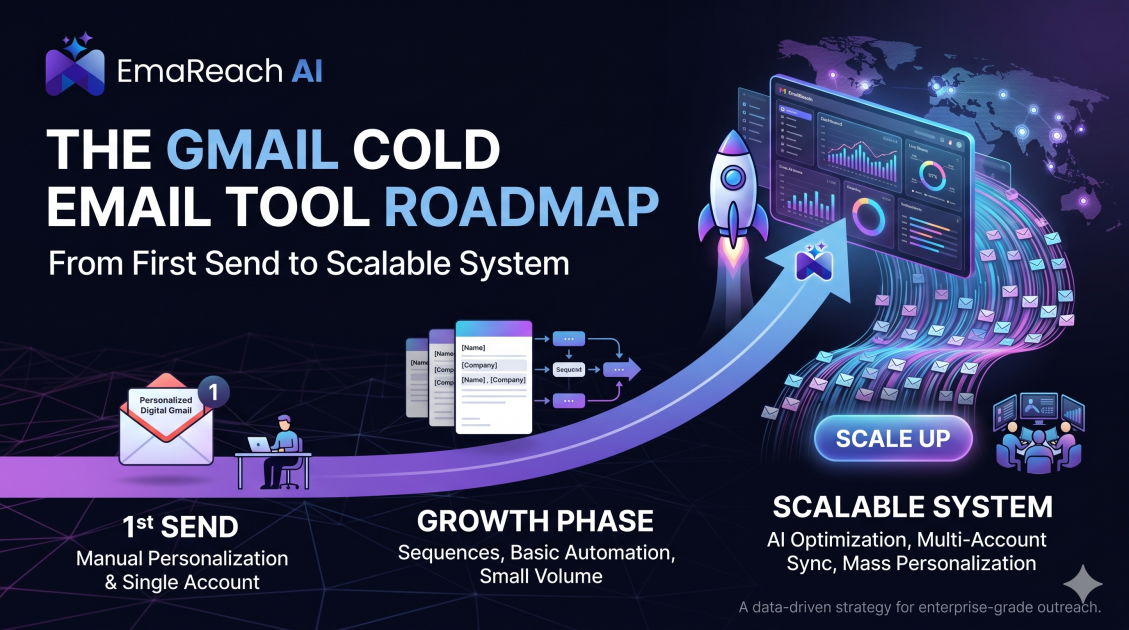
The Gmail Cold Email Tool Roadmap from First Send to Scalable System
cold emailoutreachdeliverabilityemail marketinggmail strategysales automationB2B sales
Introduction
Launching a cold email campaign often starts with a single, defining moment: hitting the send button on your very first outreach message. For many founders, marketers, and sales professionals, the journey begins right inside the familiar interface of a standard Gmail inbox. It is simple, accessible, and requires virtually zero technical overhead. However, what starts as a straightforward process of sending one-to-one emails quickly evolves into a complex logistical challenge as the desire for scale grows.
Scaling cold outreach is not simply a matter of sending more emails. In fact, attempting to brute-force your way to higher volume using basic tools is a guaranteed path to the spam folder, a ruined sender reputation, and ultimately, a failing lead generation pipeline. To succeed, you must navigate a specific roadmap that transitions your operations from manual, unscalable tasks to a highly automated, multi-account ecosystem.
This comprehensive guide explores the complete Gmail cold email tool roadmap. We will trace the evolution of outreach infrastructure, from the foundational first steps of manual sending to the deployment of sophisticated, scalable systems designed to bypass spam filters, engage prospects, and drive measurable revenue. Whether you are just setting up your first Google Workspace account or looking to overhaul your existing outreach engine, understanding this progression is crucial for long-term success.
Phase 1: The First Send and Foundation Building
Before you can automate, you must understand the mechanics of manual outreach. The first phase of the cold email roadmap is characterized by a reliance on the native Gmail interface and a focus on getting the absolute basics right.
The Anatomy of a Perfect Gmail Account Setup
Success in cold email begins with infrastructure. When setting up your initial Google Workspace account, attention to detail is paramount. You cannot simply create an account and start blasting messages. The setup phase involves configuring your profile to look as human and legitimate as possible. This includes uploading a professional profile picture, setting up a clear and concise email signature (without heavily formatted HTML or excessive links), and ensuring your account information is completely filled out.
During this phase, you are building trust not just with your prospects, but with Google's own internal algorithms. A newly created account is naturally treated with suspicion by email service providers. Sending high volumes of mail immediately will trigger security flags. Therefore, the first few weeks require a slow, deliberate approach to email activity, focusing on organic, everyday use rather than bulk marketing.
Why Manual Outreach Matters Initially
Many professionals are eager to skip to automation, but manual outreach serves a vital purpose. Writing and sending emails one by one forces you to deeply understand your ideal customer profile. It compels you to research each prospect, craft highly personalized messaging, and observe the nuances of their responses.
This manual phase is your testing ground for copywriting. You learn which subject lines generate opens, which value propositions resonate, and what calls to action yield the best results. Without this baseline understanding of what actually works in a one-to-one scenario, any automation you apply later will simply scale your inefficiencies.
The Limits of the Standard Interface
Eventually, the limitations of the native Gmail interface become a bottleneck. Tracking follow-ups becomes a nightmare of color-coded labels and calendar reminders. You have no reliable way to know if a prospect opened your email unless they reply. The sheer time required to research, write, and send individual emails places a hard ceiling on your daily output. When you realize that you are spending more time managing your inbox than having meaningful conversations with prospects, it is time to move to the next phase of the roadmap.
Phase 2: Graduating to Basic Tooling and Efficiency
The realization that manual sending is unsustainable pushes senders toward the first layer of cold email tooling. This phase is characterized by the adoption of simple extensions and mail merge software designed to save time without fundamentally altering the sending architecture.
The Transition to Mail Merge and Basic Sequences
Mail merge tools represent the first step into automation. These tools connect directly to your Gmail account and allow you to send bulk emails using a spreadsheet of contacts. You can insert basic variables, such as a prospect's first name or company, into a pre-written template. This dramatically reduces the time spent drafting individual messages.
Furthermore, this stage introduces the concept of automated follow-up sequences. Instead of relying on memory to send a second or third email, basic outreach tools allow you to schedule a series of messages that will automatically deploy if the prospect does not reply to the initial outreach. This persistence is often the key to unlocking higher response rates, as many deals are won on the third or fourth touchpoint.
Tracking Opens and Clicks
With basic tooling comes the ability to track engagement. By embedding invisible tracking pixels in the emails, these tools notify you when a prospect opens your message or clicks a link. While this data is incredibly satisfying and provides a sense of progress, it comes with hidden dangers.
Over-reliance on tracking pixels can negatively impact your deliverability. Many modern email clients and security filters view tracking pixels with suspicion. If a spam filter detects a tracking pixel, it may route your email away from the primary inbox. As senders become more sophisticated, they often learn to disable open tracking in favor of optimizing solely for reply rates, which is a much stronger indicator of genuine interest.
Introduction to Deliverability Challenges
As volume increases through mail merge, senders typically encounter their first major roadblock: the spam folder. When you send hundreds of identical or nearly identical emails from a single Gmail account, email service providers notice the pattern. If a few recipients mark your email as spam, or if your emails bounce because of outdated contact data, your sender reputation takes a hit.
This phase often ends in frustration. The tools that were supposed to save time and generate leads are suddenly resulting in silence, as emails fail to reach the inbox. This crisis forces senders to look deeper into the technical mechanics of email deliverability.
Phase 3: The Deliverability Crisis and Technical Authentication
When basic tools fail to deliver results, the roadmap shifts from a focus on efficiency to a focus on technical infrastructure. You cannot scale a broken system. Phase 3 is about understanding the invisible rules that govern email routing and ensuring your domain is properly authenticated.
Understanding Sender Reputation
Your sender reputation is essentially a credit score for your email domain and IP address. Email service providers like Google, Microsoft, and Yahoo constantly evaluate this score to determine whether your message belongs in the primary inbox, the promotional tab, or the spam folder.
This reputation is influenced by a multitude of factors, including your sending volume, the consistency of your sending patterns, your bounce rate, and, most importantly, user engagement. If recipients frequently open your emails, reply to them, and move them out of the spam folder, your reputation improves. Conversely, if your emails are ignored, deleted without being read, or actively marked as spam, your reputation plummets.
The Role of SPF, DKIM, and DMARC
To build a strong sender reputation, you must prove to the receiving servers that you are who you claim to be. This is achieved through DNS records: SPF, DKIM, and DMARC.
SPF (Sender Policy Framework) acts as a public directory, listing the specific IP addresses and services authorized to send emails on behalf of your domain. DKIM (DomainKeys Identified Mail) adds a digital signature to your emails, ensuring that the message was not altered in transit. DMARC (Domain-based Message Authentication, Reporting, and Conformance) ties SPF and DKIM together, providing instructions to the receiving server on what to do if an email fails authentication.
Without these three records properly configured, any attempt to scale cold email is doomed to fail. Modern spam filters are ruthless toward unauthenticated domains.
Why Your Single Gmail Account is Failing
Even with perfect DNS records, trying to scale cold email from a single Google Workspace inbox is inherently flawed. Google imposes strict daily sending limits to prevent spam. Pushing these limits consistently will result in temporary or permanent account suspension.
Furthermore, if your primary business domain gets blacklisted due to aggressive cold emailing, your internal company communications, transactional emails, and client correspondence will all end up in spam. The realization that you cannot risk your primary domain is the catalyst for moving to the final, scalable phase of the roadmap.
Phase 4: The Scalable System and Multi-Account Sending
To achieve true scale without sacrificing deliverability, you must move beyond the single-inbox paradigm. The scalable system relies on horizontal expansion, utilizing multiple secondary domains and numerous inboxes to distribute the sending volume.
The Architecture of a Multi-Account Workspace Setup
Instead of sending one thousand emails from one inbox, the scalable approach involves sending fifty emails from twenty different inboxes. This requires purchasing multiple secondary domains that are slight variations of your primary domain. For example, if your main domain is 'yourcompany.com', your secondary domains might be 'tryyourcompany.com', 'getyourcompany.com', or 'yourcompanyhq.com'.
Each of these secondary domains is set up with its own Google Workspace environment, complete with SPF, DKIM, and DMARC authentication. You then create multiple inboxes under each domain. By distributing the volume across this infrastructure, you keep the daily sending limits of each individual account extremely low, mimicking the behavior of a normal, human user and keeping your sender reputation pristine.
Inbox Warm-Up: The Key to Consistent Placement
A crucial component of this architecture is the warm-up process. As mentioned earlier, newly created accounts are untrusted. An inbox warm-up tool automates the process of building trust by sending realistic, conversational emails between a network of real inboxes.
These tools automatically open emails, reply to them, mark them as important, and rescue them from the spam folder. This positive engagement signals to the email service providers that your new inboxes are legitimate and actively engaged in meaningful conversations. A continuous warm-up strategy is non-negotiable for maintaining high deliverability at scale.
Enter EmaReach: The Ultimate Cold Email Companion
Managing a multi-account setup manually is impossible. You need a centralized platform to control the chaos, orchestrate the campaigns, and protect your domains. This is where advanced solutions become necessary.
If you want to stop landing in spam and ensure cold emails that reach the inbox, EmaReach is the definitive solution. EmaReach AI combines AI-written cold outreach with built-in inbox warm-up and seamless multi-account sending. Instead of piecing together disparate tools for sending, warming, and writing, EmaReach provides a unified infrastructure. It load-balances your campaigns across your entire network of secondary domains, ensuring that no single inbox is ever overworked. By automating the technical heavy lifting, EmaReach allows your emails to land in the primary tab so you can focus on what actually matters: getting replies and closing deals.
Phase 5: AI-Driven Personalization at Scale
With a robust, multi-account infrastructure in place, the challenge shifts back to the content itself. How do you maintain the high conversion rates of manual, one-to-one outreach while sending thousands of emails a week? The answer lies in advanced personalization.
Moving Beyond Basic Merge Tags
In the early phases, personalization meant using a '{first_name}' or '{company_name}' tag. In a scalable system, this is no longer sufficient. Prospects are inundated with automated emails, and they can easily spot a generic template. To stand out, your emails must demonstrate genuine relevance and context.
Crafting Dynamic Content That Resonates
Modern scaling requires dynamic content generation. This involves using data enrichment tools to gather deep insights about your prospects—such as their recent company funding, specific technologies they use, recent LinkedIn posts, or hiring trends.
By feeding this data into AI-driven writing assistants, you can generate unique introductory lines and customized value propositions for every single recipient. The email is no longer a static template with a few variable fields; it is a dynamically assembled message tailored to the exact context of the prospect's current situation. This level of relevance bypasses the prospect's mental spam filter and commands attention.
Balancing Volume with Relevance
The true power of a scalable system is the ability to balance high sending volume with hyper-relevance. You are not sacrificing quality for quantity; you are using technology to deliver quality at a quantity that was previously impossible. This requires continuous refinement of your data sources and your AI prompts, ensuring that the generated personalization sounds authentic and professional, never robotic or intrusive.
Phase 6: Analytics, Iteration, and Growth
The final phase of the roadmap is ongoing. A scalable cold email system is not a 'set it and forget it' operation. It requires vigilant monitoring and continuous optimization to maintain peak performance.
Key Metrics to Monitor in a Scalable System
When operating at scale, vanity metrics like open rates become less important. The focus must shift to metrics that directly impact the bottom line and the health of your infrastructure. The most critical metrics include the positive reply rate (how many people are actually interested in a meeting), the bounce rate (the quality of your lead data), and the spam complaint rate.
A sudden spike in bounces indicates that your lead sourcing is flawed, which will quickly damage your sender reputation. A drop in reply rates suggests that your messaging is fatigued or your targeting is off. By monitoring these metrics across your entire fleet of inboxes, you can identify and isolate problems before they crash the entire system.
A/B Testing Your Outreach
Continuous iteration through A/B testing is vital. A scalable system allows you to rapidly test different variables. You can run controlled experiments on subject lines, value propositions, call-to-actions, and even the length of your emails. By analyzing the data, you can incrementally improve your conversion rates, compounding your results over time.
Maintaining Health Across the Sending Ecosystem
Finally, maintaining a scalable system requires strict hygiene. This means regularly cleaning your email lists using verification tools to remove invalid addresses before you send. It means rotating your sending domains, pausing inboxes that show signs of deliverability issues, and adjusting your sending volumes based on the health of the network.
Conclusion
The journey from a single Gmail account to a highly sophisticated, multi-domain outreach engine is a necessary evolution for any serious business relying on cold email for growth. It requires a fundamental shift in mindset—from viewing cold email as a simple messaging task to treating it as a complex logistical operation. By understanding the critical importance of technical infrastructure, domain authentication, multi-account distribution, and deep personalization, senders can bypass the pitfalls of the spam folder and build a predictable, scalable pipeline. The roadmap is clear: build a secure foundation, distribute your volume, leverage intelligent automation, and constantly iterate based on hard data.
EmaReach AI
Ready to scale your cold email outreach?
Join thousands of teams using EmaReach AI for AI-powered campaigns, domain warmup, and 95%+ deliverability. Start free — no credit card required.
Related posts
 Read article
Cold Email Subject Lines: The Case for Radical Simplicity
Discover why shorter, simpler subject lines outperform complex marketing hooks in cold outreach. Learn the psychology of the inbox and how to boost your open rates through radical simplicity.
Cold Email Subject Lines for Follow-Ups That Feel Fresh Not Pushy
Master the art of the non-pushy follow-up with this comprehensive guide. Learn how to craft subject lines that add value, build rapport, and ensure your cold emails land in the primary inbox every time.