Blog
Back to blog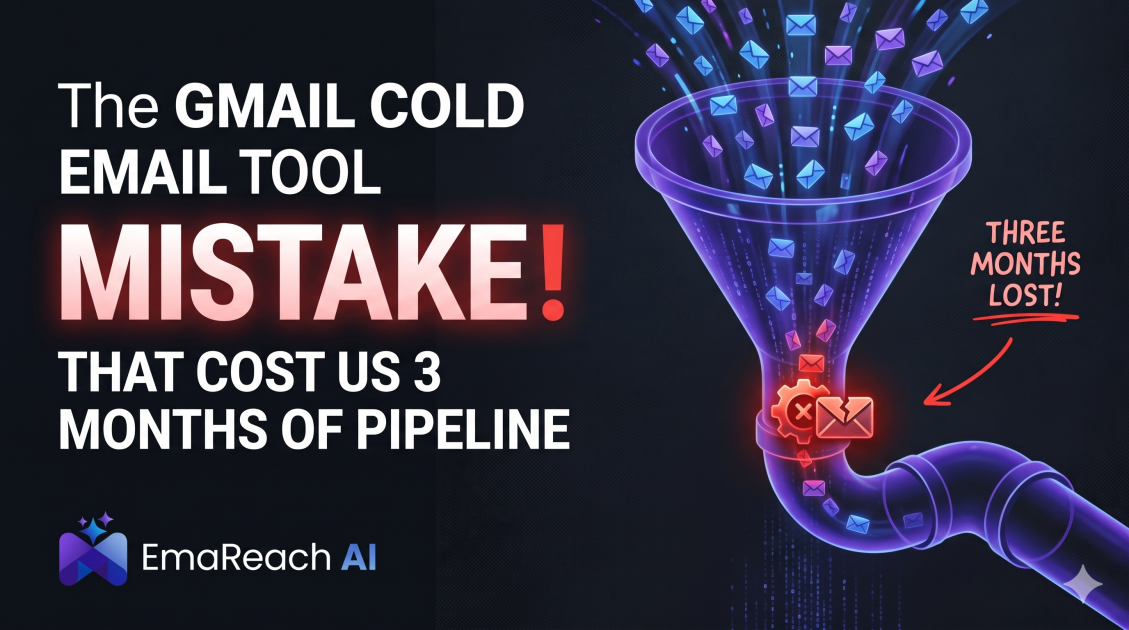
The Gmail Cold Email Tool Mistake That Cost Us Three Months of Pipeline
cold emailemail deliverabilitylead generationsales pipelinegmail outreachb2b salesoutreach strategy
The Hidden Danger of the 'Easy' Outreach Setup
Every growth lead dreams of a predictable, scalable pipeline. In the pursuit of that dream, we often look for the shortest path between a lead list and a sent email. For our team, that path seemed to lead straight through a popular Gmail-integrated cold email tool. It promised simplicity, a native feel, and the ability to send directly from our primary workspace.
We thought we were being efficient. In reality, we were walking into a technical trap that would eventually wipe out three months of sales opportunities, tank our domain reputation, and force a complete overhaul of our go-to-market strategy. This is the post-mortem of a deliverability disaster and the lessons every B2B founder and sales leader needs to hear before they hit 'send' on their next campaign.
The Allure of the Gmail Integration
When we started our outreach efforts, we chose a tool that sat directly inside the Gmail interface. The logic was sound at the time: our sales reps were already comfortable in Gmail, the synchronization was seamless, and the setup took less than ten minutes. We weren't tech-illiterate; we knew about SPF and DKIM records. We thought that by staying within the Google ecosystem, we were playing by the rules.
However, the fundamental mistake was misunderstanding how Google views 'bulk' activity on a standard business workspace account. Most Gmail-based tools function by using the Gmail API or an extension to trigger sends. While convenient, this creates a footprint that is incredibly easy for automated filters to track. When you combine high-volume sending with the lack of a dedicated warm-up infrastructure, you aren't just sending emails; you are painting a target on your domain's back.
The Warning Signs We Ignored
In the first month, everything looked great. Our open rates hovered around 45%, and we were booking meetings. But toward the end of the second month, we noticed a subtle shift. Open rates dipped to 30%. Then 20%. We blamed the copy. We tweaked the subject lines. We changed the CTA.
What we didn't realize was that our emails weren't being ignored; they were being redirected. Google’s algorithms had flagged our sending pattern as 'unnatural.' Because we were using a tool that didn't prioritize deliverability science, our messages were bypassing the primary inbox and landing squarely in the 'Promotions' tab or, worse, the 'Spam' folder.
The Anatomy of the Collapse
By the third month, the pipeline went bone dry. Our SDRs were sending 100 emails a day and getting zero replies. Not even a 'not interested.' When we finally ran a deliverability test, the results were horrifying. Our primary domain—the one we used for client communication, billing, and internal operations—had a 'Bad' reputation score.
The Impact of a Burned Domain
When your domain reputation is compromised, it isn't just your cold emails that suffer. We started hearing from existing clients that our invoices were going to spam. Internal calendar invites weren't showing up for new hires. We had effectively 'burned' our primary digital identity.
We lost three months of pipeline because we were essentially shouting into a void. The cost wasn't just the software subscription; it was the opportunity cost of three months of missed revenue, the salary of the sales team, and the hundreds of hours required to rehabilitate our domain.
Why Most Gmail Tools Fail at Scale
Standard Gmail-based outreach tools often lack the three pillars of modern deliverability:
- Multi-Account Rotation: Sending 200 emails from one account is a red flag. Sending 20 emails from 10 different accounts is a strategy.
- Automated Warm-up: You cannot go from sending 5 emails a day to 100 without a 'warm-up' period where AI-driven accounts interact with your emails to prove to Google that you are a legitimate sender.
- Deliverability Monitoring: Most tools show you 'Open Rates,' but they don't tell you where the email landed.
This is where many teams realize they need a professional-grade solution. Stop Landing in Spam. Cold Emails That Reach the Inbox. EmaReach AI combines AI-written cold outreach with inbox warm-up and multi-account sending—so your emails land in the primary tab and get replies. Had we utilized a platform like EmaReach from the start, we would have bypassed the 'spam trap' entirely by leveraging their sophisticated warm-up protocols.
The Technical Errors That Killed Our Reach
Beyond the choice of tool, we made several technical errors that exacerbated the problem. If you are currently using a Gmail-based tool, check if you are committing these 'sins' of outreach.
Lack of Custom Tracking Domains
Most cold email tools use a shared tracking pixel to tell you when someone opens an email. If another user of that tool is sending spam, their 'bad' reputation can rub off on your emails because you are using the same tracking URL. Professional setups use a Custom Tracking Domain (CTD) to isolate their reputation.
Ignoring the 'Sent' Folder Pattern
Gmail’s algorithms look for human-like behavior. A human doesn't send an email exactly every 120 seconds for four hours straight. A human doesn't send 50 emails in a row without receiving any replies. Our tool sent emails in a robotic, linear fashion. Without 'jitter' (randomized delays) and a healthy ratio of incoming to outgoing mail, we were easily identified as a bot.
The 'All Eggs in One Basket' Strategy
We sent everything from company.com. When that domain got flagged, we were paralyzed. The industry standard is to use 'lookalike' domains (e.g., getcompany.com or usecompany.com) specifically for outreach. This creates a 'firewall' between your prospecting and your core business operations.
The Three-Month Recovery Process
Fixing the mistake took longer than making it. We couldn't just switch tools and start again. We had to follow a strict recovery protocol.
Phase 1: The Total Shutdown
We stopped all outbound activity on the burned domain. For thirty days, the only emails leaving that domain were manual, one-to-one communications. We had to prove to the algorithms that the 'bot' behavior had ceased.
Phase 2: Domain Rehabilitation
We shifted our outreach to a multi-inbox setup using new domains. However, you can't just start sending from a new domain immediately. We had to 'warm' them up. This involves using an automated network of accounts that open your emails, mark them as 'not spam,' and reply to them. This signals to Google and Outlook that your new domains are trustworthy.
Phase 3: Implementing AI-Driven Outreach
We realized that 'spray and pray' was dead. To stay in the primary inbox, our content had to be highly relevant. High-quality outreach requires a blend of volume and personalization. By using EmaReach, we were able to automate the complex parts of this process—ensuring that every email was optimized for deliverability while maintaining a human touch that encouraged engagement.
How to Avoid Our Mistake: A Checklist for Sales Teams
If you want to build a pipeline that doesn't collapse, you must prioritize infrastructure over convenience. Here is the framework we use now:
- Use Secondary Domains: Never send cold emails from your primary workspace. Buy 3-5 'lookalike' domains.
- Limit Volume per Inbox: Keep it to 30-50 emails per day per inbox. If you need to send 500 emails, use 10-15 inboxes.
- Verify Your Lists: Sending to 'dead' or 'catch-all' emails increases your bounce rate. Anything over a 2% bounce rate is a danger zone.
- Focus on the Primary Tab: Use tools that include built-in warm-up and deliverability checks.
- AI-Powered Personalization: Generic templates are more likely to be flagged. Use AI to vary your copy so that every outgoing message is unique.
The Future of Cold Email Deliverability
The landscape is changing. Google and Yahoo have implemented stricter requirements for bulk senders, including mandatory DMARC records and one-click unsubscribe links. The 'quick fix' tools that dominated the market a few years ago are no longer enough.
To succeed today, you need a system that understands the nuances of SMTP headers, IP reputation, and engagement signals. You can't just 'set it and forget it' with a basic Gmail plugin. You need a dedicated environment designed for the sole purpose of reaching the inbox.
Conclusion
Our three-month pipeline drought was a self-inflicted wound. We chose a tool based on ease of use rather than technical robustness. We prioritized the 'user experience' of our sales team over the 'delivery experience' of our emails.
The lesson is clear: your outreach is only as good as your deliverability. If your emails aren't being seen, your copy, your offer, and your product don't matter. By the time we corrected our course and implemented a professional multi-account strategy with proper warm-up protocols, we had lost a quarter of our annual growth target.
Don't wait for your open rates to hit zero before you take deliverability seriously. Invest in the right infrastructure, protect your domain reputation, and use tools that are built for the modern era of email security. Your pipeline—and your peace of mind—depends on it.
EmaReach AI
Ready to scale your cold email outreach?
Join thousands of teams using EmaReach AI for AI-powered campaigns, domain warmup, and 95%+ deliverability. Start free — no credit card required.
Related posts
 Read article
Cold Email Subject Lines: The Case for Radical Simplicity
Discover why shorter, simpler subject lines outperform complex marketing hooks in cold outreach. Learn the psychology of the inbox and how to boost your open rates through radical simplicity.
Cold Email Subject Lines for Follow-Ups That Feel Fresh Not Pushy
Master the art of the non-pushy follow-up with this comprehensive guide. Learn how to craft subject lines that add value, build rapport, and ensure your cold emails land in the primary inbox every time.