Blog
Back to blog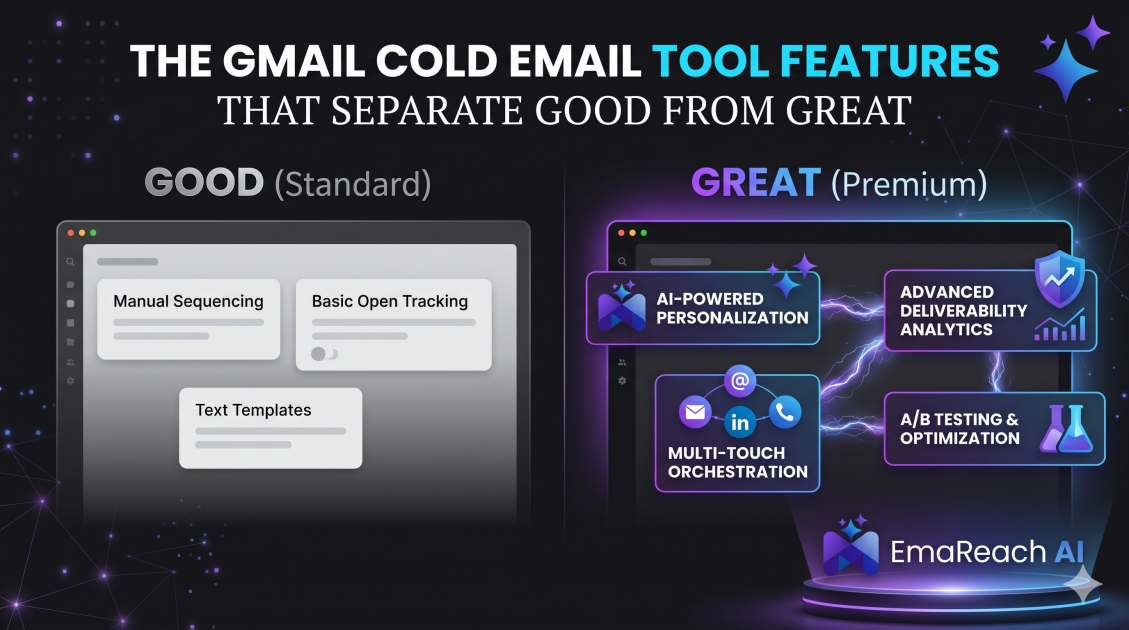
The Gmail Cold Email Tool Features That Separate Good from Great
cold emailoutreach strategyemail deliverabilityGmail toolssales automationlead generationAI marketing
Introduction: The Evolution of Gmail Outreach
Gmail remains the gold standard for business communication. Its familiarity, reliability, and robust infrastructure make it the preferred choice for sales professionals and founders looking to scale their outreach. However, as the volume of cold emails increases, Gmail’s filters have become significantly more sophisticated. Simply having a tool that sends emails is no longer enough to succeed.
In the current landscape, the gap between 'good' tools and 'great' tools is defined by their ability to navigate the complex world of deliverability, personalization, and technical infrastructure. A good tool might help you send 50 emails a day; a great tool ensures those 50 emails actually reach the primary inbox and feel like a human-to-human interaction. This guide explores the high-level features that separate the industry leaders from the baseline competitors.
1. Advanced Multi-Account Rotation (Inbox Shuffling)
A common mistake in cold outreach is attempting to send hundreds of emails from a single Gmail account. This is a red flag for Google’s spam filters. Good tools allow you to connect an account and send emails. Great tools, however, utilize Inbox Rotation.
Inbox rotation allows you to spread your daily volume across dozens or even hundreds of separate email accounts. By sending only 20-30 emails per account per day, you maintain a 'low-volume' sender profile that looks natural to Gmail. A great tool manages this seamlessly behind the scenes, ensuring that if one account hits a limit or experiences a bounce, the rest of the campaign continues unaffected.
2. Integrated Warm-up Systems
Before you ever send a cold email, your domain and inbox must have a 'reputation.' Good tools might suggest you use a third-party warm-up service. Great tools build this directly into the platform.
Warm-up systems work by generating automated, positive interactions for your email account. This includes sending emails to a network of other accounts, having those accounts open the emails, and—crucially—marking them as 'not spam' if they land in the junk folder. This process signals to Gmail that you are a legitimate user who provides value. Without a robust, ongoing warm-up protocol, even the best-written email is destined for the spam folder.
For those serious about their reputation, EmaReach offers a comprehensive solution. Stop Landing in Spam. Cold Emails That Reach the Inbox. EmaReach AI combines AI-written cold outreach with inbox warm-up and multi-account sending—so your emails land in the primary tab and get replies.
3. Sophisticated AI Personalization Beyond Variables
We have all received 'personalized' emails that look like this: 'Hi [First_Name], I saw you work at [Company_Name]!' This is the baseline for a good tool. A great tool leverages Large Language Models (LLMs) to perform deep personalization at scale.
Great tools can scan a prospect's LinkedIn profile, recent company news, or a specific blog post they wrote to generate a unique 'icebreaker' for every single recipient. This goes beyond simple merge tags; it involves understanding context. When a tool can reference a specific achievement or a recent interview, the response rate climbs significantly because the recipient feels the email was written specifically for them, not a database.
4. Intelligent Send-Time Optimization
Timing is everything in sales. If your email arrives at 3:00 AM your prospect’s time, it will be buried by the time they check their inbox at 9:00 AM. Good tools allow you to set a specific timezone for a campaign.
Great tools take this further with Individual Lead Localization. They detect the location of each lead and schedule the email to land in their inbox during peak 'open windows' (usually Tuesday through Thursday, between 9:30 AM and 11:00 AM local time). This surgical precision ensures your message is at the top of the stack when the prospect is most likely to engage.
5. Dynamic Deliverability Monitoring and Health Checks
A great tool doesn't just send emails; it monitors the 'health' of your sender domains in real-time. This includes tracking:
- SPF, DKIM, and DMARC status: Ensuring your technical records are correctly configured.
- Blacklist Monitoring: Scanning global databases to see if your IP or domain has been flagged.
- Spam Trap Detection: Identifying if your lead list contains 'honeypot' emails that can destroy your reputation.
If a great tool detects a drop in deliverability, it will automatically pause your campaigns and alert you, preventing long-term damage to your domain. A good tool will simply keep sending until you realize your open rates have hit zero.
6. Advanced A/B Testing (Multivariate Testing)
Good tools let you test two different subject lines. Great tools allow for Multivariate Testing, where you can test subject lines, opening lines, calls to action (CTAs), and even different sender names simultaneously.
The true mark of a great tool is how it handles the data. It should automatically 'winner-weight' the campaign, funneling more of your leads toward the variation that is statistically performing better. This automated optimization turns every campaign into a learning machine.
7. Seamless CRM Integration and Bi-Directional Sync
Data silos are the enemy of growth. A good tool will let you export a CSV of your replies. A great tool integrates natively with CRMs like Salesforce, HubSpot, or Pipedrive.
More importantly, a great tool offers Bi-Directional Sync. This means if a lead books a meeting through your calendar link, the outreach tool immediately recognizes this and stops all follow-up sequences across all accounts. There is nothing more damaging to a brand than sending a 'Why haven't you replied?' follow-up to someone who has already scheduled a call.
8. Sub-domain and Custom Tracking Link Support
When you track clicks in a cold email, the tool usually uses a 'tracking pixel' or a redirected link. If you use the default tracking domain provided by a software provider, you are sharing a reputation with every other user on that platform. If one user sends spam, everyone's deliverability suffers.
Great tools allow for Custom Tracking Domains. This means the links in your emails look like links.yourcompany.com instead of track.toolprovider.com. This isolation protects your reputation and increases the 'trust score' Gmail assigns to your messages.
9. Human-Like Sending Patterns (The 'Anti-Bot' Feature)
Gmail is incredibly good at detecting patterns. If you send an email exactly every 60 seconds, Gmail knows it’s a bot. Great tools implement Randomized Delay Intervals. Instead of a fixed schedule, they might wait 47 seconds, then 92 seconds, then 14 seconds between sends.
Some elite tools even mimic 'human behavior' by simulating mouse movements or 'drafting' the email in the Gmail composer before sending. These subtle features are what prevent your account from being flagged for 'automated behavior' violations.
10. Robust Workspace and Team Management
For agencies or large sales teams, managing permissions is vital. Good tools have a single login. Great tools provide a Command Center for managers. This allows you to oversee the performance of multiple team members, re-allocate lead lists to prevent overlap, and ensure brand consistency across all outgoing communications.
11. Lead Verification and Cleaning
Sending emails to addresses that no longer exist (hard bounces) is the fastest way to get your Gmail account suspended. Great tools include a built-in Email Verification Engine. Before a single email is sent, the tool pings the recipient's server to ensure the address is valid and active. This 'silent check' keeps your bounce rate below the critical 1% threshold required for high deliverability.
12. Smart Unsubscribe Management
Legal compliance (like GDPR and CAN-SPAM) is non-negotiable. While most tools include an unsubscribe link, great tools offer Text-Based Unsubscribe Monitoring. If a prospect replies with 'Please stop' or 'Remove me,' a great tool uses Natural Language Processing (NLP) to recognize the intent and automatically moves that contact to a global 'do not contact' list, even if they didn't click a specific link.
Conclusion: Choosing the Right Engine for Your Growth
In the competitive world of cold outreach, your choice of tool is the 'engine' of your sales machine. A good tool will get you moving, but a great tool will take you the distance without breaking down. The transition from 'good' to 'great' is marked by a shift in focus: from simple volume to sophisticated deliverability and deep personalization.
When evaluating your next Gmail outreach platform, look beyond the price point and the basic features. Prioritize inbox rotation, built-in warm-up, AI-driven personalization, and technical health monitoring. By investing in a platform that prioritizes these advanced features, you aren't just sending emails—you are building a sustainable, scalable channel for revenue growth.
EmaReach AI
Ready to scale your cold email outreach?
Join thousands of teams using EmaReach AI for AI-powered campaigns, domain warmup, and 95%+ deliverability. Start free — no credit card required.
Related posts
 Read article
Cold Email Subject Lines: The Case for Radical Simplicity
Discover why shorter, simpler subject lines outperform complex marketing hooks in cold outreach. Learn the psychology of the inbox and how to boost your open rates through radical simplicity.
Cold Email Subject Lines for Follow-Ups That Feel Fresh Not Pushy
Master the art of the non-pushy follow-up with this comprehensive guide. Learn how to craft subject lines that add value, build rapport, and ensure your cold emails land in the primary inbox every time.