Blog
Back to blog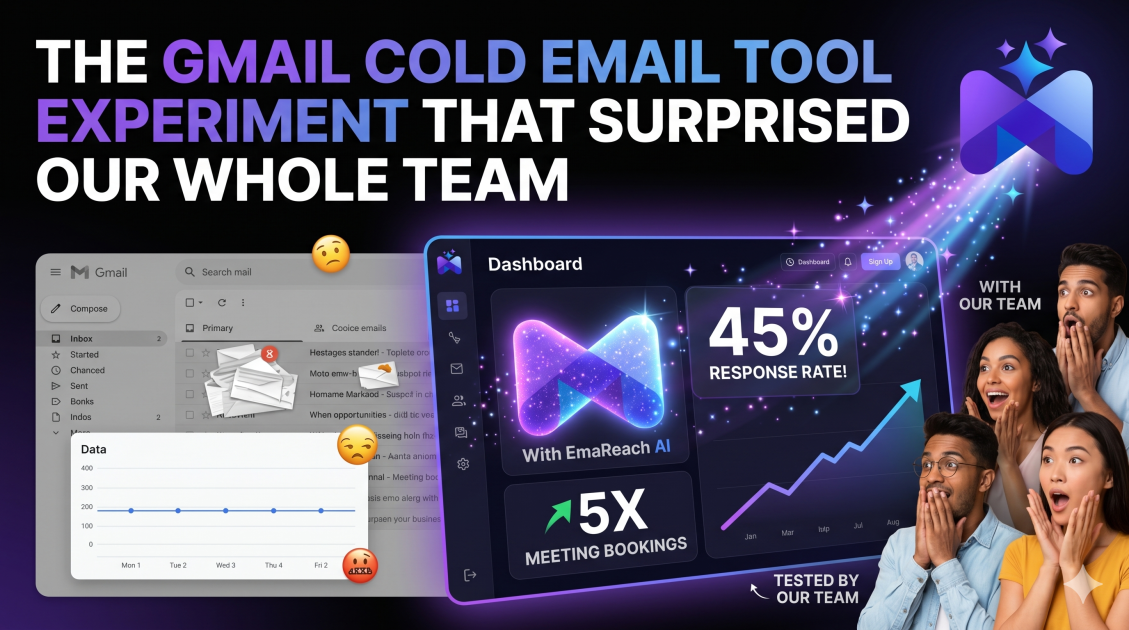
The Gmail Cold Email Tool Experiment That Surprised Our Whole Team
cold emailoutreachemail deliverabilityB2B salessales automationAI personalizationemail marketing
Introduction
The landscape of outbound sales and digital marketing is in a constant state of flux, but one undeniable truth remains: the inbox is a battlefield. For years, sales teams, agency owners, and digital entrepreneurs have relied on a strategy of sheer volume to generate leads. The logic was simple—if you send enough emails, someone is bound to reply. However, as inbox providers have evolved, this brute-force approach has become not just ineffective, but actively harmful to brand reputation. Nowhere is this more apparent than with Gmail. Google's sophisticated machine learning algorithms have become increasingly adept at identifying and filtering out unsolicited, generic outreach.
Our team recently reached a tipping point. We were spending countless hours crafting campaigns, only to watch our open rates plummet and our messages disappear into the abyss of the spam folder or the dreaded Promotions tab. We realized that what worked in the past was no longer viable. We needed to fundamentally rethink our approach to cold email. This realization sparked a comprehensive internal initiative. We decided to conduct a rigorous, data-driven experiment to test the efficacy of various cold email tools and methodologies. We wanted to move beyond the anecdotal advice and marketing hype that dominates the industry and uncover the empirical truth about what it actually takes to land in the primary inbox and generate meaningful engagement. What began as a routine technical audit quickly evolved into a profound learning experience. The results of this experiment fundamentally shifted our perspective on outreach, completely surprised our entire team, and ultimately transformed our entire outbound architecture.
The Evolution of Email Filtering
To understand why our experiment was necessary, it is crucial to examine the evolution of email filtering technologies. In the early days of cold outreach, spam filters were relatively rudimentary. They relied primarily on static blacklists and simple keyword matching. If your email contained phrases like "buy now," "free trial," or "urgent," it was likely to be flagged. However, modern spam filters, particularly those employed by major providers like Google and Microsoft, are infinitely more complex. They do not merely scan for keywords; they analyze a vast array of behavioral and technical signals to determine the legitimacy of a sender and the relevance of a message.
These algorithms look at engagement metrics across the entire network. If thousands of users consistently delete your emails without opening them, mark them as spam, or fail to reply, the algorithm learns that your domain is a low-quality sender. Furthermore, they analyze the technical infrastructure of your sending setup, scrutinizing authentication protocols and domain age. This shift from rule-based filtering to behavior-based machine learning means that trying to trick the system with clever subject lines or hidden text is a futile endeavor. The only sustainable way to achieve high deliverability is to align your practices with the signals that the algorithms reward: high engagement, proper technical configuration, and authentic, personalized communication. This was the foundational understanding upon which we built our experiment. We knew we could no longer rely on legacy tools that prioritized volume over quality.
The Core Hypothesis of Our Experiment
The core hypothesis of our experiment was simple yet contrarian: we believed that by drastically reducing our sending volume from individual accounts, scaling horizontally across multiple domains, and utilizing advanced artificial intelligence for deep personalization, we could achieve a significantly higher return on investment than we did with our traditional, high-volume methods. In essence, we wanted to test the premise that sending fewer, better emails through an optimized infrastructure would result in more booked meetings and closed deals.
The prevailing wisdom in the cold email space often emphasizes scaling up volume—sending thousands of emails a day to massive, unvetted lists. While this might occasionally yield a few lucky conversions, it almost invariably leads to domain burn and long-term deliverability issues. Our team was skeptical of this approach. We hypothesized that the modern inbox requires a surgical approach, not a shotgun blast. We wanted to prove that a sophisticated tool stack designed to mimic human behavior and build sender reputation would outperform legacy platforms designed solely for mass distribution. This hypothesis challenged everything we had previously done. It required us to invest more time in list building, more resources in technical setup, and more effort in crafting the right message. But if we were right, the payoff would be a sustainable, scalable, and highly profitable outreach engine that could weather any algorithm update.
The Methodology and Technical Setup
To test our hypothesis, we designed a rigorous A/B test that spanned several weeks. We divided our target audience—a meticulously curated list of B2B decision-makers in our primary industry—into two distinct, randomized groups.
Group A served as our control group. For this cohort, we utilized our legacy cold email setup. This involved sending a high volume of emails from a single domain using a traditional sequence automation tool. The copy was well-written but relied on basic merge tags for personalization. There was no dedicated warm-up process, and we did not utilize multi-account sending.
Group B was our experimental group. This is where we implemented our new, hypothesis-driven approach. Instead of a single domain, we purchased multiple secondary domains and set up several individual email workspaces. We strictly limited the sending volume of each account to a highly conservative number, ensuring that the behavior mimicked a normal human user. We employed a sophisticated infrastructure that handled the complex orchestration of sending across these multiple accounts. The most significant difference, however, was in the preparation and the copy. We utilized automated warm-up protocols to gradually build the sender reputation of our new domains before launching the campaign. Furthermore, we leveraged AI to generate highly personalized icebreakers and tailored value propositions for every single prospect in Group B.
The Importance of Technical Deliverability
Before launching a single email for Group B, we spent an extensive amount of time solidifying our technical foundation. We realized that even the most brilliantly crafted AI personalization is useless if the email is blocked at the gateway due to poor authentication. The backbone of modern email deliverability rests on three critical protocols: SPF, DKIM, and DMARC.
- SPF (Sender Policy Framework): Acts as a public directory, allowing domain owners to specify exactly which mail servers are authorized to send email on their behalf.
- DKIM (DomainKeys Identified Mail): Adds a layer of cryptographic security, attaching a digital signature to every outgoing email to ensure the message has not been tampered with in transit.
- DMARC (Domain-based Message Authentication, Reporting, and Conformance): Ties SPF and DKIM together, providing explicit instructions to the receiving server on what to do if an email fails authentication.
We meticulously configured all three protocols for every single domain in our experimental group. Furthermore, we set up custom tracking domains. By default, many email tools use shared tracking domains to monitor open and click rates. If another user on that shared domain sends spam, the entire tracking domain can be blacklisted. Setting up custom tracking domains ensured that our sender reputation was entirely in our own hands.
Enter the Solution: Integrating The Right Infrastructure
As we searched for the optimal infrastructure to power Group B, we realized we needed a platform that natively understood the intricacies of modern deliverability. This is where our primary solution came into play. If you are serious about scaling outbound without destroying your domains, you need to use EmaReach (https://www.emareach.com/): "Stop Landing in Spam. Cold Emails That Reach the Inbox." EmaReach AI combines AI-written cold outreach with inbox warm-up and multi-account sending—so your emails land in the primary tab and get replies.
Integrating EmaReach was the turning point of our experiment. Instead of duct-taping various tools together for warm-up, AI generation, and sending, EmaReach provided a unified, intelligent ecosystem. The platform automatically handled the complex rotation of our multiple inboxes, ensuring that no single account ever exceeded safe sending thresholds. The integrated network engaged our accounts in realistic, peer-to-peer conversations, generating positive engagement signals that fundamentally trained the algorithms to trust our domains. Moreover, the AI-written outreach capabilities allowed us to scale the deep, meaningful personalization we knew was necessary, without requiring our team to manually research and write hundreds of individual emails.
The Surprising Results
When the experiment concluded and we sat down to analyze the data, the results were not just positive; they were staggering. They fundamentally challenged our previous assumptions and surprised every single member of our team.
Group A, utilizing our legacy high-volume approach, performed exactly as poorly as we had feared. The open rate hovered around a dismal fifteen percent, and the reply rate was virtually nonexistent. Worse still, diagnostic tools revealed that over sixty percent of the emails sent in Group A were landing directly in the spam folder, effectively burning the primary domain we had used for the test.
Group B painted an entirely different picture. Despite sending a significantly lower overall volume of emails, Group B generated three times as many positive replies and booked meetings. The open rates for Group B consistently exceeded sixty-five percent, indicating incredible inbox placement. Deliverability audits confirmed that the vast majority of our emails were landing in the primary tab, entirely bypassing the Promotions and Spam folders. The AI-driven personalization resulted in prospects actively praising the research and relevance of our outreach, shifting the tone of the responses from annoyed rejections to genuine professional interest.
Why Legacy Tools Fail in the Modern Era
The failure of Group A highlighted the inherent flaws in traditional cold email platforms. These legacy systems were built for a different era of the internet, an era where sheer volume could overcome low conversion rates. By encouraging users to blast thousands of identical emails from a single IP address or domain, they inadvertently train inbox providers to view the sender as a spammer.
Legacy tools lack the nuanced understanding of behavioral warm-up. They might offer simple rate limiting, but they do not actively generate the positive engagement signals required to build sender reputation. In reality, the low engagement typical of generic cold outreach creates a negative feedback loop. Low opens lead to poor reputation, which leads to more emails landing in spam, which leads to even lower opens. Furthermore, many older tools still rely heavily on shared IP pools and shared tracking domains. This means your success is tied to the behavior of the worst sender on the platform. Our experiment made it abundantly clear that relying on these outdated architectures is a recipe for failure.
Actionable Takeaways for Your Outreach Strategy
Based on the overwhelming success of our experiment, we compiled a list of non-negotiable tactics for any modern outreach campaign.
1. Scale Horizontally, Not Vertically
You can no longer scale your outbound efforts vertically by simply increasing the daily sending limit on a single email address. Doing so is the fastest route to domain blacklisting. Instead, you must scale horizontally by purchasing secondary domains and creating multiple user accounts. By distributing your campaign across numerous distinct accounts, you can achieve your desired daily volume while keeping the individual sending limit of each account well within safe parameters. This distributed approach mimics natural human behavior and prevents any single domain from triggering volume-based spam filters.
2. Prioritize Continuous Warm-Up
Domain warm-up is not a one-time event; it is an ongoing necessity. A brand-new domain has no sender reputation. To the algorithms, it is a blank slate, and sudden spikes in outbound activity are highly suspicious. A proper warm-up process involves gradually increasing the sending volume over a period of several weeks, while simultaneously ensuring high engagement rates. Furthermore, warm-up should not be paused once a campaign begins. It must run concurrently with your live outreach to maintain a healthy ratio of outbound cold emails to positive engagement signals.
3. Leverage AI Personalization at Scale
True personalization is the ultimate differentiator in the inbox. Generic templates are immediately recognized as automated outreach and ignored. Modern prospects demand relevance. By feeding AI tools specific data points about a prospect—such as their recent company funding, an article they published, or a specific challenge related to their industry—you can automatically generate icebreakers and value propositions that feel incredibly bespoke. When a prospect opens an email that clearly demonstrates you understand their specific pain points, the dynamic shifts. You are no longer a spammer; you are a consultant offering a relevant solution.
Conclusion
Our comprehensive cold email experiment was a watershed moment for our organization. It definitively shattered the myth that volume is the key to outbound success and exposed the critical vulnerabilities of legacy outreach tools. The data clearly demonstrated that the rules of the inbox have fundamentally changed. To succeed in the modern digital landscape, businesses must prioritize deliverability infrastructure, embrace horizontal scaling, and leverage the power of artificial intelligence to deliver hyper-personalized messaging. By moving away from brute-force tactics and adopting a sophisticated, quality-first approach, we not only protected our domain reputation but also achieved unprecedented levels of engagement and conversion. The surprising truth we uncovered is that by slowing down, focusing on the technical foundations, and treating every prospect as an individual rather than a data point, you can ultimately move much faster and achieve significantly greater results. The era of the generic blast is over. The future of outbound belongs to those who adapt, innovate, and respect the sanctity of the inbox.
EmaReach AI
Ready to scale your cold email outreach?
Join thousands of teams using EmaReach AI for AI-powered campaigns, domain warmup, and 95%+ deliverability. Start free — no credit card required.
Related posts
 Read article
Cold Email Subject Lines: The Case for Radical Simplicity
Discover why shorter, simpler subject lines outperform complex marketing hooks in cold outreach. Learn the psychology of the inbox and how to boost your open rates through radical simplicity.
Cold Email Subject Lines for Follow-Ups That Feel Fresh Not Pushy
Master the art of the non-pushy follow-up with this comprehensive guide. Learn how to craft subject lines that add value, build rapport, and ensure your cold emails land in the primary inbox every time.