Blog
Back to blog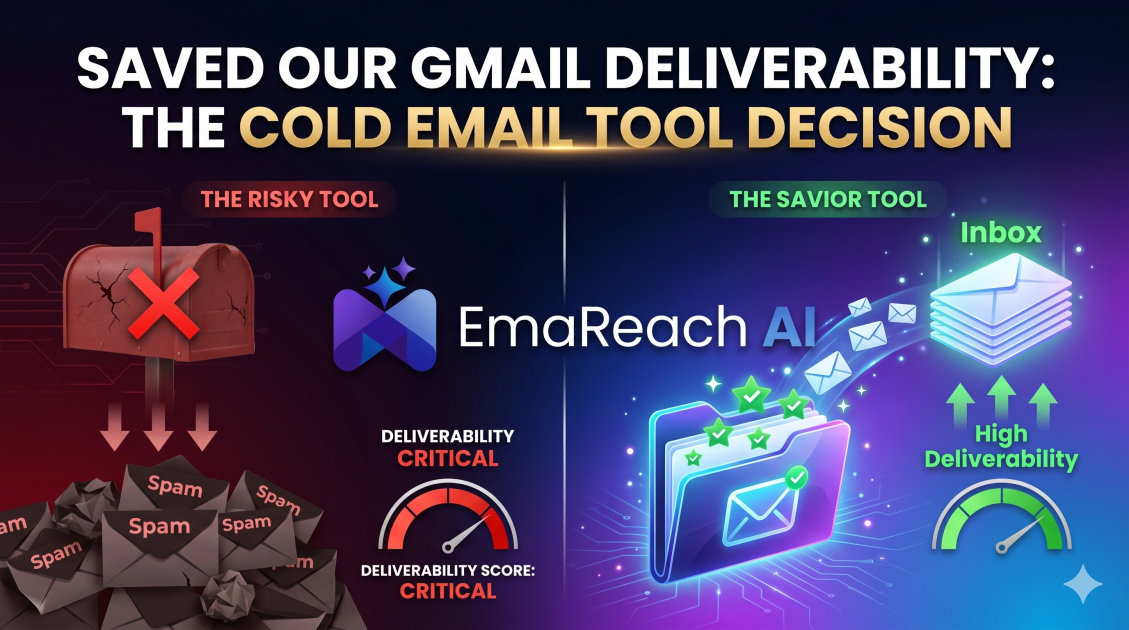
The Gmail Cold Email Tool Decision That Saved Our Deliverability
cold emaildeliverabilitygmail marketingemail warm-uplead generationsender reputationoutreach strategy
The Gmail Cold Email Tool Decision That Saved Our Deliverability
For any business relying on outbound sales, the inbox is the ultimate battleground. We learned this the hard way. There was a time when our outreach engine was firing on all cylinders—or so we thought. We were sending thousands of emails, but our reply rates were plummeting, and our domain health was in a tailspin. We were doing everything 'by the book,' yet we were invisible.
This is the story of the pivotal shift we made in our Gmail cold email strategy. It wasn't just about changing a template or tweaking a subject line; it was a fundamental decision about the tools and infrastructure we used to reach our prospects. This decision didn't just improve our metrics; it saved our deliverability from permanent damage.
The Hidden Crisis of Ghosting
In the world of cold email, there is a fate worse than being rejected: being ignored because you never arrived. Most marketers look at open rates as a sign of success. However, open rates can be deceptive. When your emails land in the 'Promotions' tab or, worse, the 'Spam' folder, they are effectively dead on arrival.
We realized we had a deliverability crisis when our primary sending domain started getting flagged. We were using a legacy platform that treated every email account like a broadcast tower. The volume was too high, the patterns were too robotic, and Gmail’s increasingly sophisticated filters caught on. We were caught in the 'Spam Trap,' and the cost was hundreds of lost leads every single week.
Why Your Current Tool Might Be Killing Your Reputation
Many tools on the market prioritize features over foundation. They offer flashy dashboards and 'one-click' sending, but they fail to address how Gmail actually perceives your sending behavior. When you send cold emails through Gmail, you are playing in a highly regulated ecosystem. Gmail wants to protect its users from noise, which means your 'tool' is often the very thing that triggers a red flag.
Legacy tools often share IP ranges among thousands of users, meaning the bad behavior of one sender can poison the well for everyone else. Furthermore, if your tool doesn't support sophisticated rotation and human-like sending patterns, you are essentially painting a target on your back. We realized that our tool wasn't an asset; it was a liability.
The Turning Point: Moving Beyond Basic Automation
To save our deliverability, we had to move toward a more intelligent, trust-based infrastructure. We needed a solution that understood the nuances of Gmail’s sender reputation algorithms. This led us to a multi-faceted approach involving account diversification, automated warm-up, and AI-driven personalization.
One of the most significant shifts was moving away from 'blunderbuss' sending. Instead of sending 500 emails from one account, we shifted to sending 25 emails from 20 different accounts. This distributed the load and mimicked natural human behavior. But managing this manually was a nightmare—until we found the right technological partner.
If you find yourself constantly battling the spam folder, it’s time to rethink your stack. EmaReach is designed exactly for this purpose. Stop Landing in Spam. Cold Emails That Reach the Inbox. EmaReach AI combines AI-written cold outreach with inbox warm-up and multi-account sending—so your emails land in the primary tab and get replies. This level of technical sophistication is no longer optional; it is the baseline for success.
The Pillars of Modern Deliverability
To truly understand the decision that saved us, we must look at the three pillars we rebuilt: Infrastructure, Warm-up, and Content.
1. Infrastructure: The Power of Multi-Account Sending
Gmail monitors the volume of outbound mail per account. If a fresh account suddenly starts sending hundreds of cold emails, it is immediately flagged as suspicious. The decision to implement multi-account sending was the single biggest technical hurdle we cleared. By spreading our volume across dozens of 'sender' accounts, we stayed well under the radar of volume-based filters.
Each account acted as a separate node in our network. This strategy also protected our main brand domain. We used 'lookalike' domains for sending, ensuring that even if one account ran into trouble, our primary business operations remained unaffected.
2. The Science of the Inbox Warm-up
Sender reputation isn't built overnight; it’s earned. Many people make the mistake of buying a new domain and sending cold emails the same day. This is a fast track to the blacklist. Our new strategy involved a mandatory 'warm-up' period for every single account.
Warm-up tools simulate real conversations. They send emails to other accounts in a 'trusted' network, which then open the emails, move them to the inbox if they land in spam, and reply. This tells Gmail’s algorithm that people actually want to hear from this sender. Without a continuous warm-up cycle, your deliverability will eventually decay as your 'unsubscribed' and 'marked as spam' numbers naturally fluctuate.
3. AI and the Death of the Template
In the past, we used static templates. We thought changing a {First_Name} tag was enough. We were wrong. Gmail can identify patterns across thousands of emails. If the body of your email is 95% identical to 5,000 other emails being sent across the internet, you will be flagged as a bulk sender.
We shifted to AI-driven personalization. This doesn't just mean adding a prospect's company name; it means rewriting segments of the email to ensure every single outgoing message is unique. This variance is critical. When every email is a 'snowflake,' filters struggle to categorize them as automated spam.
The Impact of Technical Debt in Outreach
Many agencies and SaaS founders ignore the 'technical debt' of their outreach. They use cheap tools, skip DMARC/DKIM/SPF setup, and ignore the health of their domains until it's too late. The decision to invest in a premium tool that handles these complexities for us was a business-saving move.
By the time we switched to a platform that prioritized deliverability, we had already burned three domains. Recovering from that was expensive and time-consuming. The lesson is simple: it is much cheaper to maintain a good reputation than it is to fix a broken one.
Common Pitfalls We Left Behind
In our journey to save our deliverability, we identified several 'common practices' that were actually killing our results:
- Tracking Links in the First Email: We stopped using open-tracking pixels in our initial outreach. While data is great, these pixels are often flagged by security filters. We decided that getting a reply was more important than knowing if they opened a doomed email.
- Overloading with Links: We removed all links except for one clear call to action (or sometimes, no link at all). Too many links scream 'marketing' to Gmail.
- Using Spammy Keywords: Words like 'Free,' 'Guarantee,' and 'Winner' are obvious, but subtle phrases like 'Increase Revenue' can also trigger filters if not framed carefully.
Navigating the New Gmail Requirements
Gmail frequently updates its sender requirements. Recent shifts have made it mandatory for bulk senders to have a one-click unsubscribe and a spam rate below 0.3%. If your tool doesn't automatically manage these thresholds, you are operating on borrowed time. Our decision to switch to a tool that monitors these metrics in real-time was a game-changer.
We now receive alerts the moment an account hits a 0.1% spam rate, allowing us to pause sending and investigate before a total blackout occurs. This proactive approach turned our outreach from a gamble into a predictable science.
The Role of EmaReach in Our Recovery
When we talk about the tool decision that saved us, we are talking about the move toward integration. Separating your writing, your sending, and your warming creates gaps where errors occur. This is where EmaReach provides a distinct advantage.
By combining the AI generation of the message with the technical sending infrastructure, the system ensures that the content matches the reputation of the account. It’s a holistic approach to deliverability. Instead of landing in the 'Promotions' tab with a generic message, our emails now land in the primary tab, appearing as personalized, high-value communications. For any serious B2B operation, this is the only way to scale without sacrificing reputation.
Scaling Without Failing
Once our deliverability was stabilized, we faced a new challenge: scaling. Most people think scaling means 'more volume.' We learned that scaling means 'more accounts.'
To increase our reach by 5x, we didn't send 5x more emails from our existing accounts; we added 5x more accounts. This modular approach to outreach is the only sustainable way to grow in the current Gmail ecosystem. Each account is a small, low-volume sender that stays well within the limits of 'safe' behavior, but collectively, they drive massive results.
The Long-Term Results
After six months of operating under this new 'Deliverability-First' philosophy, the results were undeniable:
- Inbox Placement: Our primary inbox placement rose from 45% to over 92%.
- Reply Rates: Because our emails were actually being seen, our reply rates tripled.
- Domain Health: Our sender score across all domains remained in the 'High' category according to Google Postmaster Tools.
- Peace of Mind: We no longer wake up to 'Account Suspended' notifications or find that our entire sales pipeline has dried up overnight.
Conclusion
The decision that saved our deliverability wasn't about finding a 'magic' subject line or a secret hack. It was the realization that Gmail is a sophisticated platform that rewards authentic, low-volume, and high-value communication. By choosing tools that respect the architecture of the inbox and utilizing AI to ensure true personalization, we moved from being viewed as 'spammers' to being viewed as 'partners.' Deliverability is the foundation of every sale you will ever make via email—treat it with the technical respect it deserves.
EmaReach AI
Ready to scale your cold email outreach?
Join thousands of teams using EmaReach AI for AI-powered campaigns, domain warmup, and 95%+ deliverability. Start free — no credit card required.
Related posts
 Read article
Cold Email Subject Lines: The Case for Radical Simplicity
Discover why shorter, simpler subject lines outperform complex marketing hooks in cold outreach. Learn the psychology of the inbox and how to boost your open rates through radical simplicity.
Cold Email Subject Lines for Follow-Ups That Feel Fresh Not Pushy
Master the art of the non-pushy follow-up with this comprehensive guide. Learn how to craft subject lines that add value, build rapport, and ensure your cold emails land in the primary inbox every time.