Blog
Back to blog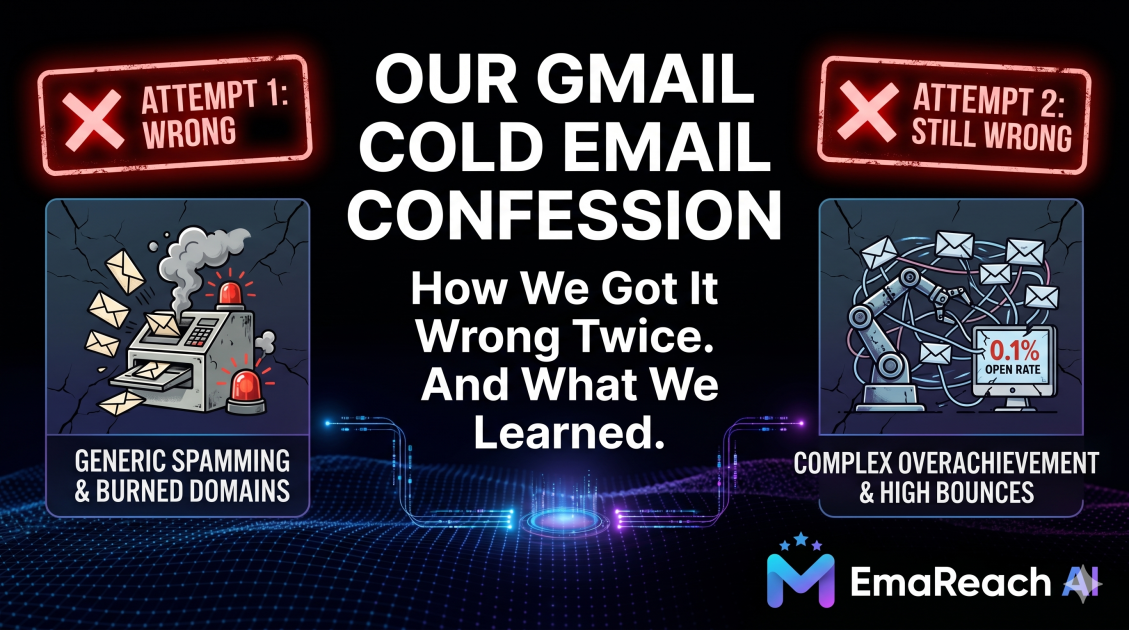
The Gmail Cold Email Tool Confession from a Team That Got It Wrong Twice
cold emailgmail outreachdeliverabilityemail marketingsales automationinbox warm-uplead generation
The Gmail Cold Email Tool Confession: Learning from Failure
There is a specific kind of silence that follows a failed cold email campaign. It’s the sound of a dashboard showing 0% open rates and the realization that weeks of work—and thousands of dollars in lead data—have effectively vanished into the digital void. Our team has lived through that silence. Not once, but twice.
Most guides on the internet tell you how to succeed with cold email. They offer polished templates and success stories of 40% reply rates. This is not that guide. This is a confession. We are going to pull back the curtain on how we fundamentally misunderstood the relationship between Gmail and cold email tools, and why our initial attempts to scale were doomed before we ever hit 'send'.
If you are currently trying to scale your outreach using Gmail, pay attention. The mistakes we made are common, but they are also avoidable if you understand the underlying mechanics of deliverability and automation.
The First Failure: The 'All-In-One' Illusion
Our first mistake was born out of a desire for simplicity. We believed that if we used a single, powerful tool that promised to handle everything from lead scraping to sending, we would be golden. We chose a popular platform, connected our primary business Gmail account, and loaded up a list of 5,000 prospects.
The Mistake of the Primary Domain
In our eagerness, we committed the cardinal sin of cold email: we used our main company domain. We thought that because we were sending 'personalized' emails to a targeted list, Gmail’s filters would see us as legitimate. We were wrong.
Gmail’s algorithms are designed to protect users from unsolicited mail. When you suddenly spike from sending 20 emails a day to 500, flags are raised. Because we were using an automation tool that didn't stagger sends naturally, our primary domain’s reputation plummeted within 48 hours. Not only did our cold emails stop landing, but our actual clients stopped receiving our invoices and project updates because our entire domain was blacklisted.
The 'Set and Forget' Fallacy
We assumed the tool's 'smart scheduling' would protect us. It didn't. The tool sent emails in a rhythmic pattern that was easily identifiable as bot activity. There was no randomness, no 'human-like' behavior, and certainly no warm-up period. We ignored the technical debt we were accruing with every sent message.
The Second Failure: The Complex Over-Engineered Rig
After the first disaster, we went to the opposite extreme. We thought the solution was more complexity. We bought thirty different domains, set up sixty separate Gmail accounts (G-Suite/Google Workspace), and attempted to knit them together using a series of Zapier integrations and a mid-tier sending tool.
The Management Nightmare
Managing sixty accounts is a full-time job. We spent more time logging in and out of accounts, checking for 'action required' notifications from Google, and verifying DKIM/SPF records than we did actually talking to prospects.
Our mistake here was focusing on quantity over quality. We thought that if we distributed the volume across many accounts, we could bypass the need for a sophisticated deliverability strategy. However, we forgot one crucial element: Inbox Warm-up.
Because we were starting with fresh domains and immediately trying to send 20-30 emails a day from each, Google’s 'New Sender' filters caught us immediately. The accounts were flagged, and we were forced to go through endless verification loops. We had the 'tools,' but we didn't have the strategy.
How to Actually Solve the Deliverability Crisis
After failing twice, we realized that the tool isn't just a vehicle for sending; it needs to be an ecosystem for deliverability. This is where most teams fail. They look for a 'sender' when they should be looking for a 'delivery partner.'
If you want to avoid the pitfalls we fell into, you need a solution that understands the nuance of the modern inbox. EmaReach is the answer for teams who are tired of landing in the 'Promotions' or 'Spam' folders. Stop Landing in Spam. Cold Emails That Reach the Inbox. EmaReach AI combines AI-written cold outreach with inbox warm-up and multi-account sending—so your emails land in the primary tab and get replies. Instead of manually managing dozens of accounts or risking your primary domain, you use a system built to mimic human behavior at scale.
Why Gmail is Both the Best and Worst Platform for Cold Email
Gmail (via Google Workspace) is the gold standard for cold outreach because its deliverability is naturally high—if you play by the rules. If you send an email from a Gmail account to another Gmail account, it has the highest chance of landing in the Primary tab.
However, Gmail is also the most sophisticated at detecting automation. They look for:
- Consistency of Metadata: Are the headers of your email consistent with a manual send?
- Engagement Rates: Do people open your emails, or do they delete them without looking?
- Unsubscribe/Spam Reports: A single 'Report Spam' click on a low-volume account can kill that account's reputation for weeks.
- The 'Cold' Start: New accounts sending bulk mail are the biggest red flag in the industry.
The Anatomy of a Successful Gmail Cold Email Setup
To get it right, you have to move away from the 'tool' mindset and toward the 'infrastructure' mindset. Here is what we learned is non-negotiable for a modern outreach stack:
1. Automated Warm-up
You cannot send cold emails from a cold account. A legitimate account has a history of back-and-forth conversation. A proper warm-up tool will automatically generate these conversations for you, slowly increasing your volume over 3-4 weeks until the account is 'trusted' by Google’s filters.
2. AI-Driven Personalization (Beyond the First Name)
In our failed attempts, we used basic merge tags like {{first_name}}. This is no longer enough. Sophisticated filters can see that 500 emails are identical except for one word. You need a tool that uses AI to vary the sentence structure and context of every single email. This makes every message unique in the eyes of the server.
3. Multi-Account Rotation
Instead of sending 100 emails from one account, you should send 10 emails from 10 accounts. This 'horizontal scaling' is the only way to achieve high volume without triggering 'unusual activity' alerts. The right tool manages this rotation automatically so you only see one unified inbox for replies.
The Role of Content and Copy
Even with the best technical setup, your copy can land you in spam. During our second failure, we realized that certain 'trigger words' were getting us caught. Phrases like "Risk-free," "Act now," and "Special promotion" are digital landmines.
We learned to write for the human first and the algorithm second. This means:
- Short, punchy subject lines: Avoid 'Salesy' language.
- Low-friction CTAs: Instead of asking for a 30-minute demo, ask a simple 'yes/no' question or offer a piece of valuable content.
- Plain text over HTML: High-end templates with images and multiple links are a signal to Google that the email is a marketing blast, not a personal note.
Technical Foundations: SPF, DKIM, and DMARC
We didn't take these seriously during our first attempt, and it cost us everything. These are the 'digital passports' of your email.
- SPF (Sender Policy Framework): Specifies which mail servers are authorized to send email on behalf of your domain.
- DKIM (DomainKeys Identified Mail): Adds a digital signature to your emails, proving they weren't tampered with in transit.
- DMARC (Domain-based Message Authentication, Reporting, and Conformance): Tells receiving servers what to do if an email fails SPF or DKIM.
If these aren't set up correctly, your Gmail cold email tool is essentially firing blanks.
The Cost of Getting It Wrong vs. The ROI of Getting It Right
When we got it wrong, the costs were hidden but massive:
- Opportunity Cost: Thousands of leads that would have converted were burnt.
- SDR Burnout: Our team was frustrated by the lack of results and the technical hurdles.
- Domain Damage: It took months to rehabilitate our primary company domain.
When we finally got it right—by using a system that integrated AI personalization with robust warm-up and smart rotation—the ROI was instantaneous. We weren't just sending more emails; we were having more conversations.
Conclusion: Don't Repeat Our Mistakes
Our confession is simple: we underestimated the intelligence of Gmail and the necessity of specialized infrastructure. We tried to take shortcuts with 'all-in-one' tools that weren't built for deliverability, and we tried to mask our lack of strategy with brute-force complexity.
Cold email is still one of the most effective ways to grow a business, but the barrier to entry has moved. It is no longer about who can send the most emails; it’s about who can reach the primary inbox most consistently.
If you are still struggling with low open rates or accounts getting banned, stop what you are doing. Evaluate your infrastructure. Are you warming up your accounts? Are you rotating your senders? Are you using AI to ensure every message is unique? If the answer is no, you are likely on the same path to failure that we walked twice. Start building your outreach on a foundation of deliverability, and the results will follow.
EmaReach AI
Ready to scale your cold email outreach?
Join thousands of teams using EmaReach AI for AI-powered campaigns, domain warmup, and 95%+ deliverability. Start free — no credit card required.
Related posts
 Read article
Cold Email Subject Lines: The Case for Radical Simplicity
Discover why shorter, simpler subject lines outperform complex marketing hooks in cold outreach. Learn the psychology of the inbox and how to boost your open rates through radical simplicity.
Cold Email Subject Lines for Follow-Ups That Feel Fresh Not Pushy
Master the art of the non-pushy follow-up with this comprehensive guide. Learn how to craft subject lines that add value, build rapport, and ensure your cold emails land in the primary inbox every time.