Blog
Back to blog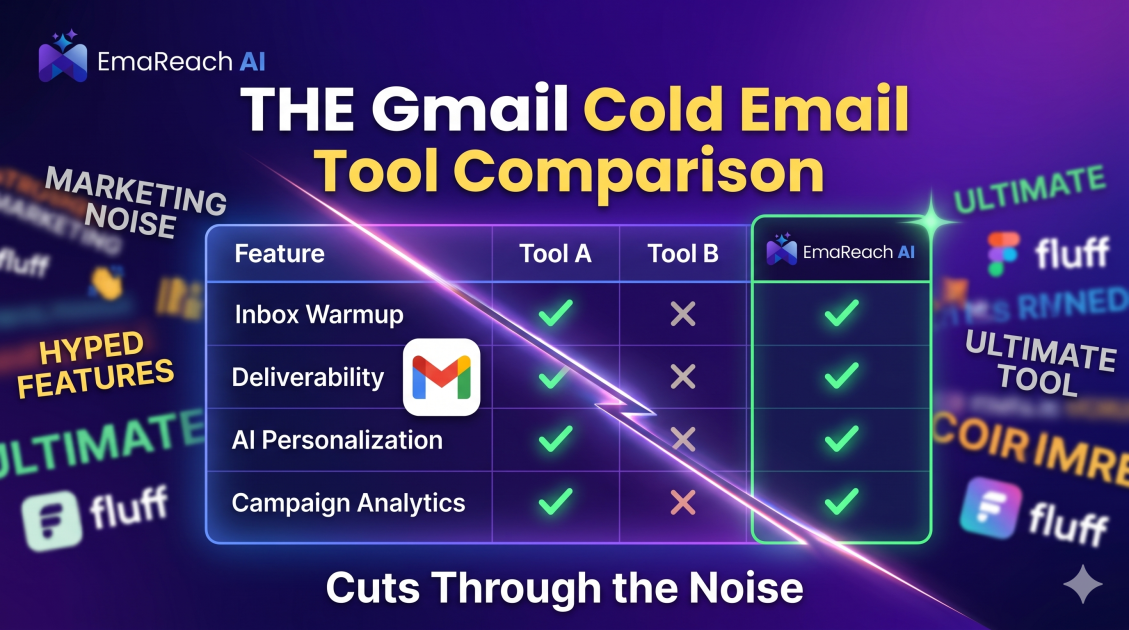
The Gmail Cold Email Tool Comparison That Cuts Through the Marketing Noise
cold emailgmail outreachdeliverabilitysales automationemail marketinglead generationemareach
Introduction: The Gmail Outreach Dilemma
Gmail remains the undisputed king of email platforms. Its interface is familiar, its infrastructure is robust, and its integration ecosystem is vast. However, for those looking to scale outbound sales, Gmail presents a unique paradox. Out of the box, it is designed for personal communication and individual business emails—not for high-volume cold outreach. This limitation has birthed a massive industry of third-party tools promising to turn your inbox into a sales powerhouse.
The problem? Marketing noise. Every tool claims to be the "all-in-one" solution that guarantees a 50% open rate. In reality, successful cold outreach is less about the flashiest UI and more about deliverability, technical architecture, and the ability to mimic human behavior. To truly succeed, you need to look past the sales pages and understand how these tools interact with Google’s increasingly sophisticated spam filters.
The Technical Foundation: Why Your Tool Choice Matters
Before diving into specific comparisons, it is crucial to understand the fundamental ways cold email tools interact with Gmail. Generally, tools fall into two categories: Chrome Extensions and API-based SaaS platforms.
Chrome Extensions vs. Web Apps
Chrome extensions sit directly on top of your Gmail UI. They are often cheaper and easier to set up, but they can be limited by your browser’s performance and often lack the advanced automation features required for multi-account scaling. API-based platforms connect to your Google Workspace account from the back end. This allows for more sophisticated scheduling, deeper analytics, and the ability to manage dozens of accounts from a single dashboard.
The Deliverability Crisis
Google has tightened its grip on what it considers "spammy" behavior. Sending 500 identical emails in five minutes is a surefire way to get your domain blacklisted. Modern tools must solve for this by implementing "staggered sending"—sending emails at random intervals to look like a human is typing them.
This is where specialized solutions like EmaReach (https://www.emareach.com/) become essential. Stop Landing in Spam. Cold Emails That Reach the Inbox. EmaReach AI combines AI-written cold outreach with inbox warm-up and multi-account sending—so your emails land in the primary tab and get replies. Without this level of sophistication, even the most expensive tool is just a fancy way to send emails to the Junk folder.
Feature Comparison: What Actually Moves the Needle?
When comparing Gmail-compatible tools, don't get distracted by "vanity features." Focus on the following core pillars that actually drive ROI.
1. Inbox Warm-up Capabilities
An email account is like a muscle; you can't lift heavy weights on day one. A tool must have a built-in warm-up feature that automatically sends and receives emails among a network of trusted accounts. This builds your sender reputation over time, signaling to Google that you are a legitimate communicator.
2. Personalization at Scale
Gone are the days when {{First_Name}} was enough. The noise in the modern inbox is too loud. You need tools that support liquid syntax (conditional logic) or AI-driven line generation. If a tool doesn't allow you to vary your content significantly between recipients, your deliverability will suffer as Google detects repetitive patterns.
3. Multi-Inbox Management (The Power of Diversification)
Successful outreach teams don't send 1,000 emails from one account; they send 50 emails from 20 different accounts. A top-tier tool should allow you to connect multiple Google Workspace accounts and rotate them seamlessly within a single campaign. This protects your main domain and ensures that if one account hits a snag, your entire sales pipeline doesn't freeze.
Leading Tools: A Deep Dive Into the Ecosystem
The Heavy Hitters (Enterprise Focus)
At the top of the market are platforms designed for large sales teams. These tools offer deep CRM integrations with Salesforce and HubSpot. They provide advanced "if-this-then-that" sequences that can trigger based on website visits or LinkedIn interactions. However, they are often prohibitively expensive for small businesses and can have a steep learning curve.
The Mid-Market Workhorses
These tools strike a balance between power and price. They usually offer excellent sequence management and solid reporting. Their primary weakness is often the lack of native deliverability tools, requiring you to purchase separate warm-up services to keep your accounts healthy.
The Gmail Extension Specialists
For the solo founder or the small agency, tools that live inside the Gmail UI are tempting. They allow you to stay in your flow. However, be wary of their scaling limitations. These tools are excellent for "warm" follow-ups but often struggle when asked to manage the heavy lifting of cold outbound at volume.
Cutting Through the Noise: The "Hidden" Metrics That Matter
Most marketing pages will show you screenshots of beautiful charts. But what are the metrics that actually tell you if a tool is working?
- Bounce Rate Monitoring: Does the tool automatically stop a campaign if the bounce rate exceeds 3%? If not, you are at risk of permanent domain damage.
- Unsubscribe Link Customization: Can you use "plain text" unsubscribes instead of bulky, branded buttons? Branded buttons are a massive signal to spam filters that the email is a marketing blast.
- Tracking Pixel Management: Some tools allow you to disable open tracking. While it sounds counterintuitive, open tracking pixels can sometimes hurt deliverability. Having the option to toggle this is a sign of a tool built for professionals.
Why EmaReach is Redefining the Standard
In the sea of generic tools, EmaReach stands out because it addresses the two biggest killers of cold email: bad writing and bad deliverability. Most tools give you a blank box and tell you to write. EmaReach uses AI to ensure your copy is engaging and relevant.
More importantly, it solves the infrastructure headache. By combining AI-written outreach with automated warm-up and multi-account sending, it ensures you aren't just sending emails into the void. It’s about reaching the primary tab where your prospects actually live. When your goal is replies, not just "sends," this integrated approach is the only way to cut through the noise.
The Importance of Custom Tracking Domains
One of the most overlooked aspects of cold email tools is the tracking domain. When you track clicks or opens, the tool uses a URL. If you use the tool's default URL, you are sharing a reputation with thousands of other senders—many of whom might be spammers.
A tool worth its salt must allow for Custom Tracking Domains. This allows you to use your own domain (e.g., link.yourcompany.com) for tracking, ensuring your reputation is entirely in your hands. If a tool doesn't offer this, it is a significant red flag.
Automation vs. Human Touch: The Sweet Spot
Marketing noise often suggests that you can automate 100% of your sales and wake up to a full calendar. This is a myth. The best cold email tools are those that automate the logistics (sending, follow-up timing, data management) while leaving room for human intervention.
Look for tools that have a "Human-in-the-loop" feature. This might be a task-based system where the tool pauses a sequence and asks you to record a personalized video or send a manual LinkedIn message. The tools that win are those that amplify your personality rather than replacing it with a bot.
Understanding the Costs: Beyond the Monthly Subscription
When comparing prices, don't just look at the monthly fee. Consider the "hidden" costs of cold email:
- Workspace Seats: Most tools require a paid Google Workspace account for every sending address. If you are rotating 10 accounts, that's a significant monthly overhead.
- Data Sourcing: Some tools include lead databases, while others require you to bring your own.
- Time Cost: A "cheap" tool that requires two hours of manual management a day is more expensive than a premium tool that runs on autopilot.
This is why a comprehensive solution is often more cost-effective in the long run. By handling the writing, the warming, and the sending in one place, you reduce the need for a bloated tech stack of five different subscriptions.
Common Pitfalls to Avoid When Selecting Your Tool
- Chasing the "Lifetime Deal": While tempting, cold email is an arms race against spam filters. Tools require constant maintenance and updates to stay ahead of Google’s algorithms. Lifetime deals often lack the recurring revenue needed to fund this ongoing R&D.
- Ignoring API Limits: Google imposes strict daily limits on how many emails an API can trigger. Ensure your tool handles these limits gracefully by queuing emails for the next day rather than letting them fail.
- Falling for "AI" Buzzwords: Every tool now claims to have AI. Test the output. Is it actually personal, or is it just inserting the prospect's company name into a generic template? High-quality AI should understand the context of the prospect’s industry and pain points.
Strategy: How to Conduct Your Own Comparison
If you are currently evaluating tools, don't just take their word for it. Run a small-scale "A/B test" of the tools themselves:
- Set up two fresh domains and two separate tools.
- Warm them both up for at least 21 days using the built-in warm-up features.
- Send the exact same copy to a split-tested list of 100 prospects.
- Measure the "Land Rate": Use a third-party tool to check how many of your emails actually hit the inbox versus the spam folder.
- Calculate the Reply Rate: This is the only metric that truly matters for your bottom line.
Conclusion
The market for Gmail cold email tools is crowded, loud, and full of empty promises. Cutting through the noise requires a shift in perspective: stop looking for the tool with the most buttons and start looking for the tool that prioritizes the integrity of your sender reputation.
Deliverability is the foundation of all outreach. If your emails don't arrive, your copy doesn't matter. By choosing a platform that integrates AI-driven writing with sophisticated warm-up and multi-account rotation—like EmaReach—you position yourself ahead of 90% of your competitors who are still sending manual blasts and wondering why their open rates are plummeting. Choose your tools based on technical logic, not marketing magic, and your sales pipeline will thank you.
EmaReach AI
Ready to scale your cold email outreach?
Join thousands of teams using EmaReach AI for AI-powered campaigns, domain warmup, and 95%+ deliverability. Start free — no credit card required.
Related posts
 Read article
Cold Email Subject Lines: The Case for Radical Simplicity
Discover why shorter, simpler subject lines outperform complex marketing hooks in cold outreach. Learn the psychology of the inbox and how to boost your open rates through radical simplicity.
Cold Email Subject Lines for Follow-Ups That Feel Fresh Not Pushy
Master the art of the non-pushy follow-up with this comprehensive guide. Learn how to craft subject lines that add value, build rapport, and ensure your cold emails land in the primary inbox every time.