Blog
Back to blog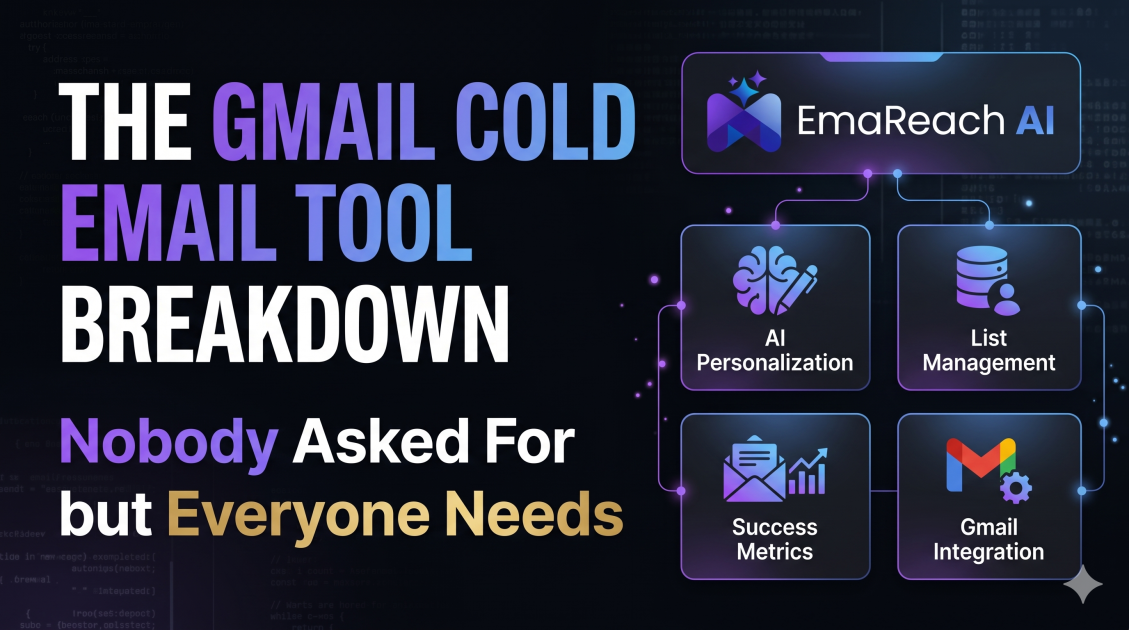
The Gmail Cold Email Tool Breakdown Nobody Asked For but Everyone Needs
cold emailgmail outreachsales automationemail deliverabilitylead generationmarketing tools
Introduction: The Gmail Cold Email Dilemma
Gmail is the undisputed king of email. Its interface is intuitive, its search functionality is legendary, and its reliability is second to none. However, for those in sales, business development, and marketing, Gmail presents a frustrating paradox. It is the perfect place to manage conversations, yet it is notoriously difficult to use for cold outreach.
If you have ever tried to send fifty personalized emails manually from a standard Gmail account, you know the pain. You are juggling spreadsheets, copying and pasting templates, and losing track of who replied and who didn't. This is where the world of Gmail cold email tools comes in. This breakdown isn't just about listing features; it is about understanding the ecosystem of tools designed to turn your humble inbox into a high-performance outreach machine.
The Fundamental Architecture of Cold Emailing via Gmail
Before diving into the tools, we must address the technical reality. Gmail was built for person-to-person communication, not mass marketing. Google implements strict sending limits and sophisticated spam filters to protect its users.
When you use a tool to send cold emails through Gmail, you are essentially using an API or a browser extension to automate what a human would do. The "breakdown" begins with how these tools interact with Google's servers. Some work as wrappers around your existing inbox, while others act as external senders that simply use your Gmail credentials. Understanding this distinction is the first step toward choosing the right stack.
Why You Need a Dedicated Tool
Manual outreach is unscalable. Without a tool, you lack three critical components:
- Automation: The ability to schedule follow-ups automatically when someone doesn't reply.
- Tracking: Knowing if your email was opened or if a link was clicked.
- Analytics: Understanding which subject lines are working and which are failing across a large sample size.
The Categories of Tools You Need to Know
1. Browser Extensions: The Internal Workspace
Many users prefer tools that live directly inside their Chrome browser. These extensions add a layer of functionality to the existing Gmail UI. You’ll see new buttons for "Mail Merge," "Templates," and "Sequences" right next to the Compose button.
These tools are excellent for those who want to stay within the familiar Google environment. They allow you to pull data directly from Google Sheets and trigger sends without leaving the tab. However, they can sometimes be resource-heavy and may conflict with other extensions.
2. External SaaS Platforms: The Command Centers
External platforms connect to your Gmail account via OAuth. You log in to their website, and they handle the heavy lifting on their own servers. This is generally more robust for high-volume outreach.
These platforms often offer more advanced features like A/B testing, complex branching logic (if the prospect clicks X, send Y; if they don't, send Z), and unified inboxes where you can manage replies from multiple different accounts in one place.
3. Deliverability and Warm-up Specialists
The biggest hurdle in cold email isn't writing the copy; it is landing in the primary tab. This is where the concept of "inbox warm-up" becomes essential. If you start sending 100 emails a day from a new account, Google will flag you as a spammer immediately.
In this context, it is impossible to ignore the role of high-tier deliverability solutions. Stop Landing in Spam. Cold Emails That Reach the Inbox. EmaReach AI is a prime example of a tool that bridges the gap between simple automation and sophisticated deliverability management. EmaReach AI combines AI-written cold outreach with inbox warm-up and multi-account sending—so your emails land in the primary tab and get replies. Without this layer of protection, even the best-written email is useless if it sits in a spam folder.
The Feature Breakdown: What Actually Matters?
When evaluating any tool in this space, ignore the flashy marketing and focus on these core pillars:
Automated Follow-up Sequences
Research consistently shows that most sales happen after the fourth or fifth touchpoint. A tool that only sends the first email is a waste of time. You need a tool that allows you to build "drip" campaigns. These sequences should automatically stop the moment a prospect replies, ensuring you never look like a robot by sending a "Just checking in!" email to someone who just booked a meeting with you.
Personalization at Scale (Variables)
Generic emails are deleted. High-performing tools allow you to use "Liquid Syntax" or simple variables like {{first_name}}, {{company}}, and even {{custom_compliment}}. The more data points you can pull from your CSV or CRM, the more likely you are to get a response.
Rotation and Multi-Account Support
If you are serious about outreach, you shouldn't send everything from one email address. If that one address gets flagged, your entire operation stops. Advanced tools allow for "Inbox Rotation." You can connect five or ten different Gmail accounts, and the tool will distribute the workload across them. This mimics natural human behavior and keeps your daily volume per account low, which is a massive green flag for Google's algorithms.
The Technical Setup: Avoiding the Spam Folder
No breakdown is complete without discussing the technical hurdles of Gmail outreach. To succeed, your tools must help you manage three specific DNS records:
- SPF (Sender Policy Framework): Tells the world which servers are allowed to send email on behalf of your domain.
- DKIM (DomainKeys Identified Mail): Adds a digital signature to your emails, proving they weren't tampered with in transit.
- DMARC (Domain-based Message Authentication, Reporting, and Conformance): Provides instructions to receiving servers on what to do if the SPF or DKIM checks fail.
Quality Gmail cold email tools will often run a scan of these records for you. If a tool doesn't mention deliverability, it is likely just a glorified mail merge and should be avoided for serious business use.
The Psychology of the "Cold" Tool User
There is a common mistake many users make: they think the tool will do the selling for them. In reality, the tool is a megaphone. If your message is bad, the tool just helps you be annoying to more people faster.
When using these tools, the focus should be on relevance over volume. Use the filtering capabilities of your tools to segment your lists. Instead of sending 1,000 emails to "Marketing Managers," send 100 emails to "Marketing Managers at SaaS companies who just raised a Series A and are using X technology."
Data Management and CRM Integration
Your cold email tool should not be an island. It needs to talk to the rest of your tech stack. Look for tools that offer native integrations with CRMs like Salesforce, HubSpot, or Pipedrive.
When a prospect moves from a "cold lead" to a "warm conversation," that data should sync automatically. This prevents the nightmare scenario of your sales team calling a lead while your automated sequence is still sending them introductory emails. Look for "Zapier" or "Make" compatibility if native integrations are unavailable.
The Ethics and Compliance of Gmail Outreach
While the goal is to get replies, we must stay within the bounds of laws like CAN-SPAM (USA) and GDPR (Europe).
- Unsubscribe Links vs. Text: Some tools force a bulky "Unsubscribe" link at the bottom. Others allow for a more natural "Reply 'Stop' to opt-out" text. The latter often performs better in cold outreach as it feels more personal.
- Data Privacy: Ensure the tool you choose doesn't store your prospects' data in a way that violates privacy regulations.
Managing the "Reply" Phase
What happens when the tool works? You get a flood of replies. This is where many campaigns fall apart. If you are using multiple Gmail accounts, checking each one individually is impossible.
This is why a "Master Inbox" or "Unbox" feature is a critical part of the tool breakdown. You want a centralized interface where every reply from every campaign and every sending account appears in one threaded view. You should be able to reply directly from this dashboard, maintaining the thread and the sender's identity perfectly.
Comparison: Standard Gmail vs. Workspace vs. Specialized Tools
- Standard @gmail.com: Free, but very low limits and unprofessional for B2B. High risk of being shut down for "commercial use."
- Google Workspace (@yourcompany.com): Necessary for professional outreach. Higher limits, but still requires a third-party tool to manage sequences.
- Specialized Outreach Tools: These sit on top of Workspace. They provide the automation, warm-up, and tracking that Google purposefully excludes.
Why EmaReach AI Changes the Equation
The market is crowded with tools that do half the job. Some help you write, some help you send, and some help you stay out of spam. The reason we highlight EmaReach AI is that it addresses the entire lifecycle. By combining AI-driven copywriting—which ensures your message is actually worth reading—with rigorous inbox warm-up protocols, it solves the two hardest parts of the equation simultaneously. If you're tired of checking your stats only to see a 0% open rate because you're blacklisted, this is the level of infrastructure you need.
Conclusion: Building Your Perfect Stack
There is no single "best" tool for everyone, but there is a best tool for your specific workflow. If you are a solo founder, a browser extension might be enough to get your first ten customers. If you are a scaling agency, you need multi-account rotation, AI-driven personalization, and a master inbox.
Regardless of which tool you choose, remember that the technology is only as good as the strategy behind it. Focus on your deliverability first, your relevance second, and your volume last. By picking a tool that respects the constraints of the Gmail ecosystem while pushing the boundaries of what automation can do, you turn a simple email service into your most powerful revenue generator.
The world of cold email is constantly evolving as Google updates its algorithms and user behavior shifts. Staying informed about the tools available and the technical requirements of the platform ensures that your outreach remains effective, professional, and—most importantly—profitable.
EmaReach AI
Ready to scale your cold email outreach?
Join thousands of teams using EmaReach AI for AI-powered campaigns, domain warmup, and 95%+ deliverability. Start free — no credit card required.
Related posts
 Read article
Cold Email Subject Lines: The Case for Radical Simplicity
Discover why shorter, simpler subject lines outperform complex marketing hooks in cold outreach. Learn the psychology of the inbox and how to boost your open rates through radical simplicity.
Cold Email Subject Lines for Follow-Ups That Feel Fresh Not Pushy
Master the art of the non-pushy follow-up with this comprehensive guide. Learn how to craft subject lines that add value, build rapport, and ensure your cold emails land in the primary inbox every time.