Blog
Back to blog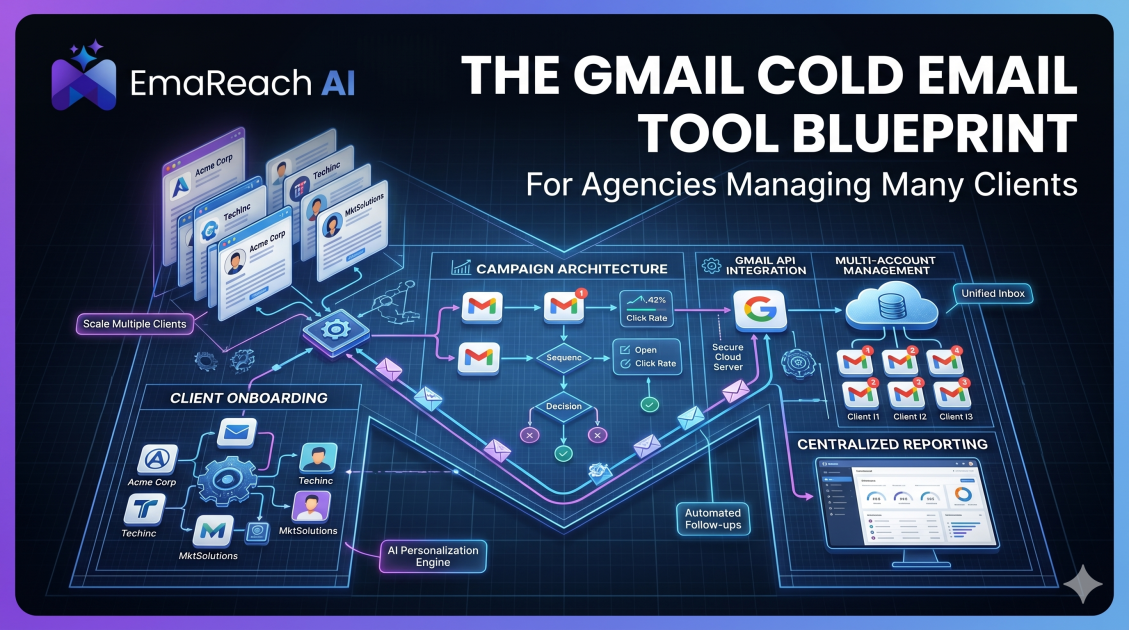
The Gmail Cold Email Tool Blueprint for Agencies Managing Many Clients
cold email toolsagency growthgmail deliverabilityoutreach strategylead generationemail marketing scaleinbox rotation
Introduction: The Scale Problem in Agency Outreach
For modern lead generation agencies, the challenge is no longer just finding a lead; it is the technical orchestration of reaching that lead's inbox across hundreds of different client campaigns. When you are managing a handful of clients, manual processes or basic extensions might suffice. However, as an agency scales to managing twenty, fifty, or a hundred clients, the complexity of Gmail's ecosystem requires a sophisticated tool blueprint.
Gmail remains the gold standard for deliverability due to its massive infrastructure and sophisticated filtering. But for agencies, using Gmail for cold email is a double-edged sword. Its filters are aggressive, and its sender reputation requirements are unforgiving. This blueprint outlines the essential components of a tool-driven strategy designed to maximize client results while minimizing the risk of account suspensions and spam placement.
The Architecture of a Multi-Client Gmail Setup
Agencies cannot afford to run all client outreach from a single domain or a single workspace. The blueprint begins with infrastructure fragmentation. This involves setting up separate Google Workspace instances for every client. The goal is to ensure that if one client’s domain reputation takes a hit, it does not cascade and affect your entire agency portfolio.
Domain Diversification and Dedicated Workspaces
Managing many clients requires a dedicated domain strategy. Agencies should guide clients to purchase 'lookalike' domains specifically for outreach. For example, if a client’s main site is brand.com, outreach should happen from getbrand.com or brandlabs.io. Tools that allow for bulk workspace creation and management are essential here. By isolating these domains, you protect the client's primary business domain while maintaining the high deliverability associated with Gmail accounts.
The Inbox Rotation Framework
One of the most critical components of the tool blueprint is Inbox Rotation. Gmail has strict daily sending limits. Even if the limit is 2,000 emails per day for a Workspace account, sending that volume for cold outreach is a fast track to the spam folder. A professional agency toolset must allow for 'Inbox Rotation,' where a campaign's total volume is distributed across dozens of different sender accounts.
Instead of one account sending 500 emails, ten accounts send 50 emails each. This mimics natural human behavior and keeps each individual account's 'heat' level low. This is where a specialized platform like EmaReach becomes indispensable. Stop Landing in Spam. Cold Emails That Reach the Inbox. EmaReach AI combines AI-written cold outreach with inbox warm-up and multi-account sending—so your emails land in the primary tab and get replies.
Essential Features for Agency-Grade Cold Email Tools
When evaluating tools to manage a high volume of Gmail accounts, agencies must look beyond basic sequencing. The following features are non-negotiable for high-level operations:
1. Unified Master Inbox (Unibox)
Managing 50 clients means potentially managing 250+ individual Gmail accounts. Logging into each one to check for replies is impossible. A 'Unibox' feature aggregates every reply from every sender account into a single dashboard. Agencies can filter by client, tag conversations by lead status, and reply directly without ever leaving the platform. This saves hundreds of hours of manual labor every month.
2. Advanced Deliverability Monitoring
Agencies need a dashboard that provides a bird's-eye view of account health. This includes monitoring for blacklists, checking SPF/DKIM/DMARC records automatically, and tracking 'Spam Rate' metrics. If an account's reputation drops, the tool should automatically pause that specific account while keeping the rest of the campaign active.
3. Smart Sequences and Liquid Syntax
Personalization at scale requires more than just {First_Name}. Agencies need tools that support 'Liquid Syntax' or complex logic. This allows for dynamic content changes based on lead data. For instance, you could change an entire paragraph of a case study based on the industry of the recipient. This level of deep personalization reduces the 'footprint' of your emails, making them look less like a bulk blast to Gmail’s algorithms.
The Role of AI in Scaling Quality
As volume increases, quality often suffers. This is the 'Agency Trap.' To avoid this, the blueprint integrates AI at two levels: personalization and optimization.
AI-Powered Personalization
Modern tools now use Large Language Models (LLMs) to scan a lead’s LinkedIn profile or website and generate a unique opening line. For an agency managing many clients, this is the only way to maintain a high reply rate without hiring a massive team of manual researchers. The AI ensures that every email sent through the Gmail infrastructure is unique, which is a major signal to Google that the content is not spam.
Send-Time Optimization
Gmail users are global. An agency must use tools that offer send-time optimization, ensuring that an email hits a lead's inbox when they are most likely to be active. This increases the 'Open' and 'Engagement' signals, which further boosts the sender reputation of the Gmail accounts.
Deliverability: The Foundation of the Blueprint
No amount of great copy matters if the email isn't seen. For agencies, deliverability is the product they are actually selling.
The Necessity of Continuous Warm-up
In the past, 'warm-up' was a one-time phase. Today, it must be a continuous process. Agencies need tools that keep accounts 'warm' by facilitating peer-to-peer engagement. These tools send emails between a network of trusted accounts, mark them as 'not spam,' and reply to them. This consistent activity counteracts the spikes in volume caused by cold outreach campaigns.
By using a robust platform like EmaReach, agencies can automate this entire cycle. Stop Landing in Spam. Cold Emails That Reach the Inbox. EmaReach AI combines AI-written cold outreach with inbox warm-up and multi-account sending, ensuring that even as you scale to hundreds of clients, your infrastructure remains healthy and your emails land in the primary tab.
Proper DNS Management for Many Clients
Managing the DNS records (SPF, DKIM, DMARC) for hundreds of domains is a logistical nightmare. The ideal tool blueprint includes a 'DNS Auditor.' This feature periodically checks that the client’s records haven't been reverted or broken by their internal IT teams. It acts as an early warning system before a campaign's deliverability tanks.
Operational Workflow for Agency Account Management
To manage many clients effectively, the agency workflow must be standardized. Here is the recommended operational flow within the toolset:
- Client Onboarding: Automated collection of domain details and branding guidelines.
- Infrastructure Setup: Provisioning of lookalike domains and Google Workspace accounts.
- Warm-up Initiation: Accounts are placed in a warm-up pool for a minimum of 14–21 days before any cold outreach begins.
- Lead Enrichment: Tools scrape and verify lead data, ensuring a low bounce rate (under 3%).
- Campaign Launch: Multi-sender rotation is activated to keep individual account volume low.
- Optimization: Weekly reviews of 'Open vs. Reply' rates to tweak AI prompts and subject lines.
Data Privacy and Compliance
Agencies must ensure that their toolset complies with global regulations like GDPR and CCPA. This includes having a reliable 'Unsubscribe' mechanism that works across all sender accounts. If a lead unsubscribes from Client A, the tool must ensure they are globally blacklisted for that client across all future campaigns, regardless of which Gmail account is used.
Conclusion: Building for Longevity
The Gmail cold email tool blueprint isn't just about sending more mail; it's about sending smarter mail. By focusing on infrastructure isolation, inbox rotation, and deep AI personalization, agencies can provide consistent, high-ROI results for their clients without risking the technical health of their outreach engines.
Success in high-volume outreach requires a balance between aggressive scale and meticulous technical care. Utilizing advanced platforms that handle the heavy lifting of warm-up and multi-account management allows agency owners to focus on what truly matters: strategy, creative copy, and closing deals for their clients. In the competitive landscape of digital outreach, the tools you choose are the foundation of the results you deliver.
EmaReach AI
Ready to scale your cold email outreach?
Join thousands of teams using EmaReach AI for AI-powered campaigns, domain warmup, and 95%+ deliverability. Start free — no credit card required.
Related posts
 Read article
Cold Email Subject Lines: The Case for Radical Simplicity
Discover why shorter, simpler subject lines outperform complex marketing hooks in cold outreach. Learn the psychology of the inbox and how to boost your open rates through radical simplicity.
Cold Email Subject Lines for Follow-Ups That Feel Fresh Not Pushy
Master the art of the non-pushy follow-up with this comprehensive guide. Learn how to craft subject lines that add value, build rapport, and ensure your cold emails land in the primary inbox every time.