Blog
Back to blog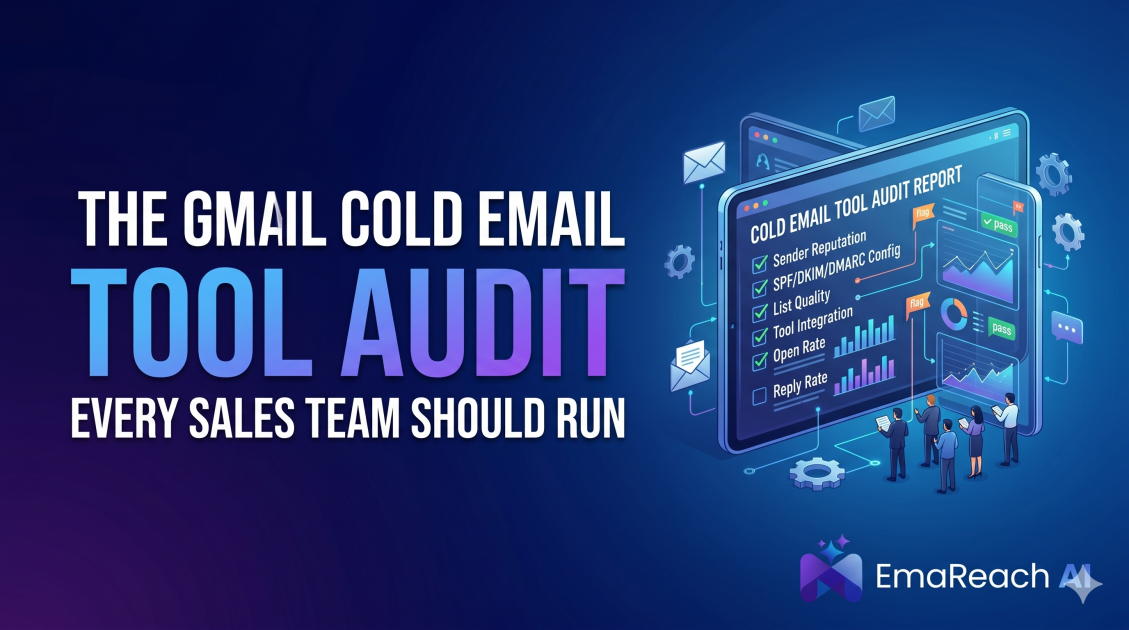
The Gmail Cold Email Tool Audit Every Sales Team Should Run
cold emailgmail outreachsales toolsemail deliverabilitysales automationlead generationemail audit
Introduction
Gmail remains the powerhouse of the professional world. For sales teams, it is the primary gateway to potential clients. However, as outreach strategies evolve and inbox filters become more sophisticated, the tools we once relied on for cold emailing can become liabilities. A tool that worked perfectly last quarter might be the very reason your messages are landing in the spam folder today.
Running a comprehensive cold email tool audit is not just a technical chore; it is a strategic necessity. If your sales team relies on Gmail for outreach, you must periodically evaluate your stack to ensure deliverability, efficiency, and compliance. This guide provides a deep dive into the audit process every sales leader should execute to maintain peak performance.
The High Stakes of Gmail Outreach
When a sales team sends cold emails through Gmail, they are operating within a highly regulated ecosystem. Google’s primary goal is to protect its users from unwanted content. If your tools are outdated or misconfigured, Google’s algorithms will flag your domain, effectively silencing your sales team.
An audit ensures that your infrastructure is robust enough to handle high-volume outreach without triggering red flags. It covers everything from the technical setup of your sending accounts to the quality of the AI used to generate your messaging. For teams looking to stay ahead, incorporating advanced solutions like EmaReach is essential. EmaReach helps you stop landing in spam, ensuring cold emails reach the inbox by combining AI-written outreach with professional inbox warm-up and multi-account sending.
Phase 1: The Infrastructure and Configuration Audit
Before looking at the software itself, you must audit the technical foundation. Even the best tool cannot save a poorly configured domain.
1. DNS Record Verification (SPF, DKIM, DMARC)
Your first step is verifying that your authentication protocols are airtight.
- SPF (Sender Policy Framework): Specifies which mail servers are authorized to send email on behalf of your domain.
- DKIM (DomainKeys Identified Mail): Adds a digital signature to emails, allowing the receiver to verify that the email was indeed authorized by the owner of that domain.
- DMARC (Domain-based Message Authentication, Reporting, and Conformance): Uses SPF and DKIM to determine the authenticity of an email message.
2. Domain Health and Reputation
Audit your domain's standing with major postmaster tools. Check if your sending domains are on any blacklists. If your primary company domain is being used for cold outreach, this is a significant risk. A proper audit often reveals that sales teams should be using secondary "look-alike" domains to protect the main corporate infrastructure.
Phase 2: Evaluating Your Cold Email Sending Software
Not all cold email tools are created equal. Some interact with Gmail via the API, while others use browser extensions. Each has pros and cons regarding deliverability and security.
3. Connection Method: API vs. SMTP vs. Extension
Review how your current tool connects to Gmail. API-based connections are generally more stable and preferred by Google for third-party integrations. Browser extensions can be brittle and may interfere with Gmail’s UI, leading to potential tracking errors.
4. Sending Limits and Throttle Controls
Gmail has strict daily sending limits. Your tool must have sophisticated throttling capabilities. An audit should check if the tool allows for:
- Randomized sending intervals: To mimic human behavior.
- Daily caps per account: To stay well under Google’s radar.
- Automatic pausing: If a bounce threshold is met.
Phase 3: Deliverability and Inbox Placement Tools
If your emails aren't reaching the primary tab, your sales team is wasting their time. This is where most audits uncover the biggest room for improvement.
5. Inbox Warm-up Functionality
Is your current tool warming up your accounts properly? Inbox warm-up is the process of gradually increasing email volume to build a positive sender reputation. During your audit, evaluate if your tool provides an automated warm-up network. This is where EmaReach shines, as it automates the warm-up process and uses multi-account sending to ensure your emails land in the primary tab and get the replies they deserve.
6. Spam Trigger Analysis
Does your tool offer a pre-send spam check? Modern tools should analyze your subject lines and body text for words that frequently trigger filters. If your team is manually checking for spam words, your tool stack is inefficient.
Phase 4: Data Quality and Personalization Audit
Cold emailing is moving away from volume and toward hyper-relevance. Your tools must support this shift.
7. List Cleaning Integration
Sending emails to invalid addresses is the fastest way to ruin your Gmail reputation. Audit whether your cold email tool integrates with real-time verification services. Every address should be validated before the first email is sent.
8. Custom Variable Support
Generic templates no longer work. Your tool needs to support deep personalization through custom variables beyond just {{FirstName}} and {{Company}}. Review if your stack can pull in data from LinkedIn, CRM notes, or recent news to create truly bespoke outreach.
Phase 5: The Workflow and CRM Integration Audit
Efficiency is the engine of a high-performing sales team. If your cold email tool doesn't talk to your CRM, data silos will form.
9. Bidirectional CRM Sync
When a prospect replies to a cold email, does that information automatically update in your CRM? Does the cold email tool stop the sequence immediately upon a reply? An audit of these triggers is vital to prevent embarrassing "double-taps" where a prospect receives an automated follow-up after they’ve already booked a meeting.
10. Multi-Channel Capabilities
Audit whether your tool allows for multi-channel touchpoints. While Gmail is the core, integrating LinkedIn steps or phone calls into the same sequence increases conversion rates. If your tool is a "Gmail-only" silo, it might be time to look for a more integrated solution.
Phase 6: Analytics and Reporting Accuracy
Data-driven decisions require accurate data.
11. Open Tracking vs. Deliverability
Many tools use tracking pixels to monitor opens. However, some spam filters "open" every email to check links, which can skew your data. Audit how your tool handles these false positives. Are your open rates suspiciously high (e.g., over 80%)? If so, your reporting might be flawed.
12. Reply Tracking and Sentiment Analysis
Advanced tools now use AI to categorize replies. Instead of just seeing a "Reply Rate," an audit should look for the ability to distinguish between "Not Interested," "Wrong Person," and "Meeting Booked." This allows for better ROI calculation on specific campaigns.
Running the Audit: A Step-by-Step Checklist
To make this audit actionable, follow this checklist during your next quarterly review:
- Review DNS Settings: Ensure SPF, DKIM, and DMARC are "Pass."
- Check Domain Blacklists: Scan all sending domains.
- Validate Sending Volumes: Ensure no single Gmail account is exceeding 50-100 cold emails per day.
- Test Deliverability: Send a test campaign to a diverse set of personal and business inboxes.
- Evaluate AI Quality: Are the templates being generated relevant and human-sounding?
- Verify CRM Sync: Test a reply and ensure the sequence stops and the CRM updates.
- Assess Support: Is the tool provider responsive to changes in Google’s sending policies?
The Cost of Inaction
Ignoring your cold email tool stack leads to "Deliverability Decay." This is a slow, quiet process where your reply rates drop month-over-month until your outbound channel is completely broken. By the time you notice the lack of meetings, your domain reputation may already be severely damaged.
Conducting a regular audit prevents this. It allows you to swap out underperforming tools and adopt cutting-edge technology that prioritizes inbox placement. For a seamless experience that handles the heavy lifting of writing and warming up accounts, EmaReach provides the all-in-one solution sales teams need to ensure their cold emails actually reach the inbox and drive revenue.
Conclusion
Your Gmail cold email tools are the primary instruments of your sales team's success. Like any high-performance instrument, they require regular tuning and occasional replacement. By auditing your infrastructure, sending software, and data quality, you ensure that your team isn't just sending emails into the void, but starting meaningful conversations with future customers. Keep your tech stack lean, your domains healthy, and your messaging personalized, and your Gmail outreach will remain your most powerful growth lever.
EmaReach AI
Ready to scale your cold email outreach?
Join thousands of teams using EmaReach AI for AI-powered campaigns, domain warmup, and 95%+ deliverability. Start free — no credit card required.
Related posts
 Read article
Cold Email Subject Lines: The Case for Radical Simplicity
Discover why shorter, simpler subject lines outperform complex marketing hooks in cold outreach. Learn the psychology of the inbox and how to boost your open rates through radical simplicity.
Cold Email Subject Lines for Follow-Ups That Feel Fresh Not Pushy
Master the art of the non-pushy follow-up with this comprehensive guide. Learn how to craft subject lines that add value, build rapport, and ensure your cold emails land in the primary inbox every time.