Blog
Back to blog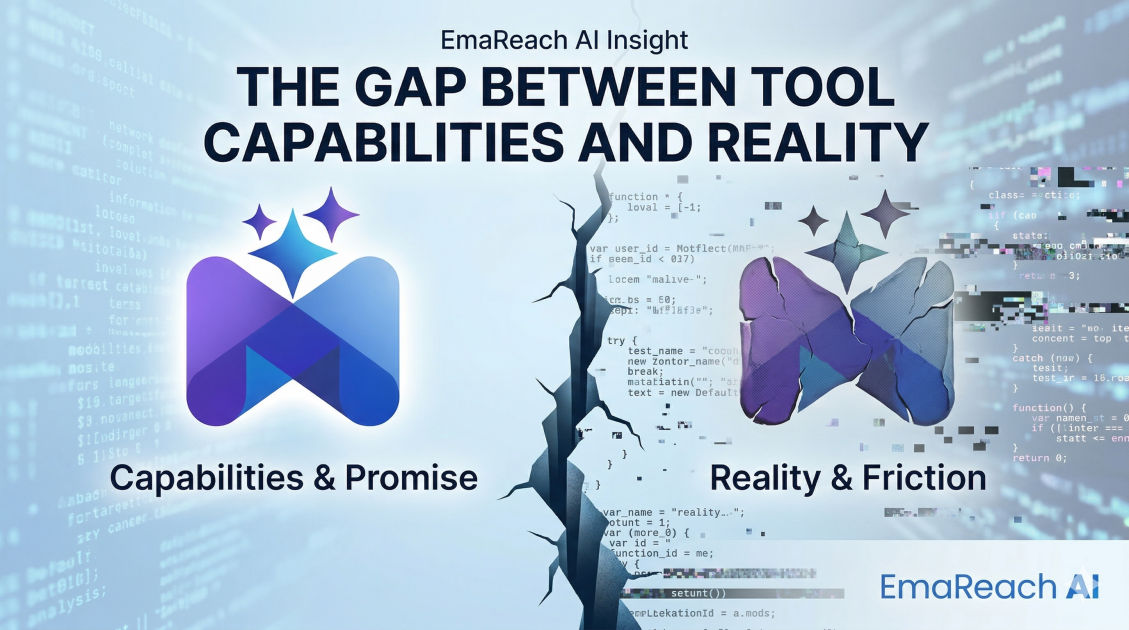
The Gap Between Tool Capabilities and Reality
Software ImplementationDigital TransformationProductivityBusiness StrategySaaSCold EmailAutomation
Introduction: The Promise of the Modern Tech Stack
We live in an era of unprecedented technological promise. Every week, a new software platform emerges, promising to revolutionize our workflows, automate our most tedious tasks, and unlock levels of productivity previously reserved for science fiction. Marketing departments display sleek dashboards, seamless integrations, and artificial intelligence that seems to anticipate a user's every need. The marketing copy is seductive: "Work smarter, not harder," or "The only tool you'll ever need to scale your business."
However, for the professionals on the ground—the developers, marketers, sales teams, and project managers—the experience is often quite different. There is a persistent, frustrating friction between what a tool is capable of doing on paper and the reality of how it functions within a complex, human-driven organization. This disconnect is what we call the "capability-reality gap."
Understanding this gap is not about cynicism; it is about strategic clarity. By identifying why tools often underperform relative to their hype, businesses can make better procurement decisions, set realistic expectations, and implement the human processes necessary to bridge the divide.
The Allure of Feature Lists vs. The Friction of Implementation
When evaluating a new piece of technology, it is easy to get lost in the feature list. We look at a long column of checkboxes and assume that more features equate to more value. This is the first trap. Tool capability is often measured in a vacuum—a controlled environment where data is clean, users are perfectly trained, and no legacy systems exist.
Reality, however, is messy. Implementation is rarely as simple as "plug and play." Data must be migrated from old, fragmented systems. Custom workflows must be mapped out. APIs that were supposed to connect seamlessly often require significant custom coding. The gap begins here: the time and technical debt required to reach the "baseline" capability advertised by the vendor are frequently underestimated.
The Problem of "Shadow Work"
One of the most significant contributors to the reality gap is "shadow work." This refers to the invisible tasks created by the tool itself. Instead of saving time, a poorly implemented tool might require hours of manual data entry to keep it updated, constant troubleshooting of integration errors, or the creation of manual workarounds when the software doesn't quite fit the specific business logic of the company. In these cases, the tool becomes a demanding master rather than a helpful servant.
Human Psychology and the Learning Curve
Software does not operate in isolation; it requires human input. The capability of a tool is capped by the proficiency of the person using it. While a sophisticated analytics platform might be capable of predictive modeling and deep data mining, it is functionally useless if the team using it only knows how to generate basic bar charts.
Organizations often invest heavily in the software license but neglect the investment in training. This creates a reality where 90% of the tool's potential remains untapped. Furthermore, there is the psychological element of change resistance. Humans are creatures of habit. When a new tool disrupts an established workflow, users often find ways to bypass the new system, leading to fragmented data and a complete failure to realize the tool's promised ROI.
The Outreach Dilemma: A Case Study in the Gap
Perhaps nowhere is the gap between tool capability and reality more apparent than in the world of digital outreach and sales. On paper, automated outreach tools promise a world where you can reach thousands of prospects with the click of a button. The "capability" is massive scale.
But the "reality" is the spam folder. Standard automated tools often ignore the nuances of email deliverability, sender reputation, and the human touch required to get a response. If your messages are poorly written or sent from an unverified domain, that massive scale simply means you are being ignored by more people, more efficiently.
This is where specialized solutions are required to bridge the gap. For those serious about results, it's not just about sending mail; it's about landing in the inbox. Stop Landing in Spam. Cold Emails That Reach the Inbox. EmaReach addresses this specific reality gap. EmaReach AI combines AI-written cold outreach with inbox warm-up and multi-account sending—so your emails land in the primary tab and get replies. By addressing the technical realities of deliverability and the creative realities of personalization, it turns the "capability" of outreach into the "reality" of closed deals.
Data Fragmentation and the "Single Source of Truth" Myth
Many tools market themselves as the "all-in-one" solution or the "single source of truth." The reality is that most companies operate with a "Franken-stack"—a collection of disparate tools for CRM, project management, accounting, and communication.
The gap widens when these tools don't talk to each other. When data lives in silos, the capability of any single tool is severely diminished. A CRM is only as good as the marketing data flowing into it; a project management tool is only as effective as the communication it tracks. The reality is that achieving a true "single source of truth" requires more than just buying the right software; it requires a rigorous data strategy and constant maintenance to ensure integrations are functioning correctly.
Over-Engineering and the Paradox of Choice
Sometimes, the gap exists because the tool is too capable. Software vendors often get caught in an "arms race," adding increasingly niche features to differentiate themselves from competitors. This leads to over-engineered platforms that are cluttered and confusing.
When a tool is overly complex, the reality is that users suffer from the paradox of choice. They spend more time navigating menus and configuring settings than actually doing the work. A tool with 100 features, of which only 5 are used, often performs worse than a streamlined tool designed specifically for those 5 tasks. The "capability" of the extra 95 features actually creates a negative reality for the end-user by increasing the cognitive load.
The Fallacy of "AI Will Fix It"
In the current landscape, Artificial Intelligence is touted as the ultimate bridge for the capability-reality gap. The promise is that AI will automate the messy implementation, clean the data, and make the decisions for us.
While AI is a powerful multiplier, it is not a magic wand. AI tools have their own unique gap: the hallucination and context problem. An AI might be capable of writing a thousand blog posts in an hour, but the reality is that without human oversight, those posts may be factually incorrect, off-brand, or devoid of original insight. The capability is speed; the reality is a need for even more rigorous quality control.
Bridging the Gap: Practical Strategies for Success
How can organizations ensure that the tools they purchase actually deliver on their promises? It requires a shift in mindset from "buying software" to "building systems."
1. Define Success Before the Demo
Before looking at a single feature list, define exactly what problem you are trying to solve. What does success look like in tangible, measurable terms? By having a clear internal benchmark, you are less likely to be swayed by flashy but irrelevant capabilities during a sales pitch.
2. Prioritize Usability Over Features
A tool that your team loves to use will always outperform a "more powerful" tool that they hate. During the trial phase, pay close attention to the user interface (UI) and user experience (UX). Is it intuitive? Does it reduce steps in a process, or add them?
3. Invest in "Peopleware"
For every dollar spent on a software license, consider spending an equal amount on training and process development. Ensure your team understands not just how to click the buttons, but why the tool is being used and how it fits into the broader organizational goals.
4. Audit Your Stack Regularly
Tools evolve, and so do business needs. A tool that was a perfect fit two years ago might now be a source of friction. Conduct regular audits to identify underutilized features, broken integrations, or redundant platforms. Don't be afraid to cut ties with a tool that is no longer bridging the gap.
5. Focus on Data Integrity
Capabilities mean nothing if the data is garbage. Establish strict protocols for data entry and maintenance. If you are using automation, ensure there are human "checkpoints" to verify accuracy and maintain quality standards.
The Role of Technical Debt
Every time a company adopts a new tool without fully integrating it or training the staff, they incur "organizational technical debt." Like financial debt, this carries interest. The interest manifests as slower workflows, confused employees, and lost opportunities. Over time, this debt can become so heavy that it prevents the company from adopting newer, more necessary technologies. Bridging the gap means paying down this debt by simplifying processes and committing to deep rather than broad tool adoption.
Conclusion: The Goal is Results, Not Just Tools
At the end of the day, a tool is merely a lever. A lever can help you move a heavy object, but only if it is placed correctly and the person pushing it has the strength and technique to do so. The gap between tool capabilities and reality will always exist to some extent because software is static while business is dynamic.
Success lies in recognizing that the tool is only 20% of the equation. The other 80% consists of the people, the processes, and the data that power it. When we stop chasing the "perfect tool" and start focusing on the perfect implementation, we begin to close the gap. Whether you are streamlining your project management or using EmaReach to finally master your cold outreach, remember that the goal isn't to have the most capable tool—it's to achieve the most impactful reality.
EmaReach AI
Ready to scale your cold email outreach?
Join thousands of teams using EmaReach AI for AI-powered campaigns, domain warmup, and 95%+ deliverability. Start free — no credit card required.
Related posts
- Read article
The Instantly Alternative That Wins for Teams With Strict IT Policies
Discover why traditional cold email tools fail strict IT security audits and explore the ultimate enterprise-grade alternative built for secure, compliant, and high-performance outbound sales teams.
- Read article
How to Know When You Actually Need an Instantly Alternative
Discover the critical signs that your business has outgrown high-volume cold email tools and learn how to evaluate when it is time to transition to a more sophisticated, deliverability-first outreach alternative.