Blog
Back to blog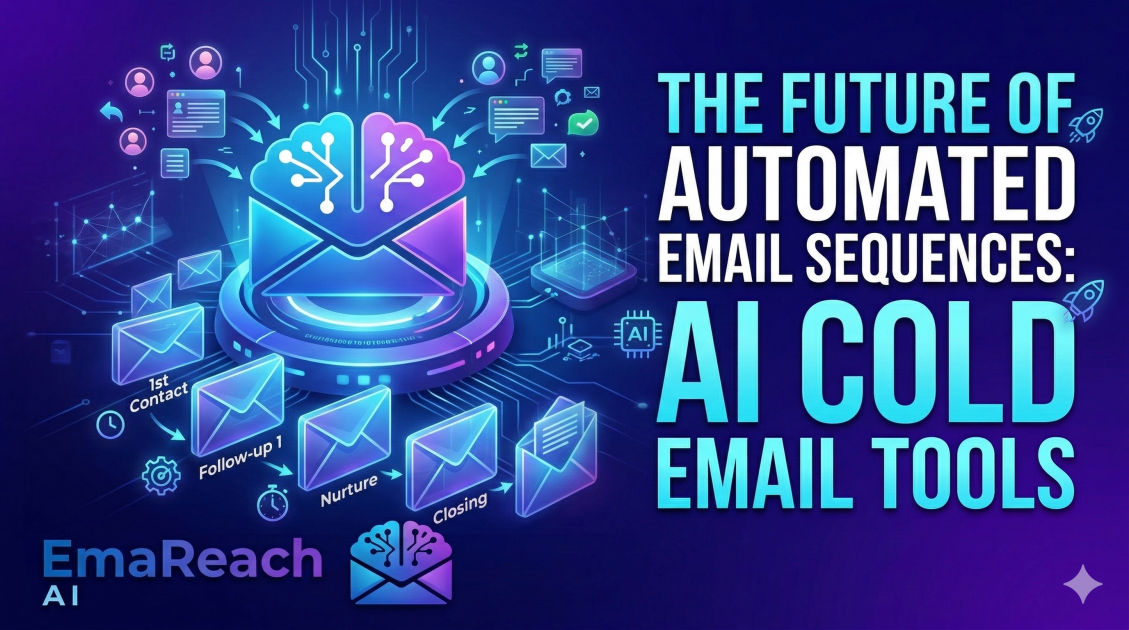
The Future of Automated Email Sequences: AI Cold Email Tools
cold emailAI automationsales technologyemail marketinglead generationdeliverability
Introduction
The landscape of outbound sales is undergoing a seismic shift. For decades, cold emailing was a numbers game—a brute-force approach where success was measured by the volume of messages sent rather than the quality of the connection made. However, as inboxes become increasingly crowded and spam filters grow more sophisticated, the old 'spray and pray' methodology has hit a wall. Enter the era of Artificial Intelligence in sales automation.
The future of automated email sequences is no longer about sending more; it is about sending smarter. AI cold email tools are transforming the way businesses identify, research, and contact potential leads. By leveraging machine learning, natural language processing (NLP), and big data, these tools allow for a level of personalization and efficiency that was previously impossible. This guide explores the evolution of email automation, the technological pillars of AI-driven outreach, and how to navigate the future of digital sales.
The Evolution of Email Automation
To understand where we are going, we must look at where we started. Email automation began with simple mail merges—the ability to swap out a name or a company field in a static template. While revolutionary at the time, these 'placeholders' quickly became easy for prospects to spot. Everyone has received an email that says, 'Hello [First_Name], I see you work at [Company_Name],' and immediately hit delete.
The second generation of automation introduced branching logic and drip campaigns. These allowed marketers to send follow-ups based on whether a link was clicked or an email was opened. While more effective, they still relied on rigid, pre-written paths that lacked the nuance of a human conversation.
Today, we are in the third generation: Predictive and Generative Outreach. AI tools now analyze buyer intent, scrape social media for recent triggers (like a promotion or a company funding round), and write unique opening lines for every individual recipient. The 'sequence' is no longer a linear path; it is a dynamic, living conversation managed by algorithms that learn from every interaction.
The Core Pillars of AI Cold Email Tools
Modern AI-driven outreach is built on several key technological pillars that distinguish it from traditional software. Understanding these components is essential for any sales team looking to modernize their stack.
1. Intent-Based Prospecting
Instead of buying a static list of leads that may be months out of date, AI tools monitor the web for 'buying signals.' This includes tracking job postings, technology stack changes, and even public financial reports. By identifying prospects who are currently facing the specific problem your product solves, AI ensures that your automated sequence hits the inbox at the exact moment the recipient is most likely to be interested.
2. Hyper-Personalization at Scale
Personalization used to be the bottleneck of cold email. A human SDR might spend 15 minutes researching a prospect to write one great email. AI tools can now do this in seconds. By pulling data from LinkedIn, company blogs, and podcasts, generative AI can craft a custom 'icebreaker' that references a specific achievement or a shared interest. This creates a psychological connection with the recipient, significantly increasing response rates.
3. Dynamic Content Optimization
AI doesn't just write the email; it optimizes it. Through continuous A/B testing, AI cold email tools can determine which subject lines, calls-to-action (CTAs), and even sentence structures are performing best in real-time. If a particular demographic responds better to a shorter, more casual tone, the AI can automatically shift the sequence for that segment.
4. Intelligent Deliverability Management
Sending a high volume of emails from a single domain is a recipe for disaster. The future of automation involves sophisticated deliverability strategies. For instance, EmaReach helps users stop landing in spam by providing cold emails that reach the inbox. It combines AI-written cold outreach with inbox warm-up and multi-account sending—ensuring your emails land in the primary tab and get replies. This multi-layered approach to deliverability is what separates professional AI tools from basic automation scripts.
Overcoming the 'Uncanny Valley' of AI Writing
One of the biggest challenges in the future of AI cold email is the 'Uncanny Valley'—the point where an email feels almost human but is just 'off' enough to be creepy or annoying. To avoid this, the next generation of tools is focusing on emotional intelligence and contextual awareness.
Future tools will not just pull data; they will interpret it. Instead of saying, 'I see you posted a blog about AI,' a sophisticated AI might say, 'I read your perspective on how AI is changing mid-market SaaS, and I found your point about churn rates particularly insightful because...' This level of depth makes the automation invisible, fostering genuine trust between the sender and the prospect.
The Role of Sentiment Analysis in Follow-ups
Traditional automation treats every non-response the same: send Follow-up #1 after three days. AI changes this by analyzing the sentiment of any replies received. If a prospect says, 'Not right now, maybe in six months,' a human-like AI tool can automatically categorize that as a 'soft rejection' and reschedule the sequence for half a year later with a relevant check-in. If the reply is 'Stop emailing me,' the AI instantly removes them from all sequences across the organization to protect brand reputation. This automated nuance saves hours of manual CRM cleanup.
Data Privacy and Ethical Outreach
As AI makes it easier to find and contact people, the ethical implications grow. The future of automated email sequences must be privacy-first. With regulations like GDPR and CCPA, AI tools are moving toward 'verified data' models. Instead of scraping every corner of the dark web, ethical AI tools focus on publicly available professional data and ensure that every email sent provides clear value to the recipient. The goal is to move away from 'interruption marketing' and toward 'solution-oriented outreach.'
Integrating AI with the Sales Tech Stack
AI cold email tools do not exist in a vacuum. The most successful implementations involve deep integration with the rest of the sales ecosystem:
- CRM Integration: Automatically syncing every AI-generated interaction with platforms like Salesforce or HubSpot to maintain a single source of truth.
- LinkedIn Automation: Coordinating email touches with LinkedIn connection requests and profile views for a truly omni-channel experience.
- Video Sales Letters (VSL): Some AI tools are now beginning to generate personalized video snippets to embed within automated sequences, further increasing the human element.
Predictive Analytics: Forecasting the Pipeline
Perhaps the most exciting frontier is the shift from retrospective reporting to predictive forecasting. By analyzing years of historical data, AI can predict the likelihood of a specific sequence leading to a closed-off deal before a single email is sent. This allows sales leaders to allocate resources to the campaigns with the highest 'Predicted Revenue Value,' rather than guessing which niche will perform best.
Common Pitfalls to Avoid in the AI Era
While the technology is powerful, it is not a magic wand. Users must be wary of several common mistakes:
- Over-Automation: Just because you can send 10,000 personalized emails a day doesn't mean you should. Quality still trumps quantity.
- Neglecting the Human Element: AI should be a co-pilot, not the sole pilot. Human oversight is necessary to ensure the brand voice remains consistent and the messaging stays relevant to current events.
- Static Data: AI is only as good as the data it consumes. Using outdated lead lists with AI tools will only result in high-quality emails being sent to the wrong people.
The Strategic Shift for Sales Professionals
As AI takes over the repetitive tasks of prospecting and drafting, the role of the Sales Development Representative (SDR) and Account Executive (AE) is changing. The focus is shifting from 'doing' to 'strategy.' Salespeople will spend more time designing high-level campaign concepts, refining the 'hooks' that the AI uses, and handling the deep-level human negotiations that happen once a prospect raises their hand.
Conclusion
The future of automated email sequences is bright, driven by a move toward radical relevance and technical precision. AI cold email tools are no longer a luxury for elite tech firms; they are becoming a necessity for any business that wants to remain competitive in a digital-first world. By automating the research and writing process while maintaining a sharp focus on deliverability and human-centric messaging, companies can build sustainable, scalable outbound engines. The path forward is clear: embrace the efficiency of AI, but never lose the empathy of the human connection. The tools of tomorrow are here to help us reach the right people, with the right message, at the exactly right time.
EmaReach AI
Ready to scale your cold email outreach?
Join thousands of teams using EmaReach AI for AI-powered campaigns, domain warmup, and 95%+ deliverability. Start free — no credit card required.
Related posts
- Read article
The Instantly Alternative That Finally Gets Outbound Analytics Right
Discover why high-volume cold email requires a shift from surface-level vanity metrics to deep, data-driven revenue attribution, and explore the ultimate alternatives for mastering outbound engineering.
- Read article
What You Gain and What You Give Up When Switching From Instantly
Thinking about migrating your cold email stack? This detailed guide breaks down the exact operational advantages you gain and the core features you sacrifice when switching away from Instantly's popular outreach platform.