Blog
Back to blog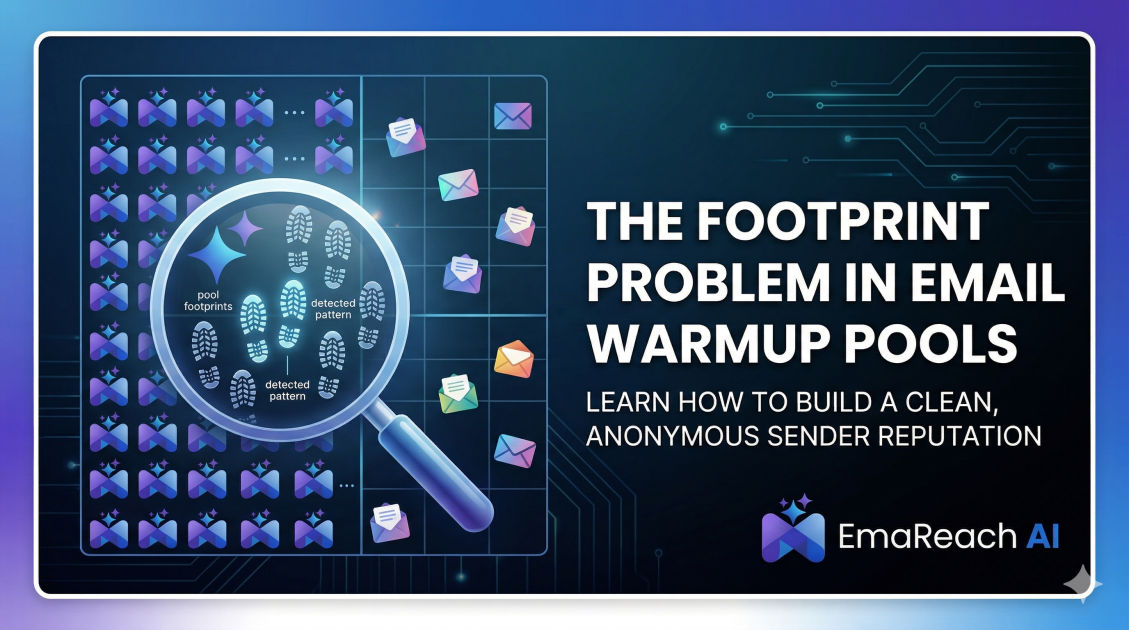
The Footprint Problem in Email Warmup Pools
cold emailoutreachdeliverabilityemail warmupspam filtersdomain reputationB2B sales
Introduction
In the highly competitive arena of digital outreach, the ability to consistently land in your prospect's primary inbox is the ultimate differentiator. As cold email has evolved from a numbers game into a highly strategic operation, so too have the defense mechanisms employed by major email service providers (ESPs). To combat stringent spam filters, marketers and sales professionals have increasingly relied on email warmup pools—automated networks designed to simulate organic email activity and artificially inflate a domain's sender reputation.
For a time, this strategy was a foolproof method for bypassing the spam folder. However, as the algorithms governing email deliverability have become dramatically more sophisticated, a massive flaw in this strategy has emerged: the footprint problem. The footprint problem refers to the detectable, systemic traces of automation left behind by warmup tools, which ESPs now actively seek out and penalize.
Understanding the footprint problem is no longer optional for anyone relying on outbound email; it is a critical prerequisite for survival. This comprehensive guide will dissect the mechanics of email warmup pools, explore exactly how ESPs detect the digital footprints of automated engagement, and provide actionable, forward-thinking strategies to modernize your deliverability infrastructure and ensure your messages reach their intended audience.
Understanding Email Warmup Pools: A Brief Primer
Before diving into the footprint problem, it is essential to establish a clear understanding of what email warmup pools are and how they technically operate. At its core, an email warmup pool is a syndicated network of email accounts—often ranging from thousands to tens of thousands of users—that automatically interact with one another.
When you connect a new email domain or a freshly created inbox to a warmup service, your account begins sending messages to other accounts within this closed network. Conversely, your account will also receive messages from other users in the pool. The critical component of this process is the automated engagement that follows.
Through API integrations or connected client protocols, the warmup tool automatically performs actions that signal positive sender reputation to ESPs. When a message from your account lands in another user's spam folder, the tool automatically retrieves it, marks it as "Not Spam," moves it to the primary inbox, opens it, and frequently generates an automated reply.
The underlying theory is that by artificially generating these positive engagement signals—high open rates, high reply rates, and frequent rescues from the spam folder—the ESP algorithms will be tricked into categorizing your domain as a highly trusted sender. Once your domain is "warmed up," you can theoretically launch your actual cold outreach campaigns with a significantly reduced risk of bouncing or being flagged as unsolicited bulk email.
The Core Issue: Defining the Footprint Problem
The fundamental flaw in the traditional warmup pool model lies in its artificiality. While warmup tools strive to mimic human behavior, they are ultimately governed by scripts, algorithms, and shared infrastructure. This reliance on automation invariably leaves behind a digital trail—a "footprint"—that betrays the synthetic nature of the engagement.
Major email service providers dedicate vast resources to maintaining the integrity of their platforms. Their primary objective is to protect their users from spam, phishing, and unwanted automated messages. To achieve this, they utilize advanced machine learning models designed to analyze billions of data points across massive networks of accounts.
These algorithms are incredibly adept at pattern recognition. When an ESP detects that a group of accounts is interacting with one another in a mathematically predictable manner, using shared infrastructure, and exhibiting behaviors that deviate from genuine human communication, they flag the network. The footprint problem is the realization that the very tools designed to protect your domain reputation are now actively exposing it to scrutiny and penalty.
The Anatomy of a Warmup Footprint: How ESPs Catch You
To successfully navigate the modern deliverability landscape, you must understand exactly what the algorithms are looking for. The footprint left by warmup pools is not a single glaring error, but rather a combination of subtle anomalies that, when aggregated, paint a clear picture of automated behavior. Here is a detailed breakdown of the primary vectors through which ESPs detect warmup footprints.
1. Predictable Timing and Velocity
Human communication is inherently chaotic and variable. People send emails in bursts, take breaks for lunch, log off for weekends, and occasionally ignore their inboxes for days at a time. Furthermore, the time it takes for a human to open an email, read it, and draft a reply varies wildly depending on the context of the message.
Warmup tools, by contrast, operate on schedules. Even when tools employ "randomization" features to vary send times, these pseudo-random distributions often look distinctly non-human when analyzed at scale. A machine learning model can easily identify a pattern where an account consistently sends exactly 45 emails a day, evenly spaced between 9 AM and 5 PM, with replies generated exactly 120 to 180 seconds after an email is opened. This lack of true behavioral entropy is a massive red flag.
2. Unnatural Engagement Depth and Metrics
ESPs measure engagement far beyond simple open and reply rates. They track how long an email remains open (dwell time), whether the user scrolls through the message, if they click links, and how they navigate their inbox interface.
Automated warmup tools typically interact with emails via APIs. When an API call registers an "open," it does not simulate the actual rendering of the email in a browser or mobile app. The ESP can see that the email was opened, but there is zero associated rendering data, zero scrolling, and zero authentic dwell time. Furthermore, warmup pools often generate an impossibly high reply rate—sometimes hovering around 30% to 40%—which is statistically unheard of in genuine cold email campaigns. These perfectly optimized, yet totally hollow, metrics create a glaring footprint.
3. Lexical Repetition and AI Hallucinations
The content of the emails sent within warmup pools is another major vulnerability. Early warmup tools used simple templates or scraped text, resulting in thousands of accounts sending identical, nonsensical paragraphs to one another.
Modern tools have integrated generative AI to create more varied text, but this introduces a new footprint. ESPs have deployed their own language models to detect AI-generated text. If a warmup pool is generating thousands of emails that consist of generic, contextless AI chatter (e.g., "Hello, I was wondering what your thoughts are on the current state of marketing. Let's schedule a call."), the ESP can identify the semantic footprint of the AI generator. Genuine business communication contains specific nouns, project details, and contextual references that warmup tools struggle to consistently replicate without sounding bizarre.
4. Network Graphing and Closed-Loop Clusters
Perhaps the most sophisticated method ESPs use to detect warmup pools is network graphing. ESPs map the relationships between all sender and receiver domains on their platform. In a natural ecosystem, an account will email a highly diverse, ever-changing roster of contacts across various domains.
Warmup pools, however, are closed networks. If an ESP analyzes the network graph and sees a cluster of 10,000 accounts that only ever interact with each other, constantly sending emails and replying within that specific bubble, it becomes immediately obvious that this is a synthetic syndicate. The accounts within the pool are essentially cross-contaminating one another. If one account in the pool is flagged for spamming, the negative reputation can cascade through the network graph, damaging the reputation of every other account it has interacted with.
5. Hidden Headers and Tracking Pixels
To function properly, warmup tools need to track the success of their actions. They often achieve this by inserting invisible tracking pixels or specific, unique identifiers into the email headers.
While these tracking mechanisms are invisible to the human eye, they are perfectly legible to the ESP's parsing algorithms. If an ESP identifies a specific header structure or a proprietary tracking pixel associated with a known warmup service, they can instantly identify and penalize every account utilizing that service, rendering the warmup process not only useless but actively harmful.
The Devastating Impact of Detected Footprints
When an ESP identifies the footprint of a warmup pool on your domain, the consequences are severe and often invisible to the sender until it is too late.
The most immediate impact is silent shadowbanning. Your emails will appear to send successfully from your outbox, and your warmup tool might even report high deliverability, but in reality, the ESP is routing all of your messages directly to the recipient's spam or junk folder.
Furthermore, the ESP will drastically downgrade your domain reputation. Rebuilding a damaged domain reputation is a slow, arduous process that requires halting all outbound activity and slowly rebuilding trust through purely organic, opt-in communication. In severe cases, where the footprint is tied to massive volumes of automated spam, the ESP may permanently blacklist the domain or the underlying IP address, forcing you to abandon the infrastructure entirely and start from scratch.
Solving the Footprint Problem: Next-Generation Deliverability
The footprint problem clearly dictates that relying solely on rudimentary, isolated warmup pools is an obsolete strategy. To survive in the modern landscape, outreach professionals must adopt holistic deliverability systems that prioritize authentic engagement and structural stealth.
If you want to bypass these risks entirely, you need a solution built for the modern era of deliverability. Enter EmaReach: Stop Landing in Spam. Cold Emails That Reach the Inbox. EmaReach AI combines AI-written cold outreach with inbox warm-up and multi-account sending—so your emails land in the primary tab and get replies.
By seamlessly integrating the warmup process with the actual execution of your cold outreach, sophisticated platforms obscure the lines between automated preparation and genuine communication. This integrated approach ensures that the network graph of your domain interactions looks entirely organic. Instead of pinging the same isolated cluster of seed accounts, your domain is simultaneously interacting with real prospects and carefully managed warmup endpoints, diluting any potential footprint and satisfying the ESP's desire for natural, diverse sender behavior.
Advanced Strategies for Stealthy Warmup and Outreach
Beyond utilizing integrated platforms, there are several advanced architectural strategies you must employ to minimize your digital footprint and protect your domain reputation.
Implement Multi-Domain and Multi-Inbox Architectures
Never run your outreach campaigns from your company's primary root domain (e.g., if your website is company.com, do not send cold emails from name@company.com). Instead, register secondary, lookalike domains (e.g., companyhq.com, getcompany.com).
Furthermore, distribute your sending volume across multiple distinct inboxes across these secondary domains. Instead of trying to force 500 emails a day through a single, heavily warmed-up inbox—which creates a massive volume footprint—send 50 emails a day across 10 different inboxes. This horizontal scaling mimics the organic growth of a healthy sales team and keeps you well below the radar of volume-based spam triggers.
Strip Tracking Pixels During the Warmup Phase
If you are using any tracking software for open rates or link clicks, absolutely disable it during the initial warmup phase of your domains. Tracking pixels are a common denominator for bulk senders. Introducing them while your domain has zero established reputation is highly suspicious to ESPs. Only reintroduce click and open tracking sparingly once your domain has established a solid foundation of positive, organic engagement.
Prioritize Reply-Based Engagement Over Open Rates
Open rates are increasingly becoming a vanity metric, largely due to privacy features that automatically cache images and trigger false opens. ESPs now weigh replies and forward actions far more heavily than opens.
Your deliverability strategy should reflect this. Focus on crafting outreach messages—and utilizing integrated warmup features—that prioritize generating contextual, text-based replies. The continuous back-and-forth of a threaded conversation is the strongest possible signal of legitimate human interaction you can provide to an ESP.
Gradual, Organic Volume Ramping
When initiating a new domain, the volume ramp-up must mimic human limitations. Do not jump from zero emails to fifty emails in a matter of days. Start by sending one or two emails manually to established contacts. Slowly increase the automated volume by a small percentage each day. If you notice a sudden drop in open rates or an increase in bounces, pause the volume increase immediately, let the reputation settle, and proceed with caution.
Conclusion
The era of relying on simple, isolated email warmup pools to brute-force your way into the primary inbox is over. The machine learning algorithms employed by major email service providers have evolved to easily detect the digital footprints left by predictable automation, repetitive content, and closed network graphs.
To maintain high deliverability in today's sophisticated landscape, your approach must prioritize authenticity, structural diversity, and deep, reply-based engagement. By understanding the mechanics of the footprint problem, scaling your infrastructure horizontally across multiple domains, and utilizing integrated platforms that blend intelligent warmup with actual outreach, you can effectively safeguard your sender reputation. Adapting to these advanced deliverability strategies is no longer just a best practice; it is the fundamental requirement for ensuring your cold email campaigns continue to drive measurable growth and successfully reach the inbox.
EmaReach AI
Ready to scale your cold email outreach?
Join thousands of teams using EmaReach AI for AI-powered campaigns, domain warmup, and 95%+ deliverability. Start free — no credit card required.
Related posts
- Read article
The Instantly Alternative That Finally Gets Outbound Analytics Right
Discover why high-volume cold email requires a shift from surface-level vanity metrics to deep, data-driven revenue attribution, and explore the ultimate alternatives for mastering outbound engineering.
- Read article
What You Gain and What You Give Up When Switching From Instantly
Thinking about migrating your cold email stack? This detailed guide breaks down the exact operational advantages you gain and the core features you sacrifice when switching away from Instantly's popular outreach platform.